



Northwest University is supporting Cat Lot village with a greenhouse for drying coffee under the National Target Program for Poverty Reduction.
After merging with the communes of Tong Co, Nong Lay, and Chieng Ngam, Chieng La commune now has 727 hectares of coffee plantations, yielding approximately 1,782 tons of fresh coffee cherries. Mr. Nguyen Anh Dung, Vice Chairman of the People's Committee of Chieng La commune, stated: This year, coffee prices fluctuated between 25,000 and 27,000 VND/kg, providing a stable income for farmers. However, due to uneven farming practices, some farmers still rely on experience rather than fully applying technical procedures, resulting in lower yields and lower quality coffee compared to its potential.
Based on that reality, in May 2025, Northwest University launched a pilot project on coffee cultivation for poor, near-poor, and newly-escaped-poverty households in Cat Lot village, with 25 participating households. Before implementation, the project conducted a site survey, assessed soil and climate conditions; organized meetings with residents to gather opinions and publicly select participating households, ensuring that the beneficiaries were the correct target group. Simultaneously, the village established a technical support and advisory team to regularly monitor, guide, and promptly resolve difficulties for households during the implementation process.

The technical advisory team in Cat Lot village guides households on techniques for pruning and trimming coffee plants.
Last year, Northwest University organized four training courses for 25 households on techniques for propagation, planting, care, pruning, fertilization, pest and disease control; harvesting, preservation, processing, and marketing of products. Through the training, 100% of the households mastered the technical procedures, proactively applying them to production, gradually shifting from spontaneous farming to planned and controlled production. Alongside technical training, the project provided each household with a set of pruning tools, seedling bags, 300 kg of fertilizer, and pesticides. The project also invested in a 100 m² coffee drying greenhouse with 16 drying racks and two fresh coffee bean hulling and threshing machines, contributing to improving post-harvest product quality and reducing dependence on weather conditions.
After 7 months of implementation, households have propagated 23,000 coffee seedlings; 100% of households have practiced intercropping and planting shade trees for coffee, contributing to soil improvement and erosion control. During production, all households use organic microbial fertilizers and well-rotted manure; inorganic fertilizers are applied correctly, with 3 applications per year. Households do not use herbicides, but weed manually; pest and disease control is carried out proactively and according to procedures, ensuring environmental safety. Currently, 25 households have sold fresh coffee to traders, doubling their income from coffee compared to 2024.
Mr. Lo Van Oan, Deputy Head of Cat Lot village, Chieng La commune, shared: "The village has 97 households, cultivating about 60 hectares of coffee, of which 20 hectares are newly planted and not yet producing a harvest. The implementation of this model has helped farmers raise awareness, proactively apply techniques, and confidently invest in production development. Currently, the village has established a technical advisory group for coffee cultivation, providing timely guidance and support to households during the production process, gradually improving farming efficiency. At the same time, the village effectively manages and utilizes the supported greenhouses for drying and preserving coffee after harvest, contributing to improved product quality and reduced losses."

The family of Mr. Quàng Văn Mười in Cát Lót village is cultivating coffee seedlings.
Visiting the coffee plantation of Mr. Quang Van Muoi, one can clearly feel the change in this farmer's approach. On his lush green coffee plantation, Mr. Muoi directly practices the technical procedures he has been trained in; the pruning and trimming of diseased branches are done skillfully and according to the correct procedures, ensuring the plantation is well-ventilated and the trees grow well. Mr. Muoi said: "With technical guidance and fertilizer support, I am confident in taking care of my coffee. This year, my family's 5,000 m2 coffee trees are bearing fruit, yielding 400 kg of coffee, which I sold at 27,000 VND/kg. In addition, I also raise cattle and goats, utilizing the composted manure to fertilize the crops, which both reduces production costs and improves efficiency. I strive to lift my family out of poverty by 2026."
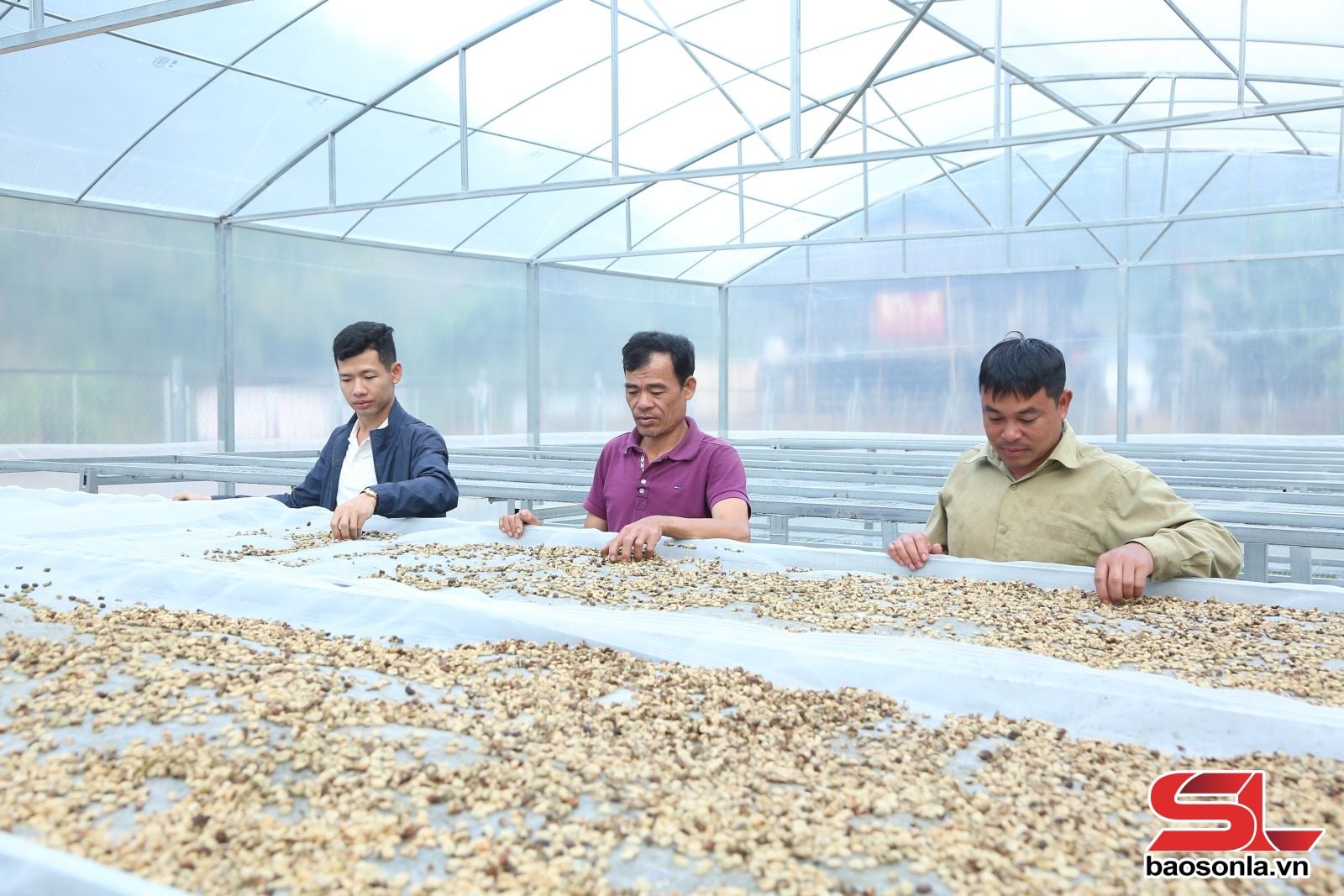
The coffee drying shed was built with support from Northwest University in Cat Lot village.
Although still in its pilot phase, the coffee farming model in Chiềng La is showing promising initial results, helping farmers gradually improve their production capacity and creating a foundation for replicating the model in the future.
Source: https://baosonla.vn/kinh-te/mo-hinh-canh-tac-ca-phe-o-chieng-la-bXMR8d7vR.html


















































































Comment (0)