

More categories of entities eligible for a 2% VAT reduction.
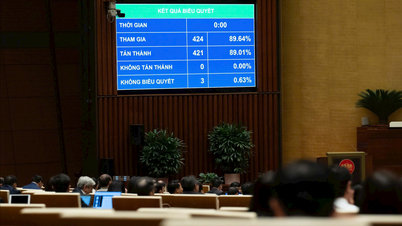
With 452 out of 453 participating delegates voting in favor (99.78%), the National Assembly officially passed the Resolution on reducing value-added tax (VAT) this morning (June 17).
Accordingly, from July 1, 2025 to December 31, 2026, the VAT rate will be reduced by 2%, to 8%, for the groups of goods and services specified in Clause 3, Article 9 of the Value Added Tax Law, except for certain groups of goods and services such as telecommunications, financial activities, banking, securities, insurance, real estate business, metal products, mining products (excluding coal), and goods and services subject to special consumption tax (excluding gasoline).
This resolution expands the scope of those eligible for tax reductions compared to previous resolutions, and extends the application period until the end of 2026.
The categories of goods and services added to the list of those eligible for tax reduction include transportation and logistics businesses, and information technology goods and services.
Furthermore, according to the regulations on VAT, teaching, vocational training, and medical services are exempt from VAT and therefore do not require tax reduction.

Services such as finance, banking, securities, and insurance are exempt from VAT and therefore are not eligible for tax reduction; meanwhile, telecommunications and real estate services are sectors that have experienced growth recently and are also not eligible for VAT reduction as stipulated in Resolution No. 43.
According to the plan proposed by the Government in Submission No. 206 dated April 16, 2025, the reduction in VAT is expected to decrease state budget revenue by approximately VND 121.74 trillion (of which, a reduction of approximately VND 39.54 trillion in the last six months of 2025 and a reduction of approximately VND 82.2 trillion in 2026).
However, reducing VAT has a stimulating effect on production, promoting business activities, thereby contributing to generating more revenue for the state budget (including the potential for increased revenue from other taxes thanks to the spillover effect of the VAT reduction policy).
To compensate for the revenue shortfall resulting from policy implementation, the Government will focus on directing ministries, central agencies, and local authorities to implement a number of solutions.
This includes strengthening management, reforming administrative procedures, and promoting digital transformation in tax management, especially in key areas and sectors, revenue from land, real estate transfers, e-commerce activities, and business activities on digital platforms.
Specifically, the use of electronic invoices generated from cash registers will be expanded to business sectors such as food and beverage services, restaurants, chain hotels, petroleum businesses, and gold trading. The goal is to achieve approximately 10% higher state budget revenue in 2025 compared to the estimated revenue in 2024.
The new concept has been officially introduced into the amended Enterprise Law.
With 455 out of 457 participating delegates voting in favor (95.19%), the National Assembly has just passed the Law amending and supplementing a number of articles of the Enterprise Law.
A notable aspect of this amendment is the addition of provisions regarding the beneficial owners of businesses.
Accordingly, the beneficial owner of a business is an individual who actually owns the charter capital or has controlling power over that business, except for the direct representative of the owner in a business wholly owned by the State and the representative of the state-invested capital in a joint-stock company or limited liability company with two or more members, as stipulated by the law on the management and investment of state capital in enterprises.
Businesses are responsible for collecting, updating, and retaining information about beneficial owners; and for providing this information to competent state authorities when requested.
This list includes key information such as: full name; date of birth; nationality; ethnicity; gender; contact address; ownership percentage or controlling interest; and legal documentation information of the individual identified as the beneficial owner.
The law also adds regulations regarding the issuance of private placement bonds by non-public companies. Accordingly, the value of bonds expected to be issued shall not exceed five times the equity capital of the issuing organization as reported in the audited financial statements of the year immediately preceding the year of issuance.
This regulation aims to improve the financial capacity of issuing companies while limiting bond repayment risks for both issuers and investors.
The drafting committee also amended point b, clause 2 and point b, clause 3 of Article 17 of the Enterprise Law to stipulate that those prohibited from establishing, contributing capital to, and managing enterprises include civil servants and public employees as prescribed by the Law on Civil Servants and the Law on Public Employees, except in cases where it is permitted under the law on national science, technology, innovation, and digital transformation.
The amended Enterprise Law takes effect from July 1st.
Source: https://vietnamnet.vn/mo-rong-doi-tuong-duoc-giam-2-thue-gia-tri-gia-tang-tu-1-7-2025-2412129.html

![[Photo] Prime Minister Pham Minh Chinh presides over a meeting on private sector economic development.](/_next/image?url=https%3A%2F%2Fvphoto.vietnam.vn%2Fthumb%2F1200x675%2Fvietnam%2Fresource%2FIMAGE%2F2025%2F12%2F20%2F1766237501876_thiet-ke-chua-co-ten-40-png.webp&w=3840&q=75)































































































Comment (0)