

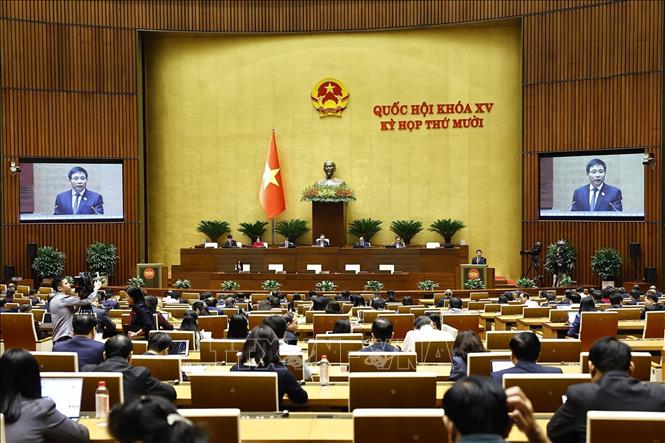
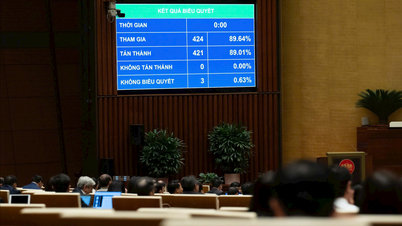
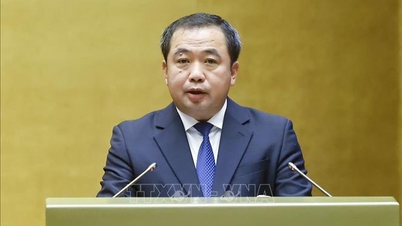
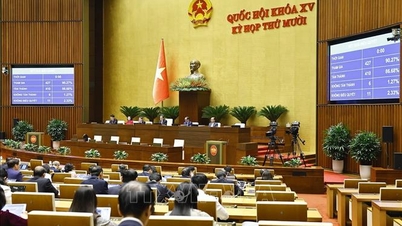
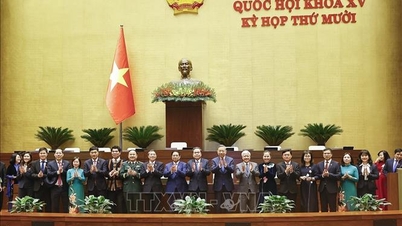
Before proceeding to the vote, the National Assembly heard Minister of Finance Nguyen Van Thang, authorized by the Prime Minister, present the report explaining, accepting, and revising the draft Law amending and supplementing a number of articles of the Value Added Tax Law.
According to the Report on Explanations, Acceptance, and Revisions of the Draft Law amending and supplementing a number of articles of the Value Added Tax Law, regarding the assessment of the impact of the policy contents in the draft law, the Government has issued Report No. 1170, in which the attached appendix includes an assessment of the impact on the legal system, the state budget, citizens, businesses, and tax administration agencies of each policy content in the draft law.
Regarding the amendment of regulations on agricultural products, the report states that the Government has made technical revisions to the drafting and wording of the Value Added Tax Law of 2016, which has been implemented consistently over many years.
Regarding the amendment of regulations on waste, by-products, and scrap materials, this is a technical revision in the drafting process to ensure policy transparency, encourage the recovery and reuse of by-products and waste from agricultural products, and create momentum to promote the development of a circular economy in the agricultural sector, thereby contributing to reducing negative impacts on the environment.
Regarding animal feed, the amendment to regulations aims to ensure consistency among goods with similar uses, such as animal feed and medicinal herbs; it also ensures fairness between domestically produced and imported animal feed. This will create an incentive for businesses to reduce selling prices to support livestock farmers.
Regarding tax refund conditions, the Government has added content on impact assessment, including reports and the percentage of tax refund applications as stipulated in current regulations. Abolishing this regulation contributes to shortening the tax refund time for businesses, ensuring the proper responsibilities and separate rights of both buyers and sellers. Tax refunds will be implemented uniformly according to the provisions of the Tax Administration Law recently passed by the National Assembly, ensuring efficiency and strictness.
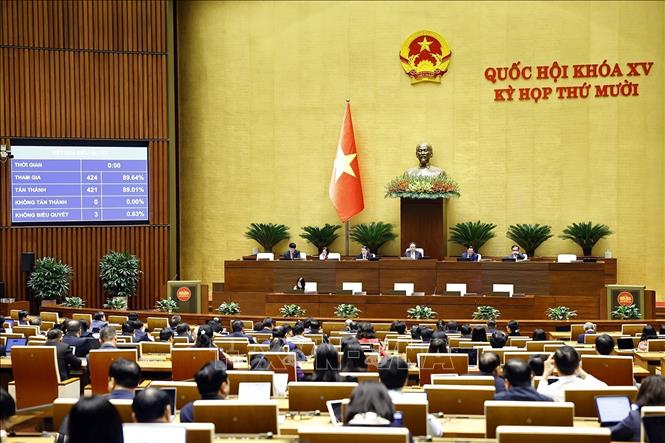
The Law amending and supplementing a number of articles of the Value Added Tax Law consists of 2 articles.
Previously, Minister of Finance Nguyen Van Thang stated that the Government considered this amendment urgent and necessary to promptly address the consequences of natural disasters, storms, and floods, and to quickly restore production and business, especially in the agricultural sector, while also removing the "bottleneck" in value-added tax refunds.
According to Minister Nguyen Van Thang, the 2008 Law on Value Added Tax stipulates that products of crops, forests, livestock, aquaculture, and fishing that have not been processed into other products or have only undergone normal preliminary processing by organizations and individuals that produce, catch, and import themselves are not subject to value added tax. If sold to other businesses or cooperatives at the commercial stage or to consumers, the final consumer is subject to the 5% tax rate.
Minister Nguyen Van Thang stated that the regulation has led to many businesses having to buy and sell invoices through multiple channels, resulting in tax fraud.
To address this issue, in 2016, the National Assembly added a provision to the Law allowing businesses to exempt themselves from declaring and paying output value-added tax (VAT), but to declare and deduct input VAT for clearly identifiable expenses such as electricity, water, and transportation at the commercial stage; and when selling to consumers, they are ultimately still subject to the 5% VAT rate. This regulation still ensures the fundamental nature of VAT, but at the same time overcomes the problem of VAT refund fraud.
However, according to the Minister, when the Value Added Tax Law of 2024 removes the above provision, it will lead to difficulties. Therefore, it is necessary to regulate this in the 2016 Law. Amending the regulations on tax refund conditions and incorporating them into the Tax Administration Law is appropriate.
The Minister also stated that recently, the Ministry of Finance has received many suggestions from corporations and general companies such as the Vietnam Coffee Corporation, Vinafood 1, Vinafood 2, agricultural, forestry and fisheries associations, and even official opinions from the Ministry of Justice, arguing that tax declaration and payment are the responsibility of the seller; tax refunds are the right of the buyer, and the two responsibilities are separate. However, according to the new regulations, buyers who want a tax refund must prove that the seller has invoices and documents and has declared and paid taxes, which is "unreasonable," because buyers cannot verify the seller's tax obligations.
During discussions on this draft law at committee and plenary meetings, most delegates agreed that this regulation needed to be amended to address practical difficulties, overcome differing interpretations among localities, which lead to numerous tax disputes, delays in tax refunds, increased financial costs, and even loopholes for fraud.
Delegate Thach Phuoc Binh (Vinh Long Province Delegation) highly appreciated the draft's policy, which expands the scope of tax-exempt items and clarifies the policy applied to agricultural products, planted forests, livestock, aquaculture, and fisheries products in the sales and import stages. According to the delegate, adding the case of businesses and cooperatives selling unprocessed products to other businesses and cooperatives is necessary and accurately reflects the reality of transactions in the agricultural product chain.
Representative Tran Huu Hau (Tay Ninh Province Delegation) stated that amending Clause 1, Article 5 is "very timely and extremely important." He explained that every year, export businesses have to temporarily deposit a large amount of capital to pay value-added tax, then wait for a refund. This mechanism causes many businesses to lose business opportunities. In a context where every percentage point of profit is crucial for survival in the international market, abolishing the "pay and then refund" mechanism will significantly strengthen businesses. Furthermore, if the old regulation remains in place, thousands of businesses and tax officials would have to handle a large number of tax refund procedures, creating pressure and potential negative risks from the "request-and-grant" mechanism. Therefore, the representative highly appreciated the government's move and requested the National Assembly to approve it soon to create a strong impetus for the agricultural sector.
Source: https://baotintuc.vn/chinh-polit/thong-qua-quy-dinh-hoan-thue-gtgt-go-diem-nghen-cho-doanh-nghiep-nong-san-20251211115626990.htm

![[Photo] Prime Minister Pham Minh Chinh holds a phone call with the CEO of Russia's Rosatom Corporation.](/_next/image?url=https%3A%2F%2Fvphoto.vietnam.vn%2Fthumb%2F1200x675%2Fvietnam%2Fresource%2FIMAGE%2F2025%2F12%2F11%2F1765464552365_dsc-5295-jpg.webp&w=3840&q=75)

![[Photo] Closing Ceremony of the 10th Session of the 15th National Assembly](/_next/image?url=https%3A%2F%2Fvphoto.vietnam.vn%2Fthumb%2F1200x675%2Fvietnam%2Fresource%2FIMAGE%2F2025%2F12%2F11%2F1765448959967_image-1437-jpg.webp&w=3840&q=75)


































![[OFFICIAL] MISA GROUP ANNOUNCES ITS PIONEERING BRAND POSITIONING IN BUILDING AGENTIC AI FOR BUSINESSES, HOUSEHOLDS, AND THE GOVERNMENT](https://vphoto.vietnam.vn/thumb/402x226/vietnam/resource/IMAGE/2025/12/11/1765444754256_agentic-ai_postfb-scaled.png)












































Comment (0)