

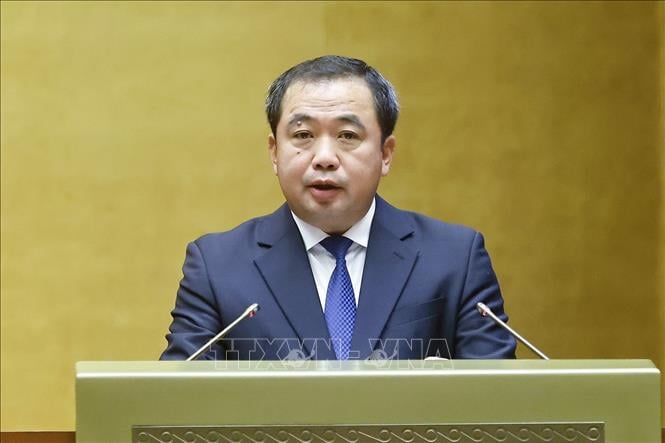
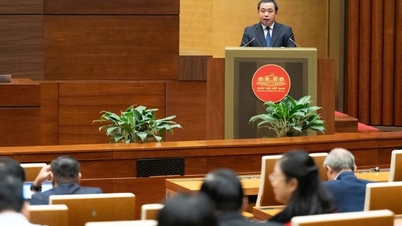
Earlier, Minister of Agriculture and Environment Tran Duc Thang presented a report on the acceptance, explanation, and draft resolution stipulating some mechanisms and policies to remove difficulties and obstacles in the implementation in 2024.
Regarding land use for projects through agreements where more than 75% of the land area and more than 75% of the land users have been agreed upon, the Provincial People's Council shall consider and approve the recovery of the remaining land area to allocate or lease it to the investor. The Government has incorporated and supplemented Clause 7, Article 3 on compensation and resettlement support for land recovery cases as stipulated in point b, Clause 2, Article 3, in the following direction: Compensation and resettlement support for the remaining land area shall be applied as in the case of state land recovery. If the total amount of compensation and support received according to the compensation and resettlement support plan per unit of land area is lower than the average of the agreed land price, the landowner whose land is recovered shall receive the remaining amount compared to that average.
Regarding the timing of land valuation for land used as payment under build-transfer (BT) contracts, the Government has incorporated feedback and refined the process as follows: The timing of land valuation for land used as payment under BT contracts is the time when the State decides to allocate or lease the land. If the State delays allocating or leasing the land for BT contract payment, the investor will receive an additional amount equivalent to the average interest rate of state-owned commercial banks on the value of the project or its components.
The period for receiving the land price is calculated from the time of acceptance of the completed project item or BT project to the time of the decision on land allocation or land lease. Minister of Agriculture and Environment Tran Duc Thang emphasized that the regulation on the time of determining land prices as above is consistent with the time of determining land prices in land law over the years; it also partially compensates for losses to investors due to the State's delay in land allocation or land lease and applies to BT contracts implemented from the date the Resolution takes effect (January 1, 2026).
The handling of difficulties and obstacles in BT contracts signed before the Resolution takes effect will be addressed in the Resolution on resolving difficulties and obstacles in outstanding projects, in order to ensure consistency and uniformity in the approach to handling them, similar to other projects.
According to Minister of Agriculture and Environment Tran Duc Thang, after receiving feedback from National Assembly deputies, the Government has reviewed and revised several contents in the draft Resolution, such as: adding a provision assigning the Government to regulate the details of land acquisition before approving compensation and resettlement plans, and land acquisition before completing resettlement arrangements; adding a provision that in cases where land is leased through auction, the land user pays the land rent in a lump sum for the entire lease period; and reviewing and revising the technical aspects of language, format, and presentation to ensure consistency in the draft Resolution.
Complete the planning system in accordance with land law.
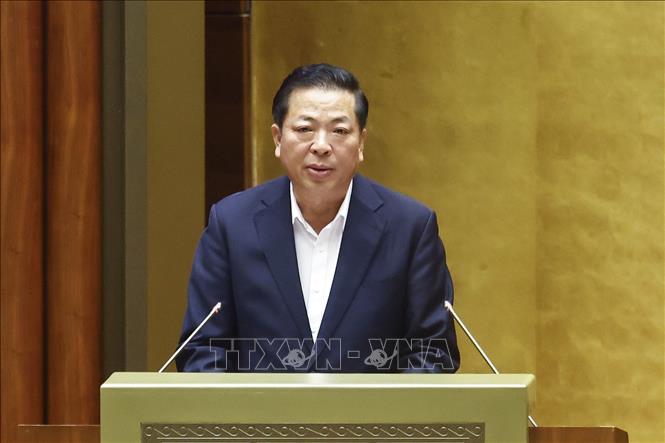
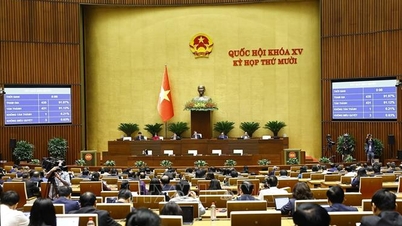
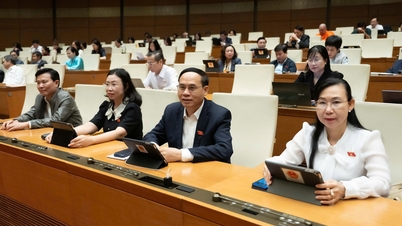
On the morning of December 11th, the National Assembly voted to pass the Law amending and supplementing a number of articles of the Law on Urban and Rural Planning with 429 out of 437 National Assembly deputies present voting in favor, accounting for 90.70% of the total number of deputies.
Earlier, the National Assembly heard Minister of Construction Tran Hong Minh present a report explaining, incorporating, and revising major contents of the draft law. The Government has fully incorporated the opinions of the National Assembly's agencies and delegates, while clarifying the direction for perfecting the urban and rural planning system in a way that is consistent with land law, planning, and the policy of sustainable urban development.
One of the notable points in the report explaining, receiving, and revising amendments and additions to some articles of the Law on Urban and Rural Planning is that the Government has accepted the suggestion not to include provisions within the scope of land law in the Law on Urban and Rural Planning.
According to the report, the content regarding land use indicators was previously proposed to be included in the general planning implementation plan of the commune to serve as a basis for land acquisition, land allocation, land leasing, and permission for land use conversion. However, the Government affirmed that this issue falls within the scope of the Land Law, and therefore accepted the opinion of the National Assembly Standing Committee, not including it in this draft law.
Regulations related to land use indicators – the basis for land acquisition, land allocation, land leasing, and permission for land use conversion – will be finalized within the land law system, as well as in the draft resolution of the National Assembly on some mechanisms and policies to address difficulties and obstacles in the implementation of the Land Law. This approach aims to ensure clarity in the scope of regulation and avoid overlap between laws.
According to Minister Tran Hong Minh, the completion of the draft Law amending and supplementing a number of articles of the Law on Urban and Rural Planning closely follows the Politburo's new Conclusion on continuing to implement Resolution No. 06-NQ/TW of 2022 on planning, construction, management and sustainable development of Vietnamese cities until 2030, with a vision to 2045. In that spirit, the Government will continue to coordinate with ministries, sectors, and localities in summarizing, evaluating, and developing specific mechanisms and policies for Hanoi, Ho Chi Minh City, and other centrally-administered cities; and simultaneously study the possibility of applying these mechanisms more broadly when conditions are met.
Mineral extraction must comply with technical, safety, and environmental protection requirements.
Also during the morning session, the National Assembly passed the draft Law amending and supplementing a number of articles of the Law on Geology and Minerals with 421 out of 432 National Assembly deputies present participating in the vote (accounting for 89.01% of the total number of National Assembly deputies).
Earlier, the National Assembly heard Minister of Agriculture and Environment Tran Duc Thang, authorized by the Prime Minister, present a summary report on the acceptance and explanation of opinions from National Assembly deputies.
Regarding the licensing mechanism for mineral exploitation serving public works and key projects, the draft Law adds a provision that mineral exploitation investment projects or mineral exploitation plans must include provisions on technical safety in mineral exploitation, environmental protection, and the determination of the deposit amount for environmental remediation and restoration as prescribed by the Minister of Agriculture and Environment. This regulation is a measure to reduce administrative procedures to accelerate the construction progress of five types of specific projects while still ensuring technical, safety, and environmental protection requirements.
The draft law aims to remove obstacles and reduce administrative procedures in the conversion of land use purposes for the exploitation of Group III minerals for construction materials and Group IV minerals for public investment projects, PPP projects, key national projects, urgent projects, disaster prevention and control projects, and some projects decided by the Chairman of the Provincial People's Committee. This regulation aims to minimize the time required to bring mineral mines for common construction materials into operation, ensuring timely supply for the aforementioned projects and works. At the same time, to ensure the consistency and uniformity of the legal system, it is necessary to amend and supplement several articles of the Land Law as proposed in the draft law.
The draft law adds a provision allowing organizations and individuals to take mineral samples for research and testing of mineral processing technologies, as stipulated by the Government. According to this provision, a Government Decree will specify the details related to taking mineral samples for research and testing of mineral processing technologies.
Source: https://baotintuc.vn/thoi-su/thong-qua-nghi-quyet-cua-quoc-hoi-ve-thao-go-kho-khan-vuong-mac-trong-thi-hanh-luat-dat-dai-20251211121649064.htm

![[Photo] Prime Minister Pham Minh Chinh holds a phone call with the CEO of Russia's Rosatom Corporation.](/_next/image?url=https%3A%2F%2Fvphoto.vietnam.vn%2Fthumb%2F1200x675%2Fvietnam%2Fresource%2FIMAGE%2F2025%2F12%2F11%2F1765464552365_dsc-5295-jpg.webp&w=3840&q=75)


![[Photo] Closing Ceremony of the 10th Session of the 15th National Assembly](/_next/image?url=https%3A%2F%2Fvphoto.vietnam.vn%2Fthumb%2F1200x675%2Fvietnam%2Fresource%2FIMAGE%2F2025%2F12%2F11%2F1765448959967_image-1437-jpg.webp&w=3840&q=75)


































![[OFFICIAL] MISA GROUP ANNOUNCES ITS PIONEERING BRAND POSITIONING IN BUILDING AGENTIC AI FOR BUSINESSES, HOUSEHOLDS, AND THE GOVERNMENT](https://vphoto.vietnam.vn/thumb/402x226/vietnam/resource/IMAGE/2025/12/11/1765444754256_agentic-ai_postfb-scaled.png)












































Comment (0)