

The question is, how can we expand in a way that addresses both the quantitative and qualitative aspects of the workforce?
The draft Circular on the professional training program for aspiring general education teachers, recently published by the Ministry of Education and Training, reveals a noteworthy approach: greater flexibility in entry requirements, but at the same time setting higher demands on actual professional competence.
According to current regulations (Circular No. 11/2021/TT-BGDĐT and Circular No. 12/2021/TT-BGDĐT), those eligible to participate in pedagogical training must be university graduates. This means that many non-pedagogical students who aspire to become teachers must wait until after graduation to obtain the pedagogical certificate, extending their eligibility by at least a year before they are eligible for recruitment. This timeframe creates a barrier of time and finances, affecting the decision of many young people to pursue a career in teaching.
The draft of the new Circular has removed this bottleneck by allowing students who have completed at least 70% of the credits in their relevant major to participate in pedagogical training. In fact, pedagogical students have already been studying courses related to pedagogy since their third year, so this regulation is considered appropriate.
This change has clear practical implications, representing a significant step towards a flexible teacher supply system that adapts to the actual needs of each locality. Instead of a "gap" between specialized training and teacher training, students can prepare for their careers as early as their third or fourth year of university.
This not only helps shorten the time to enter the profession and prepare a pool of teachers for educational institutions earlier, but also contributes to overcoming difficulties in attracting human resources for the industry, especially for specialized subjects such as Music, Fine Arts, and Information Technology, which are currently facing a shortage of recruits.
Expanding the recruitment pool does not mean a reduction in quality standards. The draft Circular clearly shows a shift in curriculum development thinking from a content-based approach to a competency-based approach, aiming to develop comprehensive professional competencies to help teachers meet the demands of the new context.
For the first time, topics such as the application of digital technology , online teaching, the use of digital platforms, and artificial intelligence (AI) have been included in teacher training programs.
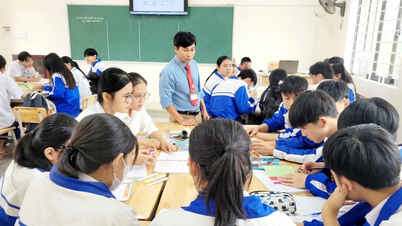
The minimum training time is clearly stipulated as 10 months, and many modules require in-person attendance. The number of credits has decreased, but the proportion of practical training has increased, with a greater focus on practical professional skills such as lesson design, classroom management, handling pedagogical situations, and organizing educational activities.
Efficiency and quality are emphasized, aiming to train a team of teachers with strong professional competence, adaptable to educational reforms, and capable of leading students in a rapidly changing learning environment.
A new generation of young teachers, diverse in professional backgrounds and possessing strong professional skills, will be given the opportunity to be nurtured early. This will undoubtedly be a breath of fresh air, contributing to the effective and in-depth implementation of the 2018 General Education Program.
Source: https://giaoducthoidai.vn/mo-rong-nguon-tuyen-giao-vien-post778722.html















































































Comment (0)