

The Hmong people are involved in tourism.
After days of hard work tending the rice plants, they have finally bloomed on the hillsides. The color of the rice, gradually changing from green to yellow, stirs the hearts of countless young men and women. From Cao Pha to Ho Bon, everywhere the yellow of the rice has become a symbol of vitality and a sign of prosperity.
Unlike the plains or midlands, the rice paddies of the Hmong people in Mu Cang Chai, besides providing daily meals, have long been a direct source of income from tourism. Hmong farmers, who toil year-round "selling their faces to the earth and their backs to the sky," have suddenly become "Westernized," transforming into tour guides, drivers for tourists, homeowners in the community, and directors of tourism cooperatives. Their income has increased many times over as a result.
In a place where people not only live off rice but also prosper from its beauty and fragrance, autumn marks a harvest time, both literally and figuratively, for the locals. When the rice paddies turn a gentle golden hue and the sun gently bathes the mountain slopes, tourists, photographers, and streamers flock to this remote land to enjoy the golden autumn colors on these terraced rice paddies.
Vang A Thao, a tour guide in Mo De commune (Mu Cang Chai - Yen Bai), shared that in the past, the people of Mu Cang Chai only waited for the golden rice harvest season to have something to eat and warm their stomachs; they didn't know how to do anything else. Since the arrival of tourism, people have more jobs: some work as tour guides, others as drivers, house cleaners, and cooks. Everyone hopes that the rice grains will be firm and retain their golden color for a long time to attract more tourists and increase their income.
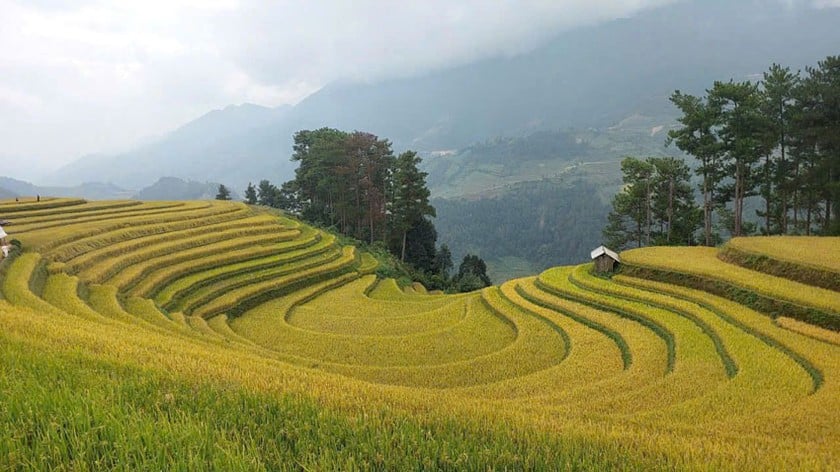 |
The scenery at Võng Lúa in Mồ Dề commune is breathtaking. |
Beside the famous Raspberry Hill rice fields, Tran Luan, a photographer from Lao Cai , confided that he had been eating and sleeping in La Pan Tan for the past few days, waiting to capture the shimmering moments of the rice harvest season. Last Monday was sunny, but the weather was inconsistent during the middle of the week, so he had to hold his breath and wait until around 3-4 pm to finally take the picture and complete his collection of golden rice photos for 2024.
As the head of a collective economic unit, Mr. Ly A Do, Director of the Doi Mam Xoi Tourism Cooperative, believes that the beauty of Mu Cang Chai lies in its endless terraced rice fields, turning a golden yellow like forest honey every autumn. Based on practical experience and a focus on developing green, harmonious, and culturally unique tourism, he has contributed to attracting both domestic and international tourists to explore the area. Thanks to his systematic approach and concentrated tourism development, Mong farmers have gained significant additional income from tourism services such as selling goods, providing accommodation, cooking, and offering motorbike taxi services to tourists.
The golden season after the storm
Mr. Pham Tien Lam, Secretary of the Party Committee of La Pan Tan commune, began his story with a somber, regretful tone, lamenting the end of a golden harvest season. Mr. Lam said that this year's golden harvest in Mu Cang Chai was memorable; while the farmers had a good rice yield, tourism revenue was negligible. In September, continuous rain and floods, especially the impact of Typhoon No. 3 (Yagi), caused many tourist groups to postpone or cancel their trips to Mu Cang Chai, despite having planned and booked accommodations in advance. Tourist numbers were sparse, and the Raspberry Hill was also less crowded this year.
Sharing the same sentiment, Mr. Tran Van Lich, Secretary of the Party Committee of Mu Cang Chai town, said that for many years the town has focused all resources on building the Khim Noi Community Cultural Tourism Village to promote tourism development in a systematic way and bring stable revenue. This year, the remnants of typhoon No. 3 had a very severe and prolonged impact, causing anxiety and fear, making many people miss the golden season. Tourism in Mu Cang Chai was therefore seriously affected. Especially in September, the Khim Noi Community Cultural Village in the town was experiencing a significant drop in visitors.
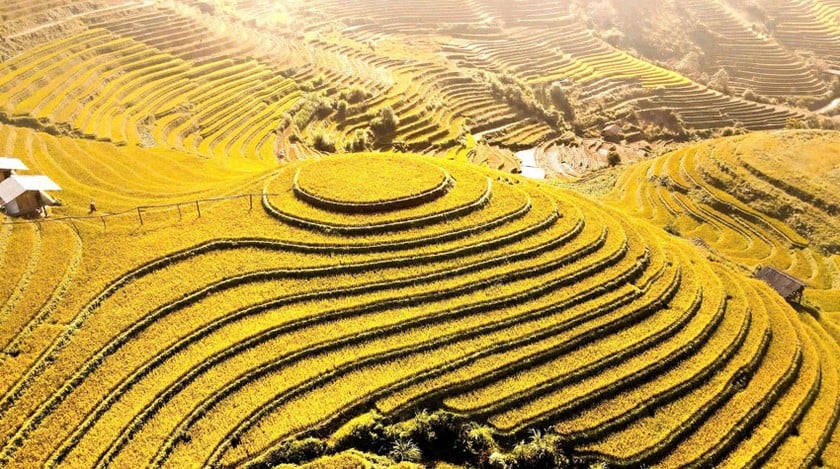 |
La Pán Tẩn Raspberry Hill is a beautiful place with golden rice fields in bloom. |
Ms. Tran Thu Uyen, manager of Suoi Kim 2 Homestay (Pung Luong commune), said that during the peak season of 2023, her family earned over 600 million VND from renting rooms to tourists. This year, however, almost all bookings made in September were canceled due to concerns about storms and heavy rain. Following the district's directive, her family has fully refunded the booking fees to guests, amounting to 200 million VND, demonstrating the significant damage to the tourism industry caused by the storms and heavy rain.
The impact of Typhoon No. 3 caused significant damage to property, crops, and the transportation system in Mu Cang Chai district, leading to the postponement of many tourism activities such as: the Son Tra Festival 2024; the Mu Cang Chai Tourism Workshop on "Creative, Safe, and Friendly" destinations; the bamboo weaving competition; the Son Tra culinary competition; the fast rice harvesting and embankment building competition; the goat fighting competition; and several other supporting activities.
According to the Department of Culture and Information of Mu Cang Chai district, from September 8th to 30th, there were 35,000 cancellations of hotel rooms, totaling 1,500 cancelled bookings, with estimated cancellation fees of approximately 7.5 billion VND. Costs for other services, including food and beverage expenses, shopping, motorbike taxi services, paragliding, and other expenses, resulted in an estimated revenue loss of 33.25 billion VND. The total estimated loss is approximately 40.75 billion VND.
Following the impact of the storm and floods, the People's Committee of Mu Cang Chai district directed tourism service businesses to implement measures to restore and develop tourism after the aftermath of Typhoon No. 3. At the same time, Mu Cang Chai implemented policies to support tourists, sharing the difficulties faced by those who had to cancel or reschedule their trips, and refunding 100% of their deposits, contributing to building the image of Mu Cang Chai as a destination that is "Unique - Safe - Friendly".
Mai Anh, a female tourist from Vinh Phuc, said that she initially booked a room at the end of September, but later canceled due to concerns about the weather affecting her trip and received a refund from the homestay owner. At the beginning of October, Mai Anh booked again and arrived in Mu Cang Chai, only to be pleasantly surprised by the weather and the beautiful golden rice fields – beyond her imagination. She shared that missing out on seeing the golden rice fields in Mu Cang Chai this year would be a great pity.
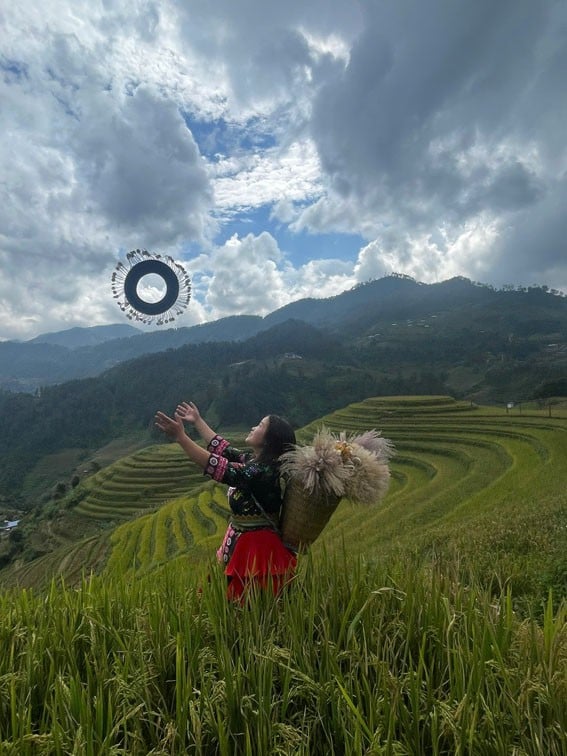 |
Tourists can dress up as Hmong girls amidst the rice paddies of Mu Cang Chai. |
According to Mr. Trinh The Binh, Head of the Culture and Information Department of Mu Cang Chai district, the aftermath of Typhoon No. 3 (Yagi) caused significant losses to the district's tourism industry in September 2024. However, entering October 2024, the weather stabilized and became more favorable, leading to a substantial increase in the number of tourists visiting Mu Cang Chai to witness the golden season. Thanks to this miraculous recovery, the businesses have been somewhat relieved of their gloom, local people have found more jobs and income, and tourism activities have gradually returned to normal.
Statistics show that in October, Mu Cang Chai district welcomed and served approximately 67,200 visitors, generating revenue of 67 billion VND. Cumulatively, in the first 10 months of 2024, the district attracted 331,472 tourists, reaching 94.7% of the plan, with tourism revenue reaching 327.3 billion VND, achieving 93.5% of the plan, including 23,718 foreign visitors.
Source: https://baophapluat.vn/mu-cang-chai-khong-lo-hen-mua-lua-vang-post531961.html
































![[Video] Sunset at Lap An Lagoon – Where the sun sets over the fishing nets](https://vphoto.vietnam.vn/thumb/1200x675/vietnam/resource/IMAGE/2026/05/31/1780192137701_beach-landscape-sea-water-nature-grass-745871-pxhere-com.jpeg)






















Comment (0)