
The art of Chan dance on stage
Robam Yeak Roam, also known as the Masked Dance, is a folk theatrical art form originating from the Reamker epic – borrowed from the Indian epic Ramayana. The story tells of Prince Phrah Ream, handsome and intelligent, who was exiled to the deep forest by his stepmother, who persuaded his father, the king, to give the throne to his own son. Ream and his wife, Seyda, had to leave the capital. His younger brother, Phrah Lek, also volunteered to follow them.
On the journey, the demon king Krong Reap, captivated by Seyda's beauty, transformed into a deer to deceive Ream and abduct her. Ream, heartbroken, resolved to rescue his wife. With the help of the monkey god Hanuman and his army of monkeys, he crossed the sea, defeated the demon army, killed Reap, and brought Seyda back. After his exile ended, Ream was given back the throne. However, influenced by slander, Ream suspected Seyda of infidelity during her time with the demons and forced her to step into the fire to prove her innocence.
The divine fire vindicated Seyda, but Ream coldly banished her while she was pregnant. Seyda gave birth in solitude, then transformed into the earth to prove her loyalty and integrity.
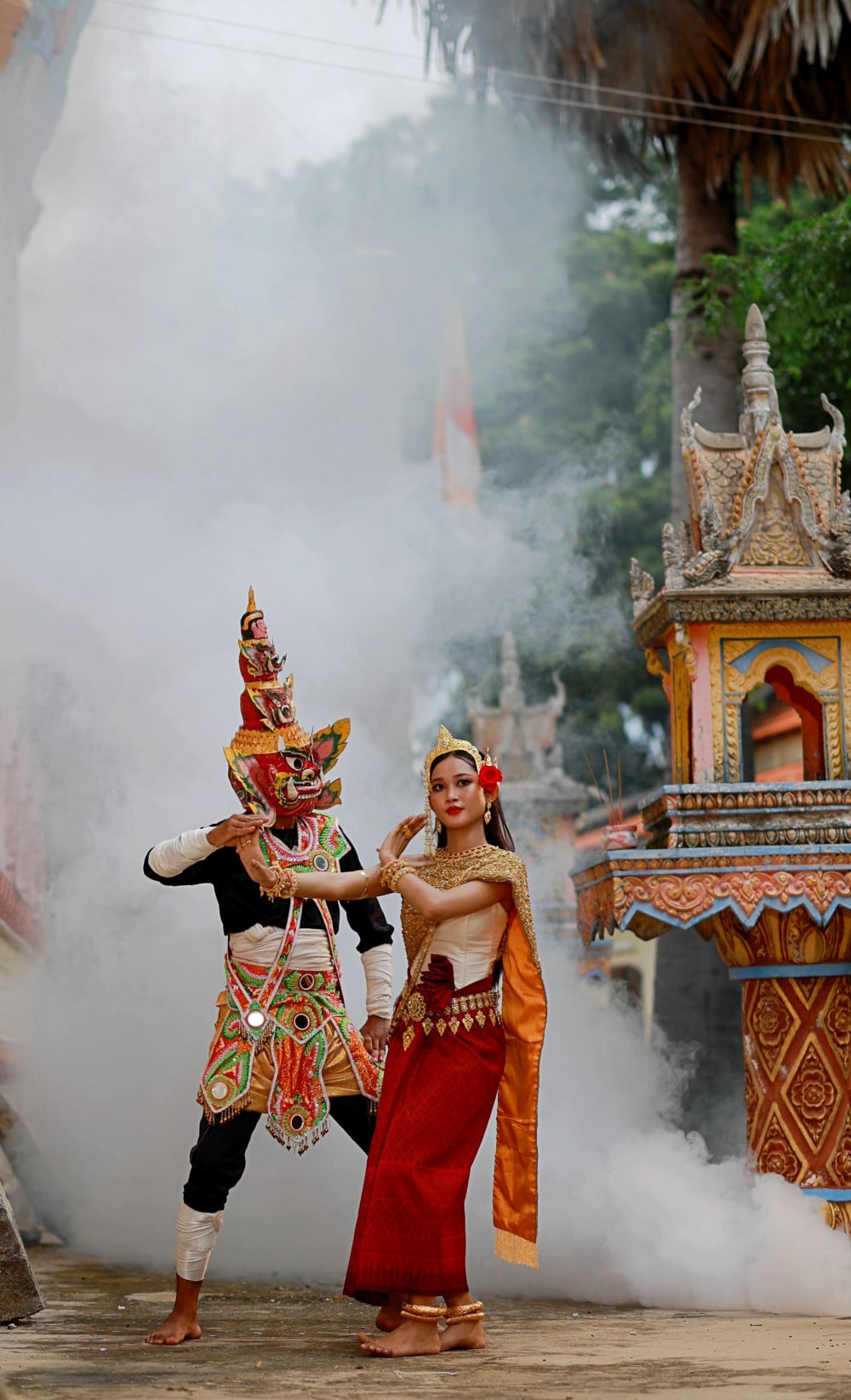
The Ogre and the Princess
The struggle between good and evil, the conflict between justice and injustice, has always been a central theme in ancient folklore. The Chằn Dance is based on the motif of a battle between Chằn – representing evil and injustice – and Khỉ – representing good, justice, and courage.
Previously, during Khmer festivals in Tay Ninh , people mainly enjoyed the rhythmic forest dances and the lively Chhay-dam drumming. However, in recent years, at the temples, one can also encounter powerful and epic Chằn dance troupes.
In Hoa Dong A hamlet, Hoa Hiep commune (now Phuoc Vinh commune), for nearly 10 years, a Chằn dance troupe has been established out of a desire to preserve the culture of the Khmer people. The management board of Chung Rut Pagoda, along with village elders and respected individuals, have campaigned and highlighted the significance of the Chằn dance to all residents. With enthusiasm and pride, the children have formed a troupe. Adults pool their money to buy costumes and hire instructors. Each vibrant costume and mysterious mask represents the dedication of the local people, working together to preserve traditional values.
Thanh Thuan, one of the boys playing the role of the Ogre in the team, said: "This role is quite tiring because we have to wear a heavy mask on our heads, and it's suffocating, but every time we perform for people, I feel very happy because I can preserve the traditional culture of my people."
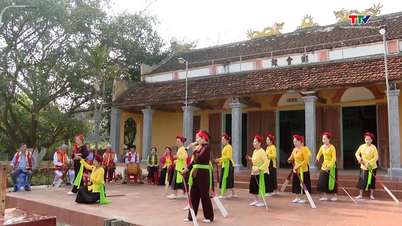
Chằn dance focuses on body language with a distinctive style where each movement alternates between fast and slow. Through each costume, gesture, and hand and foot movement, the character and temperament of the person are clearly depicted. The revival of Chằn dance in the life of the Khmer community in Tay Ninh demonstrates an awareness of preserving ethnic identity and contributes to the preservation of intangible cultural heritage.
For about three years now, in Ninh Dien commune, the abbot of Svay Pagoda (Sat Rat Pagoda) and the Khmer people have been reviving the traditional Chằn dance of their ethnic group. The dance troupe has about 10 members. Phan Đếtl, a 22-year-old man, looking strong in his Chằn costume, said that he joined the Chằn dance troupe right from its inception.
“With guidance from a teacher from Tra Vinh, we learned the basic dance steps, then practiced together. We saved up and bought our costumes from Tra Vinh and Soc Trang. Each mask costs several million dong, but we still enjoy it and feel happy performing our ethnic dance,” Phan Detl shared.

Binh Na Quinh, So Guot, and Phan Detl have been performing the Chan dance for three years.
In the group, So Guot, 14 years old this year, is also extremely interested in the traditional Chằn dance. So Guot plays the role of the Monkey. With his small stature and slender figure, So Guot excellently portrays the role of an intelligent, cunning, and agile monkey. So Guot said that besides performing the Chằn dance during major festivals and holidays for the villagers, they have also been invited to participate in cultural events at the commune and district levels, and have occasionally assisted photographers from within and outside the province.
“We’re used to performing for our neighbors, but performing on stage for everyone to see, we’re all nervous but very happy and proud. We will try our best to preserve and spread our people’s culture even further,” Sô Guốt shared somewhat shyly.
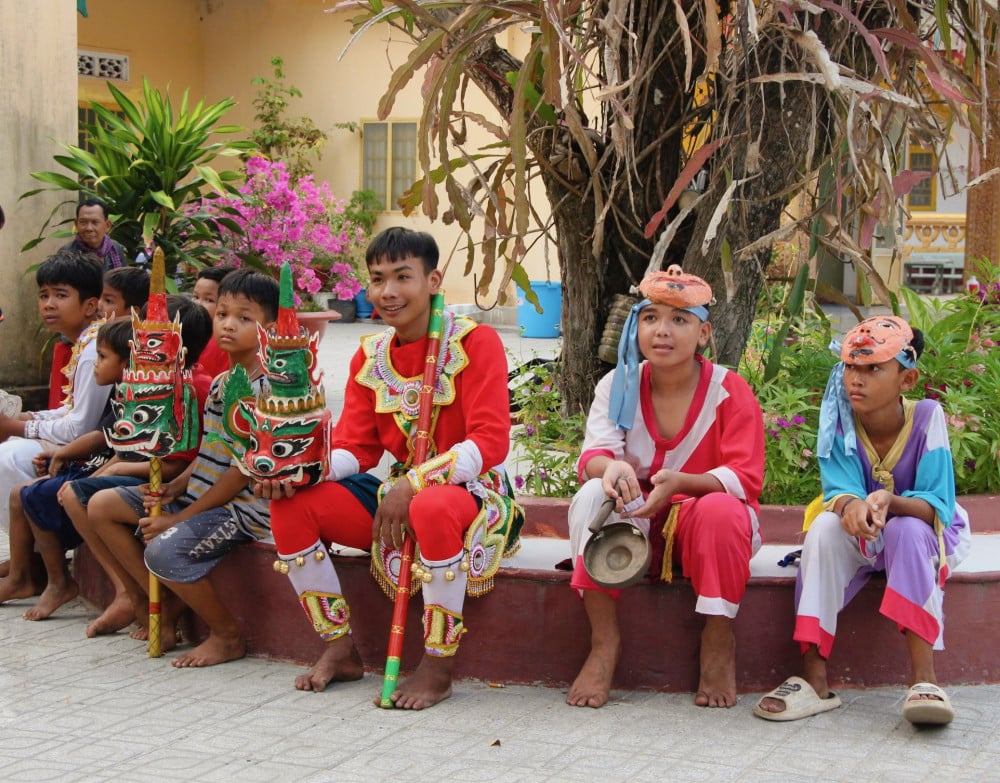
Binh Na Quinh, So Guot, and Phan Detl have been performing the Chan dance for three years.
For these children, each dance move and drum beat is not just an exercise, but also a way to engage with culture, contributing daily to preserving the traditional values of their ancestors. Because the Chằn dance drama is not only visually stunning and entertaining, but also embodies the aspiration for good to triumph over evil, the wish to ward off bad luck, and bring good fortune and peace to the village.
Venerable An Van Pat, the manager of Chung Rut Pagoda (Phuoc Vinh commune, Tay Ninh province), spoke about the meaning of the Chan dance: "If the Kinh people have lion dances to ward off bad luck and welcome good fortune, then the Chan dance of the Khmer people carries a similar meaning. The dance troupe will go to each house to perform and bless the people during the New Year."
Although the journey of preserving the Chằn dance art is fraught with difficulties, the passionate eyes of the Khmer men and women of Tay Ninh always shine with national pride. For them, each drum beat, each dance move is not just a performance but also the breath of culture, a thread connecting today's generation to their roots. It is precisely this perseverance and dedication that will allow the Chằn dance to continue spreading in community life, becoming a source of pride for the Khmer people and a unique highlight in the tapestry of Vietnamese culture.
Khai Tuong
Source: https://baolongan.vn/mua-chan-trong-van-hoa-khmer-a202620.html


![[Photo] General Secretary and President To Lam and the President of the Philippines hold talks.](https://vphoto.vietnam.vn/thumb/1200x675/vietnam/resource/IMAGE/2026/06/01/1780286997787_anh-man-hinh-2026-06-01-luc-11-09-43.png)




















































Comment (0)