

The joy of a bountiful harvest is still evident in the smiles of every villager in A Đeng hamlet, A Ngo commune, Dakrong district. It has been a long time since the name Ra Du rice – the pride of the Pa Ko people here – has been mentioned so much.
Joyful Rice Harvest Season
As November arrives, with the last vestiges of warm sunshine lingering on the leaves, the reeds bloom white in the forest, and the rice fields at the foot of the mountains begin to turn golden, the Pa Kô people in A Ngo begin their rice harvest.

The joy of the people when the Ra Du rice harvest is bountiful - Photo: PROVIDED BY THE WOMEN'S UNION OF A NGO COMMUNE
For the first time in many years of decline, the Ra Du rice variety – a sacred crop of the spirits – is yielding a bountiful harvest. Meticulously cutting handfuls of rice stalks and placing them into baskets, Ms. Ho A Rip from A Deng village excitedly boasts: “This year, the Ra Du rice is lush and green, with plump, golden grains. Every household has plenty of rice, so everyone is happy!” Next to Ms. Rip's field, many other Pa Ko people are also harvesting their rice, their laughter echoing throughout the forest.
Now 80 years old, Mrs. Ho Thi Hep from A Deng village doesn't remember exactly when the Ra Du rice variety first appeared. In her memory, she only recalls that since childhood she followed her mother to the fields to plant rice and then waited for the day to carry baskets to harvest it. Those golden seasons of heavy-laden Ra Du rice grew up alongside her childhood memories.
Ms. Hiep recounted that, for the people of A Deng, Ra Du rice is not simply food but also a "heavenly treasure," an indispensable item for offering to the spirits during the new rice festival or for welcoming honored guests. In the past, Ra Du rice was grown in the fields, so it grew according to the natural laws of the earth and sky; the villagers never used fertilizers or pesticides. After being placed in the soil, the Ra Du rice grains germinated on their own, absorbing nutrients and water from the forest rains, sprouting green shoots alongside the sky and earth. Therefore, Ra Du rice is sticky, delicious, and has a distinctive flavor of the mountains and forests.
Holding a handful of ripe Ra Du rice in her hands, Mrs. Hiep said: “For so many years, today is the first time we Pa Ko people have experienced the bustling atmosphere of harvest season with Ra Du rice. This year, my family planted two plots of land, and every field yielded a bountiful harvest, with grains heavy on the ears. The gods have blessed us with a good harvest, heralding a year of prosperity for our village.”
To answer our further questions about Ra Du rice, Ho Thi Mien, Chairwoman of the Women's Union of A Ngo commune, shared: "Ra Du is also known as 'sacred rice,' with large, sticky grains of dark pink rice. When cooked, the rice is very fragrant and not dry. Only when chewed thoroughly can you feel the delicious taste permeate your tongue."
Since ancient times, the A Ngo people have known how to choose fertile, thick-layered soil to sow Ra Du rice seeds. The rice grows for about six months, so only one crop can be grown each year. Because the Pa Ko people consider this rice to be "sacred rice," they perform rituals to appease the spirits during planting, sowing, and harvesting. When the rice is harvested, they hold a ceremony of offering new rice to pray for heavy, firm grains, ensuring the threshing baskets are neither empty nor empty, with the grains filling the entire basket and the entire sack.
The ceremony lasts from 2-4 days, and the offering tray cannot be without the heaviest, most grain-laden Ra Du rice, threshed by the villagers to offer to the gods. After threshing the rice, before bringing it home, the people perform a ceremony to welcome the rice god into their home, wishing for abundance, happiness, and that the rice will not be stolen by rats or birds upon arrival. The Ra Du rice brought home is carefully stored in a dry place or, after milling, is placed in a basket and carried to the market.
The journey to restore indigenous rice varieties.
Although Ra Du rice is a valuable variety with good rice quality, it is selective about soil conditions and has a long growth cycle, so local people are gradually planting it less than before, and many have even abandoned it due to low yields. Faced with the risk of this precious rice variety disappearing, as a native of the village, Ms. Miem has repeatedly pondered solutions to restore the traditional rice variety of the area. Ms. Miem shared: “In previous years, I and other villagers collected Ra Du rice seeds to plant both on the hillside and in the paddy fields at the foot of the mountain. However, every season the rice crop failed, with empty grains due to unfavorable weather or inappropriate planting seasons. Because Ra Du is considered a “sacred rice” plant, according to the villagers' beliefs, it will yield many grains if it pleases someone, and empty grains if it doesn't.”

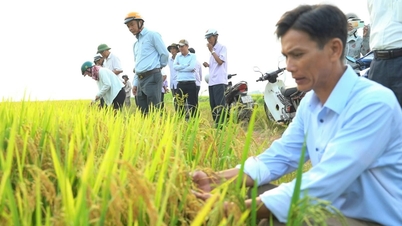
People in A Đeng village, A Ngo commune, harvest Ra Dư rice - Photo: LN
In early 2023, with the support of the Provincial Women's Union and the attention of the local government, the indigenous Ra Du rice variety was restored. Vice President of the Provincial Women's Union, Tran Thi Thuy Nga, shared: “Implementing the 'Accompanying Women in Border Areas' program launched by the Central Vietnam Women's Union and the Border Guard Command, in early 2023, the Provincial Women's Union, in coordination with relevant units, provided 100 million VND to implement a model for restoring the indigenous Ra Du rice variety in A Ngo commune.”
"22 households participated in the model on an area of 1.5 hectares." Based on the existing experience of the people, along with lessons learned from previous seasons, the farmers made appropriate changes from sowing seeds to adjusting the amount of fertilizer and water level for each field. Ms. Ho A Rip added: "Thanks to the good application of cultivation and care techniques, this season's Ra Du rice crop was bountiful, with much higher yields than in previous seasons. Currently, my family has kept the best ears to use as seeds for the next season."
Sharing more about her experience in growing Ra Du rice, Ms. Mien confided: “The most important thing for high yields of Ra Du rice is to sow at the right time. The most suitable time to sow is from the end of April to the beginning of May, when there are thunderstorms and just enough moisture for the plants to germinate well. To ensure smooth cultivation, we formed a Ra Du rice cultivation group, held regular meetings to implement new techniques, guide effective care methods, and share valuable experiences during production. Thanks to this, after nearly 6 months of care, we reaped the rewards with a bountiful harvest. The villagers are very happy because the traditional rice variety of our village has been restored.”
To help the Ra Du rice grow far
In the final days of the year, A Đeng village is bathed in warm spring sunshine. After drying the rice and storing it in the granary, selecting the plumpest ears to keep as seeds for the next season, the villagers eagerly prepare for the New Year's feast.
“Since the harvest, upon hearing that the Ra Du rice crop was bountiful, we have received many orders for Ra Du rice at relatively high prices, from 30,000 to 50,000 VND/kg, but we don't have enough to sell because each household only cultivates about 2 sao (approximately 2,000 square meters). Because it's a rice variety that is resistant to pests and diseases, farmers limit fertilization and absolutely do not use pesticides during cultivation, making it a clean rice variety that is very safe for health. With the help of the Provincial Women's Union, in the next season, we will continue to encourage people to expand the area planted with Ra Du rice, ensuring food security and creating additional income for people from this traditional crop,” Ms. Mien shared.

The harvested rice is carefully dried before being stored in the granary and prepared for the Tet (Lunar New Year) feast - Photo: LN
Ra Du rice is not only associated with the traditions of the A Ngo ethnic minority people in the highlands, but it is also one of the top-quality local rice varieties. A forgotten traditional crop that has been revived through natural, low-risk farming methods, producing clean rice, this is a significant advantage for building a brand for this indigenous rice variety, contributing to improving living standards and ensuring food security for people in the border region.
In addition, the locality also needs a long-term plan for developing Ra Du rice in an organic and biological direction, transferring technology and techniques to people in the area, and at the same time having appropriate marketing strategies so that Ra Du rice products can continue to reach a wider market.
Le Nhu
Source


















































































Comment (0)