

According to the Department of Animal Husbandry and Veterinary Medicine of Binh Dinh province, in the first quarter of 2025, the total pig herd in Binh Dinh increased by over 5% compared to the same period last year, reaching nearly 1 million pigs if including piglets and sows.
Currently, African swine fever is breaking out in many provinces and cities across the country, and since Binh Dinh province has previously experienced this disease, the pathogen is always lurking in the environment and could erupt at any time.
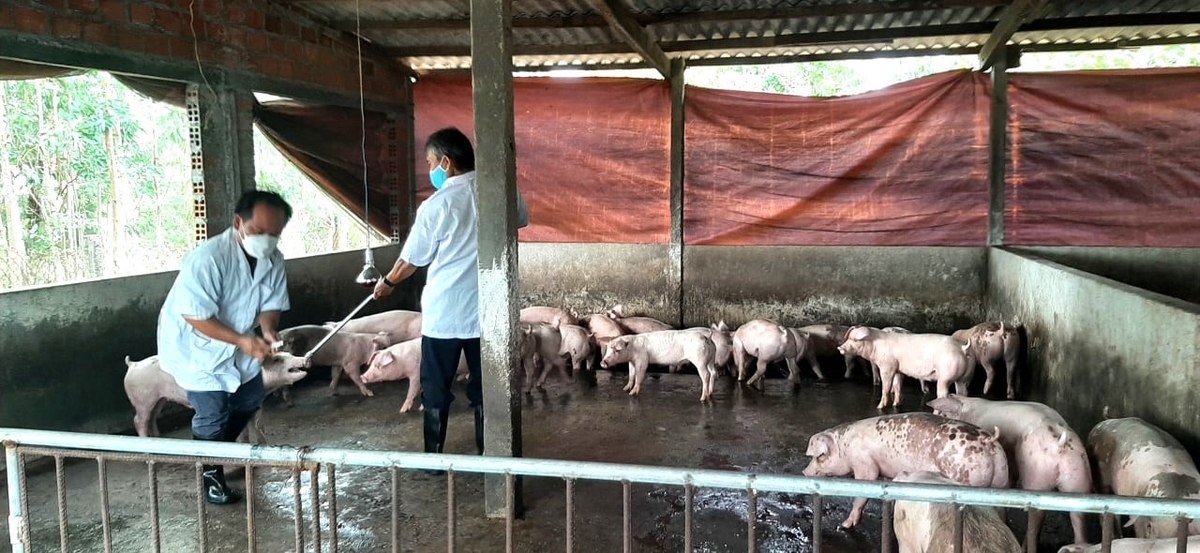
Authorities in Binh Dinh province advise livestock farmers to fully vaccinate their pigs to increase their resistance and fight against African swine fever. Photo: V.D.T.
Mr. Huynh Ngoc Diep, Head of the Department of Livestock and Veterinary Medicine in Binh Dinh, shared that the Binh Dinh authorities are deeply concerned that while livestock farmers are aggressively rebuilding their herds, there is a risk of a massive influx of breeding pigs from other provinces. This is not to mention the possibility of importing pork to meet market demand, which could bring in diseases. Therefore, the locality is strengthening its control efforts.
Currently, all pigs imported into Binh Dinh province must be declared through the Cu Mong Animal Quarantine Station (Ghenh Rang ward, Quy Nhon city). Upon receiving the information, the Cu Mong Animal Quarantine Station will immediately notify the Agricultural Service Center of the province where the pigs are imported, specifying the time, in order to coordinate monitoring.
In addition, the authorities in Binh Dinh are continuing to strengthen disease surveillance and warning, while also implementing vaccination programs against dangerous animal diseases such as avian influenza, foot-and-mouth disease, and lumpy skin disease in cattle and buffaloes. For pig vaccines, farmers are encouraged to self-vaccinate their pigs through a socialized approach.
“To prevent African swine fever, we are strengthening management and supervision of livestock farming in the area. We are intensifying inspections and strictly handling violations in livestock farming, purchasing, processing, and consumption of animal products, especially smuggled pigs and pigs of unknown origin that are mixed into the area and spreading the disease,” said Mr. Nguyen Thanh Vuong, Director of the Agricultural Services Center of Hoai An district, the locality with the largest pig herd in Binh Dinh province.
According to Mr. Huynh Ngoc Diep, the provincial authorities are currently advising livestock farmers to actively vaccinate their pigs against African swine fever. The People's Committee of Binh Dinh province has also directed local authorities to advise farmers to contact commune-level veterinary staff before vaccination, so that the staff can inform the local Agricultural Services Center for guidance and advice,” Mr. Huynh Ngoc Diep stated.
"When vaccinating pigs against African swine fever, supervision by commune-level veterinary staff is necessary because this vaccine must be administered to the correct target group of pigs (pigs aged 4-8 weeks). Without supervision, farmers vaccinating the wrong pigs could lead to unfortunate incidents. Supervision is needed so that if any problems occur, veterinary staff can confirm it, allowing farmers to receive government support as per regulations," Mr. Diep explained.
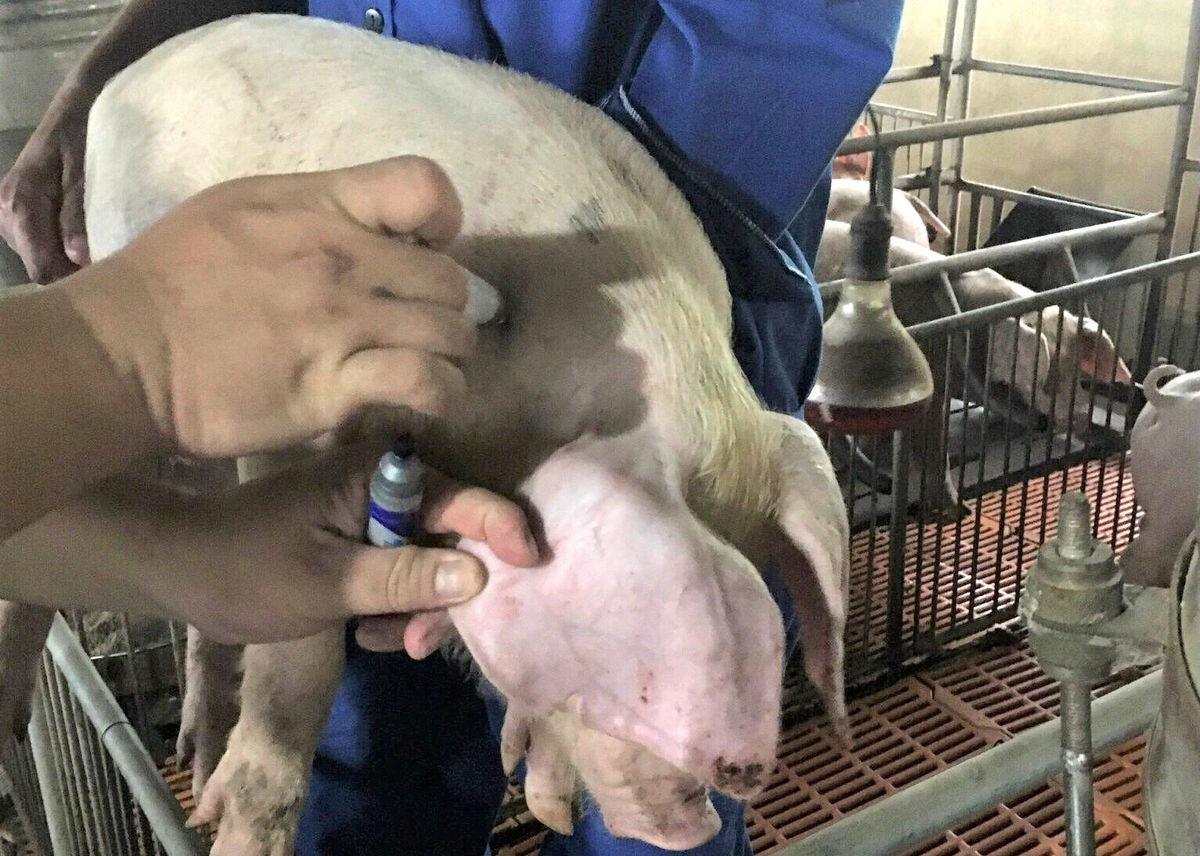
The vaccination rate against African swine fever in Binh Dinh province is very low. Photo: V.D.T.
However, the current vaccination rate against African Swine Fever (ASF) for pigs in Binh Dinh is very low. Only a few farms, aware of the necessity, have vaccinated their pigs, and the number is not large. According to the authorities, the number of pigs vaccinated against ASF is negligible compared to the total herd, only about 100,000 out of approximately 720,000 market pigs.
In reality, large-scale industrial pig farms fully vaccinate their pigs to protect their assets, while small-scale farmers are very negligent. This is because one vial of African swine fever vaccine is needed to vaccinate 10-20 pigs, while each household only raises 3-4 pigs. Buying one vial of vaccine means they won't use it all, and throwing it away is wasteful because a vial of African swine fever vaccine currently costs 40,000-50,000 VND, so they don't use it.
"Our farmers still lack cooperation in business. Small-scale livestock farmers could form groups of 2-3 households, each raising 5-7 pigs, to buy one vial of African swine fever vaccine to inject their pigs, but they don't do it," Mr. Diep shared.
Source: https://nongnghiep.vn/muon-kieu-phong-chong-dich-ta-lon-chau-phi-d744930.html
![[Image] The appearance of the Bien Hoa-Vung Tau expressway before its opening.](https://vphoto.vietnam.vn/thumb/1200x675/vietnam/resource/IMAGE/2026/03/25/1774430324663_ndo_br_2-resize-6064-jpg.webp)









![OCOP during Tet season: [Article 4] Elevating local products](https://vphoto.vietnam.vn/thumb/402x226/vietnam/resource/IMAGE/2026/01/29/1769652810578_2935-z6982071462129_649e82db06fb2f2ea701388b1f5f5b0b-173322_176-185229-202804_457.jpeg)
































































Comment (0)