

In contrast to the energy sector, base metals, particularly copper, came under pressure as inventories rose and the US dollar strengthened. The volatile energy market contributed to a 1.6% increase in the MXV-Index, reaching 2,700 points – its highest level in approximately eight years.

World oil prices hit their highest level since July 2024.
The energy market immediately heated up again in yesterday's trading session. Notably, Brent crude prices reversed course and rose by nearly 3.7%, climbing to $84.33 per barrel; while WTI crude also recorded its fifth consecutive day of gains, rising by nearly 8.5%, surpassing $81 per barrel. Currently, both benchmark oil commodities are anchored at their highest prices since July 2024.
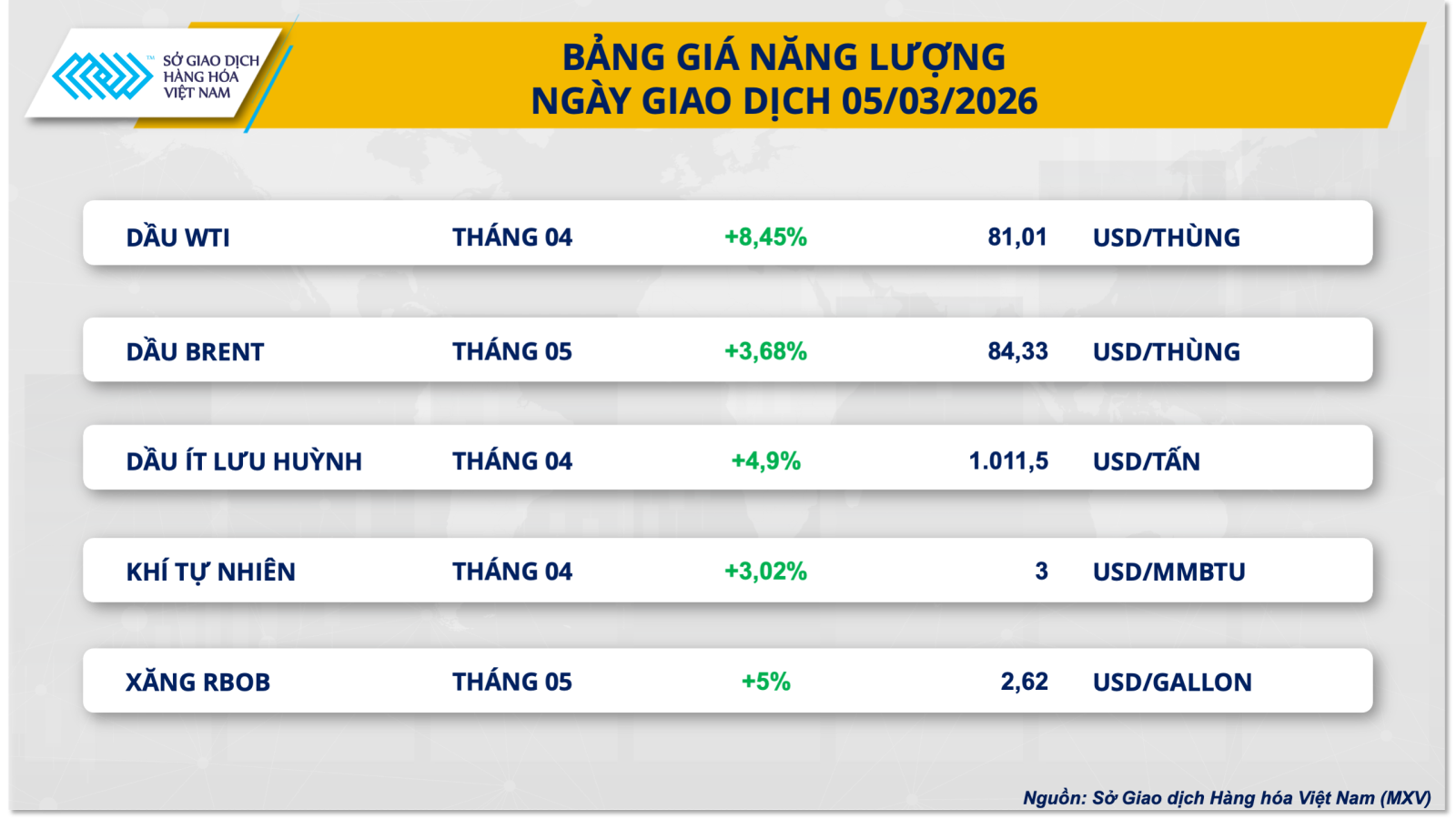
In his latest statement yesterday, US President Donald Trump asserted that he was not overly concerned about the soaring global energy prices due to escalating tensions in Iran. Instead, Washington's top priority is now deploying military operations in the region. This stance, along with the Trump administration leaving the timeframe of the operation open, has fueled market concerns about the risk of a prolonged blockade of the Strait of Hormuz.
Assessing the current situation, John Kilduff, founding partner at Again Capital, commented: “The deadlock in the Strait of Hormuz will continue to fuel oil prices. The fact that many countries have been forced to temporarily suspend production will have long-lasting consequences, as these facilities cannot immediately restore 100% capacity, thereby putting significant pressure on supply in the coming period.”
Market reports have emerged suggesting that China has reportedly instructed refineries to halt the signing of new fuel export contracts and is seeking to cancel committed shipments due to severe crude oil shortages that have drastically reduced refining output. A domino effect has also spread, with numerous other refineries in India and the Middle East forced to close or drastically reduce capacity due to security risks and potential supply chain disruptions.
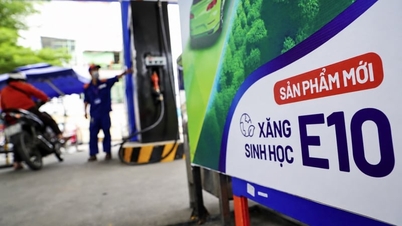
Given the sharp rise in global oil prices, it was predictable that domestic retail gasoline and diesel prices would also be affected, especially as supply disruptions from the Middle East have had a significant impact on the energy markets of many Asian countries. In yesterday's price adjustment by the Ministry of Industry and Trade and the Ministry of Finance, all five retail gasoline and diesel products recorded significant price increases.
Notably, in line with the nearly 150% surge in kerosene prices on the Singapore Exchange (SGX), domestic kerosene prices also recorded a record adjustment, jumping by more than 7,100 VND/liter (equivalent to an increase of over 36.6%), leading the upward trend in the price adjustment period. At the same time, E5 RON 92 and RON 95 gasoline both increased by around 2,000 VND/liter, while diesel also rose by nearly 3,800 VND/liter (equivalent to 19.5%).
Metal markets are in turmoil, with COMEX copper prices under significant pressure.
Meanwhile, yesterday's metal market saw red dominating most of the key commodities in the group. In particular, the price of copper on the COMEX exchange for May delivery lost nearly 1.7%, falling to $12,796 per ton.
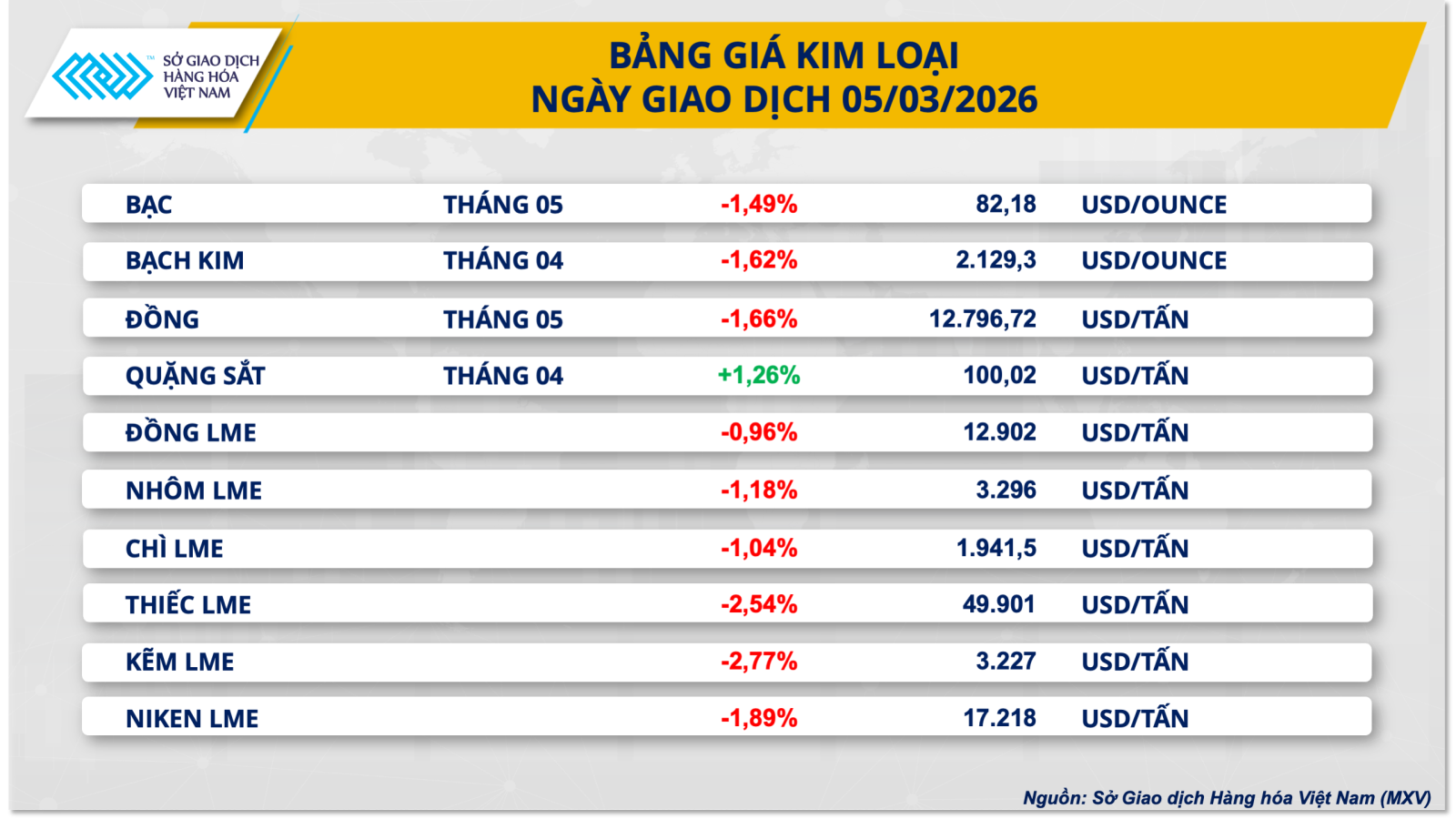
According to the Vietnam Commodity Exchange (MXV), the recovery of the US dollar has put significant pressure on the metals market. Due to their pricing in US dollars, the transaction costs of these commodities have become more expensive for investors holding other currencies, thereby weakening market demand. In addition, the market is also facing oversupply pressure as inventories at major trading centers have exceeded 1 million tons.
Rising geopolitical risks and persistent inflation concerns have triggered a defensive sentiment in the market. Furthermore, investors continue to expect the Federal Reserve (Fed) to keep interest rates high for a longer period to curb inflation. The combination of these two factors has fueled a strong flow of safe-haven funds into the US dollar. At the close of yesterday's session, the Dollar Index (DXY) reversed course and rose nearly 0.3%, reaching 99.06 points.
Furthermore, the global refined copper market is also facing pressure from oversupply. According to the International Copper Study Group (ICSG), the market is expected to record a surplus of approximately 380,000 tonnes in 2025, 5.3 times higher than the surplus of 69,000 tonnes in 2024.
In fact, total copper inventories at major trading centers have now exceeded 1 million tons, raising concerns about the absorption capacity of physical demand. According to data from LSEG as of March 5th, copper inventories at COMEX (US) storage facilities have surpassed 544,000 tons, an increase of nearly 20% compared to the beginning of 2026. Similarly, reserves at the LME (UK) have surged 98% to over 282,000 tons, while inventories on the SHFE (China) have also ballooned by 117%, reaching 391,000 tons.
While the increase in US inventories can be explained by stockpiling in anticipation of tariff risks, the inventory trends on the LME and SHFE reflect a continued abundance of refined copper supply, while industrial demand is not yet strong enough to absorb this increase, especially given that refining output in China remains high.
Source: https://baotintuc.vn/thi-truong-tien-te/mxvindex-len-vung-cao-nhat-trong-8-nam-qua-20260306082944118.htm




![[Photo] General Secretary and President To Lam presides over a working session with the Central Policy and Strategy Committee on the development of the materials industry.](https://vphoto.vietnam.vn/thumb/1200x675/vietnam/resource/IMAGE/2026/05/21/1779359935432_a3-bnd-3129-1412-jpg.webp)
![[Photo] National Assembly Chairman Tran Thanh Man working with the Standing Committee of the Law and Justice Committee](https://vphoto.vietnam.vn/thumb/1200x675/vietnam/resource/IMAGE/2026/05/21/1779378929214_ndo_br_1-4610-jpg.webp)

























































































Comment (0)