

According to Yonhap on April 7, General Charles Flynn, Commander of the U.S. Army Pacific, stated that the U.S. military has developed long-range precision weapons, and he listed the SM-6 anti-aircraft missile and the Tomahawk cruise missile as potential weapons for use in this new system.
Charles Flynn stated that the system would soon be deployed in the region, but he did not specify the type of launcher, nor the timing or location of the deployment. Experts widely speculate that this could be the Typhon ground-based missile launcher system that the US military has been developing since last year.
Previously, according to Japanese media, Guam – a US territory in the western Pacific – was considered a potential location for deploying this system.
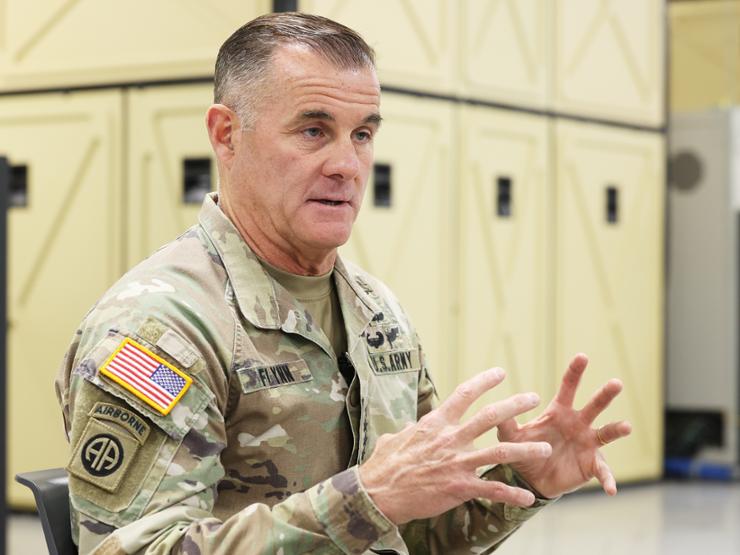
General Charles Flynn, Commander of the U.S. Army Pacific, speaks in an interview with Yonhap in South Korea on April 6, 2024.
SCREENSHOT FROM THE KOREA TIMES
The SM-6 is designed to intercept ballistic missiles and has a range of over 240 km. The Tomahawk is a subsonic cruise missile capable of striking targets up to approximately 2,500 km away.
Charles Flynn's statement marks the first confirmation by the U.S. of the types of weapons systems that will be deployed in the Indo-Pacific region this year. Furthermore, this move also marks a historic shift, as it is the first time such a weapons system has been deployed in the region since the U.S. and the Soviet Union signed the Intermediate-Range Nuclear Forces (INF) Treaty in 1987.
The INF Treaty banned ground-launched short- and medium-range missiles. At the time, the US and the Soviet Union possessed a combined total of 2,611 missiles of this class, mostly located in Europe and Southeast Asia. However, the agreement expired in 2019, and neither the US nor Russia renewed it.
Flynn stated: "North Korea's missile tests are concerning and destabilizing to the region. Based on our recent operations in the region, I am confident in the multi-layered missile defense system that the United States currently possesses."
North Korea announced on April 3rd that it had test-fired a new hypersonic medium-range ballistic missile, known as the Hwasongpho-16B, and asserted that all of its missiles now use solid fuel and are capable of carrying maneuverable nuclear warheads. Hypersonic missiles are known to be difficult to intercept with conventional missile defense systems because they can travel at five times the speed of sound, with highly variable flight paths and altitudes.
U.S. military forces in South Korea operate the PAC-3 short-range missile defense system, the Medium-Range Air Defense Missile System (M-SAM) – developed by South Korea from the Cheongung missile – and the Terminal High Altitude Area Defense (THAAD) system.
Speaking to Yonhap, Flynn also highlighted the potential risks surrounding suspicions that North Korea is supplying weapons to Russia. At the same time, he praised South Korea's active participation in multinational military exercises with the U.S. and its allies. These activities send an important message amid rising security challenges.
In addition, U.S. General Charles Flynn also welcomed the progress in U.S.-South Korea defense relations over the past several decades. General Flynn is currently on a three-country tour of Asia, including Japan, Thailand, and South Korea.
Source link




![[Image] Checking the security conditions at the exam site, ready for the 10th grade exam.](https://vphoto.vietnam.vn/thumb/1200x675/vietnam/resource/IMAGE/2026/05/28/1779943458889_z7872507660648-d764421a26e8cd7b61d70d142a48a685-jpg.webp)
![[Photo] Opening Ceremony of the National People's Council Conference on the Implementation of Directions and Tasks for the 2026-2031 Term](https://vphoto.vietnam.vn/thumb/1200x675/vietnam/resource/IMAGE/2026/05/28/1779939257690_ndo_br_bnd-1991-jpg.webp)

























































































Comment (0)