

Besides the common name "dragon," it is also known by its Sino-Vietnamese pronunciation "Long" and its Chinese zodiac name "Thìn." There are five types of Thìn according to the Chinese zodiac: Giáp Thìn, Bính Thìn, Mậu Thìn, Canh Thìn, and Nhâm Thìn. From the original dragon, Vietnamese life and language have also given rise to other names such as "giao long" and "thuồng luồng," all of which are creatures of imagination.
From its outward appearance, the dragon appears to be a combination of characteristics from two animals: the crocodile and the snake. Dragons resemble crocodiles in distinctive features such as the head, scales, and legs, and snakes in their long bodies. Dragons are born underwater but can fly into the sky. They can fly without wings. Their mouths can both spew water and fire. However, the Vietnamese psyche primarily associates the dragon with water-spraying rain. This is evident in two typical folk tales: the Legend of Ba Be Lake and the Legend of Muc Pond .
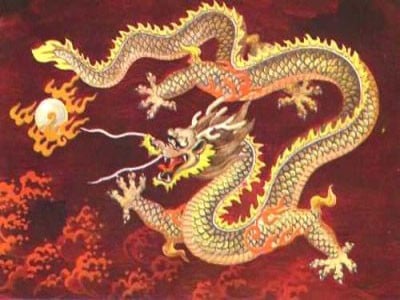
Illustrative image
When mentioning dragons, one immediately thinks of the most majestic and fierce creature among all the animals in the Chinese zodiac. Dragons, therefore, symbolize power and dominance, and are often associated with the emperor. In the Sino-Vietnamese vocabulary, an entire class of words has been formed to refer to the objects and belongings used daily by the emperor, or anything belonging to the emperor, all containing the word "dragon": dragon robe, dragon bed, dragon carriage, dragon palanquin, dragon countenance, dragon boat… The rain-making deity is called the dragon king. The word "dragon" also carries meanings associated with good fortune, happiness, and prosperity. This forms the basis for a series of terms such as: dragon vein, dragon gate, dragon phoenix, dragon fortune, dragon cloud (gathering of dragons and clouds).
In feng shui, when building houses or temples and shrines, people often decorate and carve dragons and tigers, and there are familiar proverbs such as: "Left green dragon, right white tiger," "Two dragons worshipping the moon," "Two dragons vying for the pearl." Many famous places in Vietnam are named with the word "Long" (Dragon): Ham Rong, Ham Long, Thang Long, Ha Long, Cuu Long, Bach Long Vi, Long Do, Long Dien… Dragons are also sometimes likened to figures with extraordinary or exceptional abilities.
Vietnamese people are proud to be descendants of dragons and fairies, associated with the legendary story of Lac Long Quan and Au Co. The dragon has also entered many Vietnamese idioms, proverbs, and folk songs with various symbolic meanings, most of which are associated with auspicious things: "Dragon flying, phoenix dancing," "Dragon visiting shrimp's house," "One day leaning against the side of a dragon boat is better than nine lifetimes sitting in a fishing boat," "Carp transforming into a dragon," "Fish meeting water, dragon meeting clouds," "With good fortune, bamboo transforms into a dragon," "Water flowing smoothly like a dragon swirling water." There are also times when the dragon falls from grace, into difficult circumstances unsuitable and incompatible with its noble position: "The dragon, down on its luck, transforms into a snake," "Golden dragon bathing in a stagnant pond."
Throughout the history of Vietnamese feudal dynasties, the image of the dragon has transformed over time, reflecting the style or ideology of the rulers. The dragons of the Ly Dynasty had gentle, simple curves: long, winding bodies covered in scales. During the Tran Dynasty, dragons began to change their forms, developing diverse shapes, with distinct differences in each region. The Tran Dynasty dragons were more robust and robust, with shorter trunks, more varied horn styles, two types of short manes curving down to the nape, more scales, and shorter, thicker claws.
During the early Le Dynasty, the dragon's trunk was replaced by a carnivorous snout, its face looked fiercer, with added eyebrows and a thick beard, its body was large and strong, combined with fiery clouds, and the power and authority of the emperor were expressed through the image of the five-clawed dragon. Many people believe that the dragon of the early Le Dynasty closely resembled the dragon of the Ming Dynasty, but in reality, the dragon of the early Le Dynasty had softer scales and tail, its mane was often split to the sides, and it appeared in a very characteristic posture of one front paw grasping its beard.
Dragons from the Mac Dynasty had two-pronged horns on their heads, bulging eyes, lion-like noses, animal-like mouths protruding forward, and their legs often had four claws.
During the Le Trung Hung period, the most turbulent and longest period in Vietnamese feudal history, the flourishing of temple and pagoda architecture led to a rich and diverse development of the dragon imagery. The most prominent features included sharp, straight manes and fiery clouds. The dragon's head was no longer split but divided into evenly spaced sections, with flared eyebrows, chin beard, and leg hairs, and two curved whiskers. By the Canh Hung period, around the mid-18th century, a dragon with a swirling tail and a more slender body appeared, a design believed to be the earliest seen in royal decrees.
Up until the last feudal dynasty of Vietnam, the Nguyen dynasty, the image of the dragon basically inherited the image of the dragon from the Le Trung Hung period, further developing it with stepped dragons, the curvature no longer regular but only bulging up in two small sections towards the tail, the dragon's forehead being somewhat more concave and slanted backward, the dragon's tail extended with sparse, sometimes sharp, bristly hairs.
Of all the dragon sculptures from the feudal era, perhaps the most remarkable is the statue of a dragon biting its own body with its legs tearing at itself. Measuring 79cm high, 136cm wide, and 103cm long, with a total weight of 3 tons, it was discovered in 1991 during the renovation of the temple dedicated to Grand Tutor Le Van Thinh, located south of Thien Thai Mountain in Bao Thap village, Gia Binh district, Bac Ninh province. The statue vividly portrays a state of intense pain, agony, and profound sorrow and resentment.
Many art researchers believe that the sculptor of this statue wanted to express the agonizing injustice suffered by Grand Tutor Le Van Thinh when he was falsely accused of transforming into a tiger to kill the king. But the message of the work is perhaps even greater. The dragon is the ultimate symbol of a wise ruler; if a dragon bites its own body, how can it ever fly again? This is similar to a king who is not wise, allowing unjust judgments to occur, especially against talented and virtuous scholars; this is the source of much suffering and self-destruction.
Unlike in the East, dragons in many Western countries appear as symbols of evil and are associated with the devil. Dragons are often linked to the task of guarding hidden treasures, and the treasure must be defeated to enter.
Meanwhile, for Vietnam, the dragon has always been a symbol of progress and advancement, starting from King Ly Thai To's dream of seeing a golden dragon soaring in the clear blue sky, which led him to move the capital from Hoa Lu to Dai La and rename it Thang Long. Therefore, in the minds of many Vietnamese people today and in the future, the dragon is always associated with beauty, development, and longevity.
Do Anh Vu
Source


































































Comment (0)