Empowering the younger generation
For many families in Tam Hai, sending their children to university is never easy. Parents' incomes depend on the fishing season, jobs are unstable, and the cost of studying far from home is ever increasing. There are times when their children's dreams of education are at risk of being shattered because the family can no longer afford it.
Mrs. Tran Thi Binh, from Tho village, Tam Hai island commune, is one such mother. Her family has three children attending school. To prevent their children from dropping out, she and her husband worked hard, borrowed money, and carefully saved every penny. When their family's resources were no longer sufficient, the policy-based credit for students became a crucial support system.
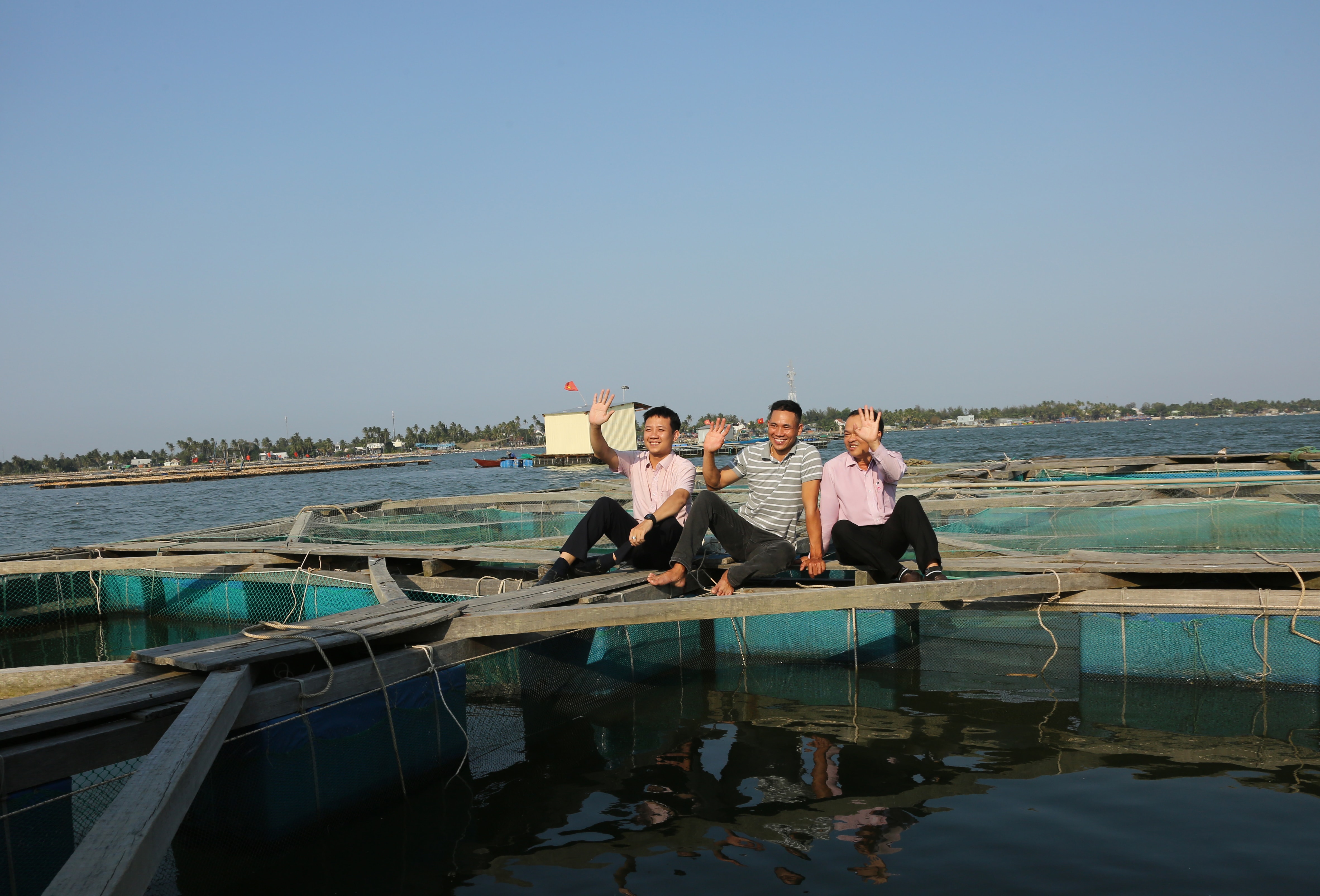
She recounted that one of her children received a loan of 20 million dong per year; by the final year, the monthly payment was around 15 million dong. That amount wasn't enough to cover all expenses, as raising three children studying far from home is a huge pressure. But for her family, it was timely support, giving parents more time and resources to manage their children's education.
What's touching about Mrs. Binh's story isn't the amount she borrowed, but the determination of a mother. No matter how difficult things get, she doesn't want her children to drop out of school. She fears they might waver along the way, but she's also proud to see them striving to succeed. For her, as long as her children graduate and find stable jobs, their lives will be less difficult than their parents'.
In island communities, student loans therefore hold a very special significance. It's an investment in generational transition. Parents may continue to make a living from fishing, but their children have more opportunities to enter new professions, free from the constraints of limited capital, few choices, and the risk of dropping out of school.



Nguyen Huu Khoa, head of the Thuan An village savings and loan group, said that many households in his group have borrowed money to send their children to school. Some families have three children attending university one after another. If they relied solely on the parents' daily labor, it would be very difficult to cover the costs of two or three children studying far from home at the same time. Thanks to student loans, many families have the means to continue their children's education. "When the children graduate and find jobs, the parents are happy. As the group leader, I'm happy too," Mr. Khoa said.
Beyond the stories of individual families on the island, the credit policy for education is expanding its significance in the context of Da Nang's need for high-quality human resources for key science , technology, and industrial sectors.
Discussing the student loan program for students studying STEM fields, Associate Professor Dr. Huynh Phuong Nam, Vice Rector of the University of Technology - Da Nang University, acknowledged that this is a very important policy, because STEM fields often have long training periods and high tuition and practical training costs, causing many talented students from disadvantaged backgrounds to hesitate when choosing them.
According to him, the students supported today, after graduation, can become the core force in research, production, and technological innovation. Looking more broadly at the Tam Hai story, a loan helping children in disadvantaged areas continue their education not only solves the immediate pressure on a family but also contributes to building a workforce for the future.
Investing in children, securing the future for Tam Hai.
In Tam Hai, policy-based credit is impacting many aspects of life. For fishermen, it provides capital to buy nets, build cages, repair boats, and invest in production. For poor and near-poor households, it creates livelihoods. For families with children attending university, it secures their future. For young people returning to their hometowns, it provides startup capital. For the locality, it is a tool for sustainable poverty reduction, rural development, and ensuring social security.
The story of Mr. Le Huynh Xuan Dai is a case in point. After working away from home for some time, he returned to Tam Hai and borrowed 100 million VND from the Social Policy Bank to invest in HDPE cages for off-season aquaculture. From this initial capital, he gradually stabilized his finances, repaid part of the principal, and continued to expand production. Mr. Dai is the endogenous resource that Tam Hai needs in the coming period. And, if people like Mr. Dai have better access to capital, technology, markets, and infrastructure, they will create a new class of stakeholders for the marine economy, ecotourism, and modern agriculture in Tam Hai.
Although Tam Hai has advantages for developing marine economy and tourism, this potential is accompanied by many difficulties: infrastructure is not yet synchronized, some projects are behind schedule, tourism is still spontaneous, investment resources are limited, digital transformation is still difficult, and the lives of a segment of the population still need support...



In this context, caring for the people's lives must be the central goal. For an island commune to develop tourism, services, and the marine economy, its people must first have stable livelihoods. To have a workforce for the future, children must receive an education. For sustainable development, the people must participate in the development process, not just stand by and watch...
Da Nang is striving to ensure that no one is left behind. For Tam Hai, that goal begins with each individual household: mothers having more money for their children's education, young people having capital to return to their hometowns and start businesses, and fishermen having better means to continue their livelihoods at sea. On this journey, the support of all levels of government and the Vietnam Bank for Social Policies (VBSP) in particular is certainly essential.
Source: https://daibieunhandan.vn/nang-canh-uoc-mo-xanh-10421486.html

![[Image] Schools organize meetings and introduce teaching models to students admitted to grade 10.](https://vphoto.vietnam.vn/thumb/1200x675/vietnam/resource/IMAGE/2026/06/25/1782368077271_ndo_br_z7970052192242-1ec8daeb77a6eed1a4e9f58c564ddd3e-jpg.webp)


![[Photo] General Secretary and President To Lam receives Palestinian Ambassador Saadi Salama](https://vphoto.vietnam.vn/thumb/1200x675/vietnam/resource/IMAGE/2026/06/25/1782365384740_a1-bnd-9423-8322-jpg.webp)
![[Image] Ho Chi Minh City: Ma Lang area, Chicken-Rice Market about to change its appearance](https://vphoto.vietnam.vn/thumb/1200x675/vietnam/resource/IMAGE/2026/06/25/1782377698627_ndo_br_m1-jpg.webp)































![[Photo] General Secretary and President To Lam attends the 13th National Congress of the Ho Chi Minh Communist Youth Union](https://vphoto.vietnam.vn/thumb/1200x675/vietnam/resource/IMAGE/2026/06/25/1782356968989_ndo_br_1-jpg.webp)