

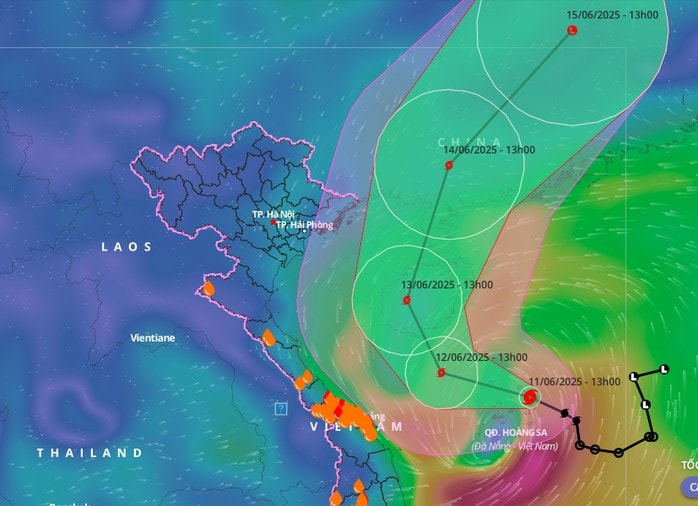
According to information from the Nghe An Meteorological and Hydrological Station, at 4 PM on June 11th, the typhoon's center was located at approximately 16.8 degrees North latitude and 111.9 degrees East longitude, over the Hoang Sa archipelago. The strongest winds near the center of the typhoon were at level 8 (62-74 km/h), with gusts up to level 10, moving in a west-northwest direction at a speed of about 15 km/h.
Proactive response measures
According to a report from the Provincial Border Guard Command: Nghe An province has 2,850 vessels/13,671 laborers directly involved in seafood fishing. As of 10:00 AM on June 11, 2025: The number of vessels anchored at ports is 2,101 vessels/10,641 laborers; 836 vessels/3,298 laborers are operating at sea.
Currently, no vessels are operating in the Paracel Islands; 164 vessels/1,242 workers are operating in the Gulf of Tonkin; 668 vessels/2,040 workers are operating along the coast of Nghe An province; and 4 vessels/16 workers are operating outside the province. No fishing vessels are out of contact, and no fishing vessels are operating in dangerous areas. All vessels currently operating at sea have received notification of the location and direction of Typhoon No. 1.
To date, Nghe An's two major irrigation reservoirs, Vuc Mau and Song Sao, have undergone inspection and trial operation, and are ready for operation according to the procedures approved by the Provincial People's Committee.
Currently, there are 23 hydropower reservoirs operating in the province; of which, 8 reservoirs are operating according to the inter-reservoir operating procedure on the Ca River basin (Ban Ve, Khe Bo, Chi Khe, Nam Non, Nam Mo, Ban Ang, Nhan Hac A, Chau Thang, Song Quang, Khe Thoi); the remaining reservoirs operate according to the single-reservoir operating procedure.
To date, Nghe An province has basically finished harvesting the spring rice crop; the entire province has sown and planted more than 19,123 hectares of summer-autumn rice (9,046 hectares of transplanted rice; 9,882 hectares of direct-seeded rice and 195 hectares of upland rice).
The total aquaculture area is 20,783 hectares (of which: freshwater aquaculture area is 18,986 hectares; brackish water aquaculture area is 1,797 hectares); there are 4,040 cages and rafts (including 2,200 freshwater fish cages; 1,061 saltwater and brackish water fish cages; and 779 estuarine oyster farms).
Avoid being caught off guard or surprised.
Of current concern is that Nghe An province has recently experienced localized heavy rainfall causing landslides in some mountainous districts. Therefore, if heavy rains continue, the risk of landslides in mountainous, hilly, and downstream areas of reservoirs and dams is very high.
Currently, all localities have developed response scenarios. In the 2025 Disaster Response Plan for Nghe An province, the People's Committee of Nghe An province has developed five scenarios for evacuating coastal residents to avoid storm surges. Depending on the storm intensity, localities will organize the evacuation of residents according to the scenario.
Currently, localities and relevant sectors are closely monitoring forecast information and developments regarding storms, rain, and floods, promptly directing and implementing response measures according to the "four on-the-spot" principle within their assigned tasks and authority, avoiding passivity and surprises to ensure the safety of lives and minimize property damage for the people.
Continue to organize inspections and counts, proactively inform and guide vessels (including fishing boats, transport ships, and tourist boats) still operating at sea to be aware of and avoid entering or leaving dangerous areas, or to return to safe shelters; take measures to ensure the safety of vessels at anchorage areas. Prepare rescue and relief forces and equipment to promptly handle any situations that may arise.
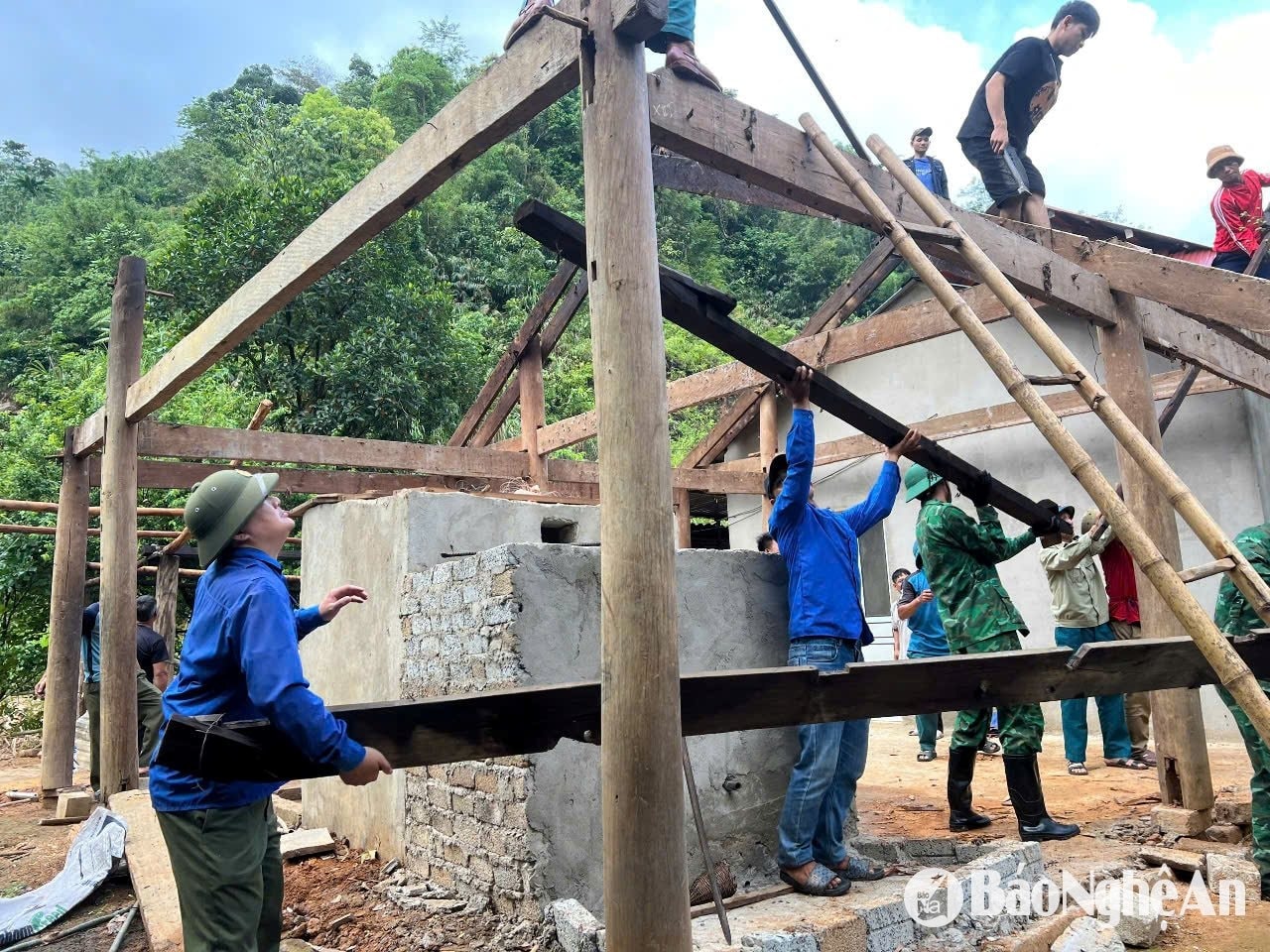
Simultaneously, deploy rapid response forces to inspect and survey residential areas along rivers, streams, dikes, dams, and low-lying areas at high risk of flooding, flash floods, and landslides, in order to proactively organize the relocation and evacuation of people when situations arise; clear waterways and promptly address any structural failures from the outset.
Prepare personnel, vehicles, equipment, and essential supplies according to the "four on-the-spot" principle to be ready to respond to any situation.
Inspect and proactively implement measures to ensure the safety of reservoirs and downstream areas; deploy permanent forces ready to operate, regulate, and handle emergency situations.
Source: https://baonghean.vn/nghe-an-chu-dong-ung-pho-with-bao-so-1-10299428.html


![[Photo] Prime Minister Pham Minh Chinh presides over a meeting on private sector economic development.](/_next/image?url=https%3A%2F%2Fvphoto.vietnam.vn%2Fthumb%2F1200x675%2Fvietnam%2Fresource%2FIMAGE%2F2025%2F12%2F20%2F1766237501876_thiet-ke-chua-co-ten-40-png.webp&w=3840&q=75)




















































































Comment (0)