

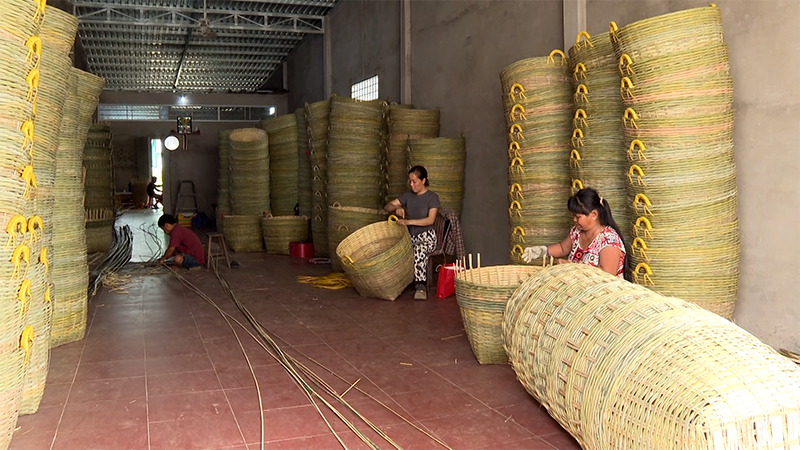
Decorating the handles of a woven basket at the home of Ms. Le Thi Anh Thu in Area 6, Nga Bay Ward, Can Tho City. Photo: QUOC HUNG
Now, people no longer work independently but cooperate with each other, with each family taking on a different task. This method saves time, increases productivity, and ensures a market for their products. Above all, this cohesion preserves the sense of community and neighborly spirit, a priceless aspect of traditional craft villages in the Mekong Delta.
Mrs. Tran Thi Mai (78 years old) is a witness to the development of this craft village. She recounted: “In the old days, hundreds of households followed this craft. A skilled weaver could make 4 to 5 baskets a day. If the family was large, the number would be even higher. Many families became wealthy thanks to basket weaving, buying land, building houses, and providing for their children's education.”
Nowadays, many alternative materials have emerged to replace traditional baskets; however, thanks to their unique advantages in design, ease of transport, and lightweight materials, traditional baskets are still widely used for storing and transporting specialties from the Mekong Delta, especially fruits. But to thrive in this craft, the villagers are operating in a new way. They are linking together, with each family handling a specific stage: some split bamboo, some shape the strips and pins, some specialize in weaving, some handle finishing the product, and some act as intermediaries for both input and output. In today's struggle for survival, each finished product is the result of the combined efforts of many pieces, from the skillful hands of those who split the bamboo, weave the baskets, assemble the rims, and tie the handles, to the experience passed down through generations. Product quality is a vital factor, the livelihood of the families and the entire village, so everyone strives to create the most durable and beautiful products possible.
One of the people who acts as a liaison for purchasing raw materials and organizing processing is Ms. Nguyen Thi Nhung (Ut Nhung). Thanks to capital and a stable market for her products, she currently contributes to creating stable jobs for several dozen local workers. Ms. Ut Nhung confided: “The villagers have been doing this job for a long time, so everyone has their own skills. I act as the liaison, then organize the workers to do each stage of the process, and then assemble everything quickly. Every 2-3 weeks, when we have enough quantity, we contact traders to deliver the goods. We're still able to make a living from this job, and I hope there will always be a market so that the villagers can have an income.”
In this craft village, Mrs. Thach Thi Thuy, daughter of Mrs. Tran Thi Mai, continues the family tradition. Mrs. Thuy and her husband are responsible for sharpening the base pins, an essential step to ensure the baskets are sturdy and durable; it's also the final step in completing the product. Each day, Mrs. Tran Thi Mai and her husband earn several hundred thousand dong from the pins they sharpen. For Mrs. Thach Thi Thuy, this is a profession that provides a stable livelihood if one is diligent, patient, and preserves the craft properly. She shared: “The craft is ingrained in me, so no matter where I go or what I do, when I get home I can always start sharpening pins or weaving baskets. Every day, I earn an income by evening.”
As for Ms. Le Thi Anh Thu, who handles the decoration and handles, the craft of weaving bamboo baskets is currently a lucrative profession, so she chose to stay in it. The work is local, allowing her time to care for her children, which makes her even more appreciative and dedicated. The tasks she undertakes are not overly strenuous but require endurance, meticulousness, and skill. She shared: "Baskets have a stable market, so people in the craft village have stable employment."
According to statistics, the village's suppliers ship out nearly 2,000 baskets per month, with each craftsman or family earning between 200,000 and 500,000 VND per day, depending on the number of products. In this hamlet, people often gather to work in the front yard, on the veranda, under the shade of trees along the riverbank… and the lively conversations fill this corner of the countryside. The seemingly disjointed way of making these baskets actually strengthens the bonds among the villagers. Everyone understands that each thin bamboo strip, each small handle, holds special value. They must fit together perfectly and be uniform, like the close-knit community spirit of mutual support in times of need. It is these simple things that have kept the basket weaving craft not only as a means of livelihood but also as a deeply ingrained cultural memory of the Mekong Delta.
NGOC NHU
Source: https://baocantho.com.vn/nghia-tinh-lang-nghe-a204445.html









































































Comment (0)