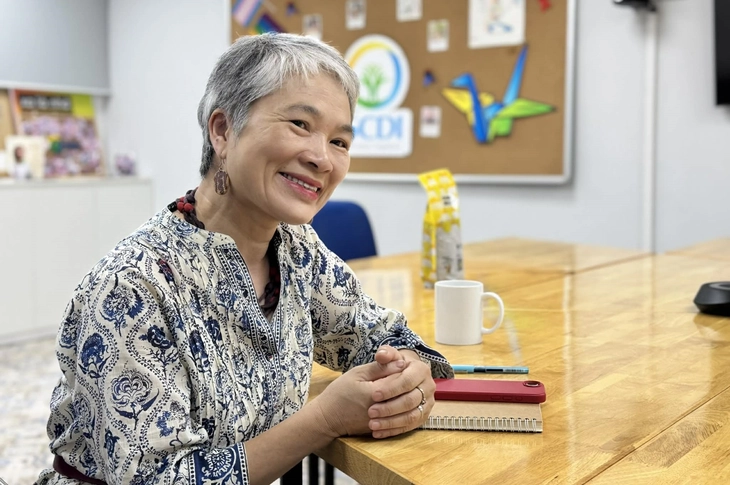
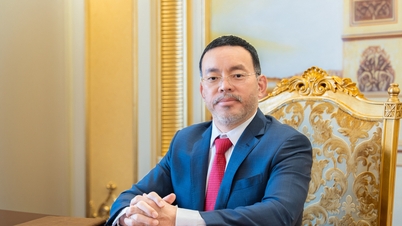
Doctor Khuat Thi Hai Oanh - Photo: DUY LINH
No podium. No microphone. Just a short walk from the elevator to another meeting room.
In those brief two minutes, she couldn't discuss global strategy or present a budget chart. Instead, she focused on the core issues of why the U.S. needs to continue supporting the Global Fund amidst a series of cuts to Washington's aid programs.
The senator remained silent. Two minutes passed, but the decision stayed. After lobbying in multiple countries, the Global Fund secured commitments of $12.6 billion for the period 2027-2029, a figure exceeding expectations, albeit reduced.
This fund will be dedicated to the prevention and control of HIV, tuberculosis, and malaria—diseases that once instilled fear in many, but which have now been alleviated thanks to the fund's support, primarily due to the efforts of those who actively campaigned for their cause.
"Giving more life" to many people.
Khuat Thi Hai Oanh, the woman in the hallway of the U.S. Congress that day, smiled, grateful for having contributed a small part to the amount received. In a context where many governments are cutting funding for international aid and development, the fact that the Global Fund received tens of billions of dollars is not simply a financial success.
For her, it was a time to "buy" more life for those whose fate would be irreversible if support were cut off.
Born into a family with a revolutionary tradition, and the daughter of Lieutenant General Khuất Duy Tiến (1931 - 2024), Dr. Khuất Thị Hải Oanh has dedicated decades to quietly working behind the scenes to ensure that medication is not in short supply and to prevent the interruption of international support for HIV/AIDS prevention and control programs in Vietnam.
The two minutes and the story at the U.S. Congress are just a small piece of the larger picture of her advocacy efforts, along with those of many other members from around the world, over the past years.
These financial figures are the result of a persistent, multi-year process of constantly shifting global priorities and increasingly fierce competition between domestic and international issues.
For Ms. Oanh, advocacy isn't about convincing others that you're right, but about making them understand why they can't turn their backs on you. Two minutes in the U.S. Congress wasn't enough to convince with logic, but it was enough to pose a moral question to the senator: What would happen if we retreated?

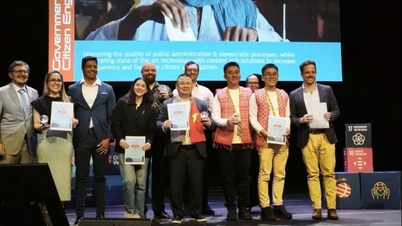
Dr. Oanh on the podium on March 10th when receiving the French Order of Merit, recognizing the efforts she and SCDI have made over the past period - Photo: Provided by the interviewee.
To enable infected people to live healthy lives.
Ms. Oanh shared that in policy advocacy, sometimes a timely story carries more weight than an entire dossier. The numbers about the consequences are not meant to cause panic. They are presented to remind us that behind every funding decision lies a chain of consequences that can last for years, even generations.
Vietnam has made remarkable progress in HIV treatment, from a time when there was virtually no medication available to a point where infected individuals can now live healthy lives and have safe children. Hundreds of thousands of people are receiving ongoing treatment.
However, behind that success, there are still vulnerable areas: second-line medicines and children's medicines – which, if purchased with government funds, are very expensive. Meanwhile, through the Global Fund – which has consistently supported second-line medicines for Vietnam – purchasing in bulk helps reduce costs while still ensuring that those in need still have access.
There are hundreds, even thousands, of advocates like her around the world. But instead of competing for a "slice of the pie" of support that is shrinking, they are striving to make that pie bigger, to create a common voice: the voice of those implementing programs in the field, of patients, and of vulnerable communities in various countries.
The journey of life
In Hai Oanh's life story, her heroic father, Khuất Duy Tiến, doesn't appear frequently. However, he is present in almost every important choice, like a quiet yet steadfast moral compass.
She recalled that when she decided to leave the military medical unit and switch to working with international organizations, he was surprised but didn't question it. He simply said: "Whatever is beneficial to the people and the country, just do it."
There was a time when she started working more with people living with HIV – a community that was once heavily stigmatized in Vietnam – and he was the first person to change.
He read the documents she brought home, the special editions filled with very real and human stories. He asked very few questions but observed very carefully, and then one day he hired a person with HIV to work in his family, asking about their well-being, caring for them, and treating them like family.
Everyone assumed that, as the daughter of a soldier, a general who had participated in two major national resistance wars in the 20th century, she must have heard the most about the hardships and difficulties. She listened, but couldn't fully grasp those fragments until one day she set foot on Hill 1015 (Charlie Hill) in Kon Tum province.
The local official recounted the story of a family who, while scavenging for scrap metal, were all killed by unexploded bombs left over from the war. A memorial was erected on Hill 1015, where, during construction, only crowbars were used instead of hoes, shovels, or bulldozers because everywhere lay the remains of heroes who had fought to the death for the independence and unification of the Fatherland.
A question lingered in her mind: What would happen if, in the future, those who emerged from the war were already at peace? That question prompted her to begin a project to collect fragments of war so that future generations would remember and understand the value of independence, peace, and national unity.
One thing Ms. Oanh rarely talks about is her special family, with her father being a Lieutenant General and Hero of the People's Armed Forces, her eldest son (Ms. Oanh's eldest brother) also being a military general, and her three children, including Dr. Hai Oanh, all actively contributing to the community and to life.
Ted Hammett, a former U.S. Marine who served in Vietnam and former Project Director of HPI Vietnam/Abt Associates USA on HIV/AIDS prevention:
A woman passionate about community service.
I first met Oanh in 2007, when I returned to Vietnam and decided to settle in Hanoi for HIV/AIDS prevention and control projects. Oanh never told me that she was the daughter of General Khuất Duy Tiến.
I only learned about that when he passed away in 2024. For me, whether she is General Tien's daughter or not doesn't affect the work between me and Oanh. She has demonstrated her capabilities, a woman who is always passionate about her work and cherishes goals that benefit the community, from her time in public health to now at SCDI.
"A place for nurturing"
In addition to her advocacy work within the Global Fund, Dr. Khuat Thi Hai Oanh is currently the head of the Center for Supporting Community Development Initiatives (SCDI).
Her small office in Hanoi is a place where the dreams of many people living with HIV are nurtured. In addition, the program she is currently pursuing aims to support children in general from very early stages: nutrition for pregnant mothers, childcare, to life skills education and social integration for children living in remote areas.
The upcoming program will take place in four communes in the Central Highlands and will continue until the children enter university. The total number of disadvantaged people that SCDI supports in Vietnam currently amounts to approximately 40,000.
LAN ANH - DUY LINH
Source: https://tuoitre.vn/nguoi-con-gai-dac-biet-cua-vi-anh-hung-20260321093451252.htm
















































































Comment (0)