

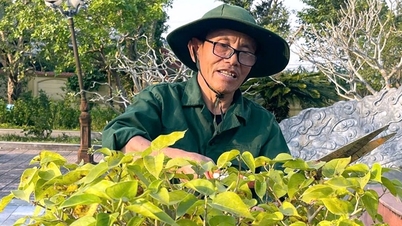
As one of the households supported by the Union of Science and Technology Associations of the city and the Green Vietnam Biodiversity Conservation Center with over 1,000 black star trees to plant on an area of more than 1 hectare, Mr. Thieu Song (Dong Lam village) said that after 6 months of planting and caring for them, most of the seedlings have developed steadily with an average height of 2-3m.
To ensure the trees grow well, he spends a few days each month clearing undergrowth, removing weeds, checking for pests and diseases, and fertilizing regularly. Alongside planting the black ebony trees, he dedicates 1.5 hectares of the forest edge to maintaining acacia cultivation to stabilize his family's finances . He says that while waiting for the black ebony trees to grow, his family continues to earn income from the acacia trees to cover living expenses and reinvest in the large timber forest. Combining perennial and short-term crops helps him secure his immediate livelihood while working towards the long-term goal of sustainable forest development.
“Acacia trees can be harvested in just 4-5 years, while large timber trees take 15-20 years, or even longer. Therefore, the family needs to focus on short-term goals to provide for basic needs, and long-term goals to nurture the land and preserve the forest. Preserving the forest means preserving a livelihood for future generations,” Mr. Song shared.
Along with Mr. Song, many other farmers in Dong Lam and Phu Tuc villages have boldly converted a few acres to several hectares of land previously used for acacia cultivation to planting black ebony, red sandalwood, rosewood, sandalwood, and green lim trees. Mr. Tran Van Viet (Phu Tuc village) said that his family has 4 hectares of acacia land waiting to be harvested. From 2024, through the encouragement of the local authorities, he is planning to convert a portion of the land from acacia trees to fruit trees and large timber trees to focus on developing the economy under the forest canopy.
Similarly, Mr. Huynh Tan Phap, Executive Director of Toom Sara Village (Phu Tuc hamlet), said that the unit is actively encouraging people to participate in the "Forest, Breathe!" project. Accordingly, starting in March, Toom Sara Village will dedicate 93% of its forest land (approximately 70 hectares) to planting Shorea spp. trees and some native trees to create a sustainable landscape and livelihood for the Co Tu community.
Mr. Phap believes that replacing acacia trees with large timber trees is a crucial choice for both the environment and local culture. Having been closely associated with the Co Tu community in Phu Tuc village for many years, he understands the changes in their lifestyles, livelihoods, and the relationship between people and the forest. According to him, the Co Tu people traditionally lived in harmony with nature, considering the forest their common home and the source of life. However, as natural forests shrink and trees are replaced by short-term acacia plantations, that sacred relationship gradually fades. “To get the community back to preserving the forest, we must first help people see the benefits of preserving it. Planting large timber trees is a way to restore the value of the forest while creating a stable, long-term income,” Mr. Phap affirmed.
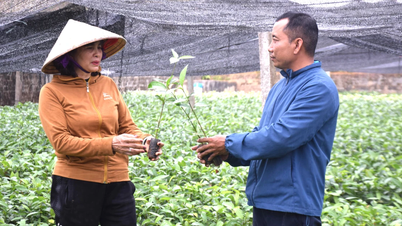
After three years of implementing the large-timber tree planting model, the People's Committee of Hoa Phu commune has mobilized people to replace old trees on an area of over 200 hectares. Mr. Nguyen Hai Cuong, Vice Chairman of the People's Committee of Hoa Phu commune, said that they are continuing to encourage people to cooperate in planting fruit trees and large-timber trees to replace production forests, as well as combining livestock farming under the forest canopy to develop the economy. To create consensus, the locality regularly coordinates with units to provide technical support, seedlings, and training in tree care skills for people, while also reviewing suitable land to expand the area for planting large-timber forests in a planned manner.
Currently, the commune has identified the planting of large timber forests as a long-term strategy linked to environmental protection, water conservation, erosion control, and sustainable income improvement for the people. Along with this, the locality continues to guide the community in accessing the carbon credit market and exploiting forest environmental services to generate stable income from planting and preserving forests in the future.
HUYNH LE
Source: https://baodanang.vn/xa-hoi/202504/nguoi-dan-xa-hoa-phu-no-luc-trong-cay-go-lon-4004593/
![[Photo] Prime Minister Pham Minh Chinh presides over a meeting on private sector economic development.](/_next/image?url=https%3A%2F%2Fvphoto.vietnam.vn%2Fthumb%2F1200x675%2Fvietnam%2Fresource%2FIMAGE%2F2025%2F12%2F20%2F1766237501876_thiet-ke-chua-co-ten-40-png.webp&w=3840&q=75)









































































Comment (0)