

Ms. Khanh has been involved in weaving Thai scarves for about 50 years. Each thread that glides through her hands evokes many memories. She confided, "This craft of mine comes from my family. Since I was little, I learned weaving from my parents, starting with raising silkworms." Looking at the spool of colored thread on the spinning wheel, she said, "Nowadays, things are easier. I buy the colored thread ready-made and just weave. In the past, I had to raise each silkworm individually and gather mulberry leaves for them to eat. It took about a month to get the silk to make the scarves."
In the past, making a Thai scarf required many meticulous steps: raising silkworms, spinning yarn, dyeing with indigo, weaving, and embroidering. All the patterns were hand-embroidered, so it took many months to complete. With skillful hands and endless creativity, Mrs. Khanh found a way to overcome the drawbacks of hand embroidery. Speaking of this improvement, she said proudly: "In the past, we had to embroider every single detail by hand. Now it's different. I pick each colored thread myself, then weave the patterns directly onto the loom. With just a flick of my wrist, the patterns appear on the fabric. Thanks to this, the time to make a scarf has been reduced to only about 10 days to a month."
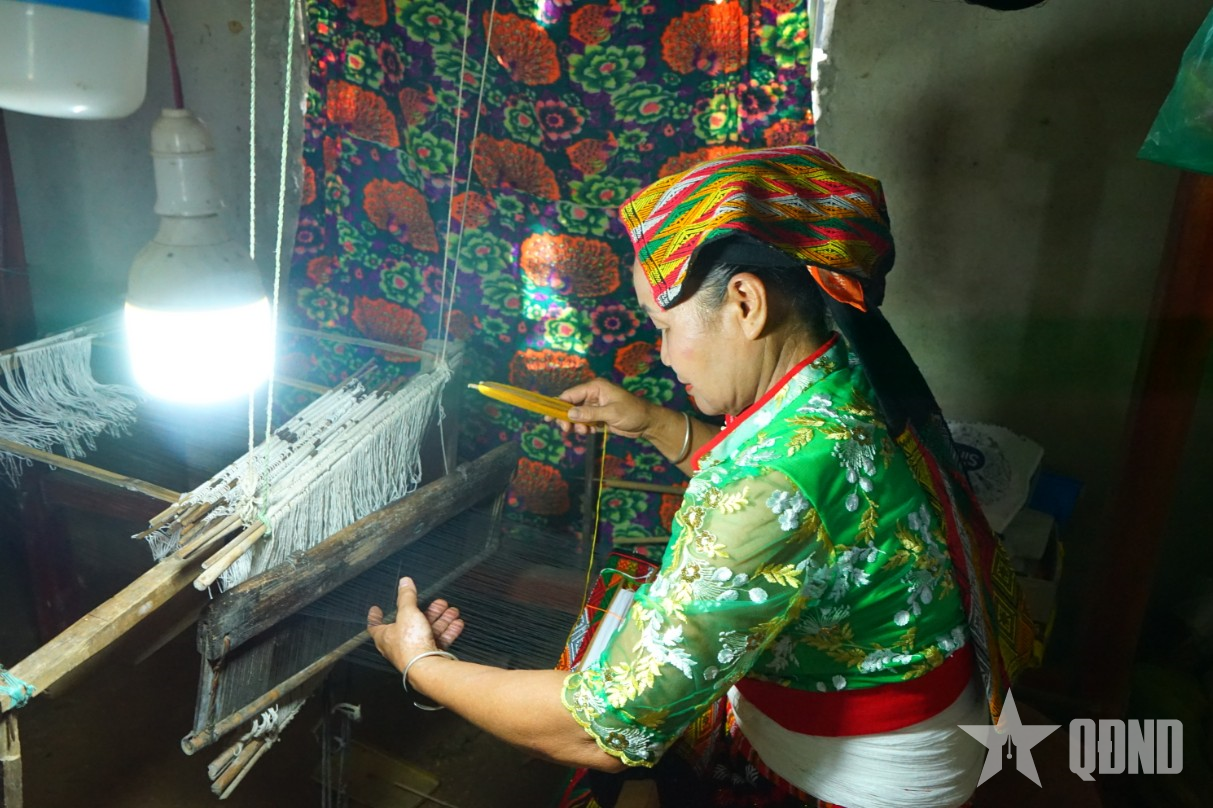 |
Ms. Lo Thi Khanh works diligently at her loom. |
Sitting by the loom, following the creaking rhythm of the weaving, Mrs. Khanh hummed a Thai folk song: “My dear/ Look up at the forest, I see so much firewood/ I wish we could gather firewood together/ Look up at the forest, I see so much wood/ I wish we could make a loom for you to spin silk.” In Thai culture, nature is considered an integral part of their being. Mrs. Khanh explained: “In the old days, the elders would go to work in the fields, on the hillsides, by the rivers and streams… whatever they saw around them, they would weave accordingly.” For example, the image of a crab's leg would be incorporated into the scarf through the shuttle-like lines. Through generations, descendants have inherited and added new patterns. The five colors on the scarf represent the five breaths of nature: green of leaves, white of clouds, red of the sun, yellow and orange of forest flowers.
Each region of the Thai people possesses its own unique cultural characteristics. These values contribute to the diverse tapestry of Vietnamese culture. However, in Thanh Ky commune, the craft of weaving Thai scarves is gradually fading away, with the majority of those preserving the tradition being middle-aged women and elderly people. Facing this threat, the local government has opened a vocational training class in the commune, equipped with 10 new looms and all the necessary tools. Ms. Lo Thi Khanh has become the "passer-on," personally instructing the women on how to spin yarn and weave patterns. Her small class has 25 students, who, upon completion, will receive a weaving certificate as recognition for carrying on the tradition.
The small lamplight shone down on the loom, illuminating the sun-tanned face of the Thai ethnic woman. When asked if the job was hard and if she ever felt discouraged, Mrs. Khanh smiled and replied, "I stopped weaving scarves more than ten years ago. But thinking about the time when no one in my Thai hometown knows how to weave anymore, I get scared. Now I do it out of passion, hoping to preserve the craft of my ancestors so that my children and grandchildren can still know and practice it."
With that belief, the creaking sound of Mrs. Khanh's loom resonates, weaving together the memories, beliefs, and soul of the Thai ethnic people of this region.
Source: https://www.qdnd.vn/van-hoa/doi-song/nguoi-giu-lua-nghe-theu-dan-toc-thai-1027360


















![[Photo] Reception to welcome General Secretary and President To Lam and his wife on their State visit to the Philippines](https://vphoto.vietnam.vn/thumb/1200x675/vietnam/resource/IMAGE/2026/06/01/1780295488620_vna-potal-chieu-dai-chao-mung-tong-bi-thu-chu-tich-nuoc-to-lam-va-phu-nhan-tham-cap-nha-nuoc-toi-philippines-8798060-7855-jpg.webp)

















































Comment (0)