

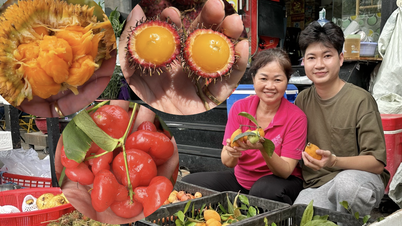
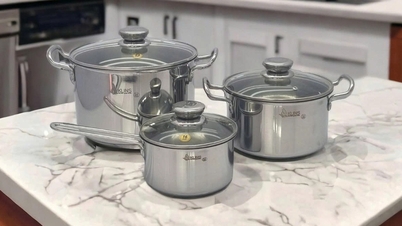
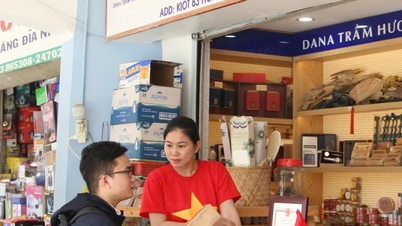
With the help of the government and charitable organizations, the people have stabilized their lives. Everyone is getting back on their feet, preparing to plant seeds, grow vegetables, and tend to their gardens, flowers, and fruits in time for Tet (Lunar New Year). Merchants and market stall owners are starting to source goods, such as pots and pans, candies, pickled onions, dried bamboo shoots, and garlic, to ensure a bustling Tet celebration. One woman is searching for and buying sour tamarind to place a deposit, harvest it, and then resell it to vendors at the market who peel it and make pickled tamarind jam.
Hearing her mention tamarind jam made me feel nostalgic. I remembered when I was still living in the countryside, going to my aunt's house to help make jam for Tet (Vietnamese New Year).
Candied fruits, made with carrots, tomatoes, pineapple, and primarily papaya, are produced year-round to supply fruit dessert shops. Carrots and papayas are shredded and soaked in lime water. Tomatoes are deseeded, and pineapples are de-eyed and sliced into small pieces. Star fruit is collected in large sacks by the women. We sit and sort the fruits into small and large portions. The hardest part is scrubbing them on a serrated cutting board. We have to scrub with just enough force to gently break the star fruit, allowing us to squeeze out the juice without crushing it. Coconut jam seems easier. We split mature coconuts with thick flesh in half. Then, we use a double-edged knife to slice them thinly, and soak them in lime water to make the coconut flesh chewy and crispy, preventing it from becoming soft, reducing the amount of liquid released during cooking, and extending its shelf life. Each type of jam is placed in a bowl, mixed with granulated sugar, and left overnight to absorb the flavors.
At dawn, a dozen charcoal stoves blazed, each with a pot of various jams on top. We rushed from one pot to another, our hands moving swiftly, mixing, stirring, and churning in the first few minutes. After making sure the sugar had slightly soaked in, we used chopsticks to push the jam to the sides, leaving a hole in the center for the syrup to drain, then each of us scooped a spoonful and poured it evenly over the jam. Every half hour, we remembered to mix the jam with sugar, then push it back to the sides as before. After the third mixing, the syrup was ready. The jam was soft and sticky, clinging together. We added red food coloring to the star fruit, then mixed it in so that every fruit was coated. The coconut jam was even more colorful, each pot a different eye-catching shade. Throughout December, the whole family ate and slept with jams. Sometimes the smell of sugar was frightening, but we still had to make them.
The plump, sour unripe tamarind fruits are quickly peeled by the women at Dinh Market, then soaked in salt water. Many people boil granulated sugar, let it cool, then put the tamarind into jars and pour in the sugar water. This allows the tamarind to absorb the sugar faster, but if left for too long, it will become slimy and ferment, spoiling quickly. My mother is different; she uses raw white granulated sugar. She arranges each fruit vertically in a glass jar. She adds sugar at a ratio of one kilogram of tamarind to one kilogram of sugar, then carefully covers the jar and keeps it in a cool place. The next day, the acidity causes the sugar to dissolve and soak into the plump tamarind fruits. Taking a bite, the sweet and sour flavors blend together, tingling the tongue. Successful pickled tamarind is when the flesh separates from the seed when eaten. If it's still sticky, then... throw it away and make another jar.
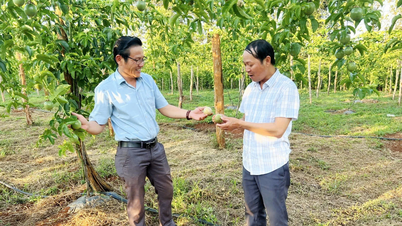
The jam-making trade in my village has been struggling for over a decade because people treat each other to expensive sweets and candies during Tet (Lunar New Year). Traditional jams have almost disappeared, failing to keep up with the times, except for pickled tamarind, which remains popular. People in Ninh Hoa grow star fruit everywhere, but they always discard the fruit, only selling the leaves for wrapping fermented pork rolls. But at the end of the year, the jam-making households become busier. The scent of lime and sugar wafts gently in the breeze. They sell their jams to many families who still maintain the tradition of offering traditional jams to their ancestors. Or for nostalgic people like me, living far from home, returning to my hometown during the spring holidays, I crave some candied pumpkin and coconut, then switch to chewy jam, fragrant jam, and add a piece of spicy ginger to warm my stomach.
Source: https://thanhnien.vn/nhan-dam-mua-mut-xu-minh-185251227154515604.htm




![[Photo] General Secretary and President To Lam and the President of the Philippines hold talks.](https://vphoto.vietnam.vn/thumb/1200x675/vietnam/resource/IMAGE/2026/06/01/1780286997787_anh-man-hinh-2026-06-01-luc-11-09-43.png)
























































































Comment (0)