

Yen Bai - From rice grains - a familiar raw material - the people of Yen Bai have skillfully created products that not only reflect their unique identity and preserve traditions but also open up opportunities for economic development, enriching the value of rice and contributing to bringing highland rice to a wider market.
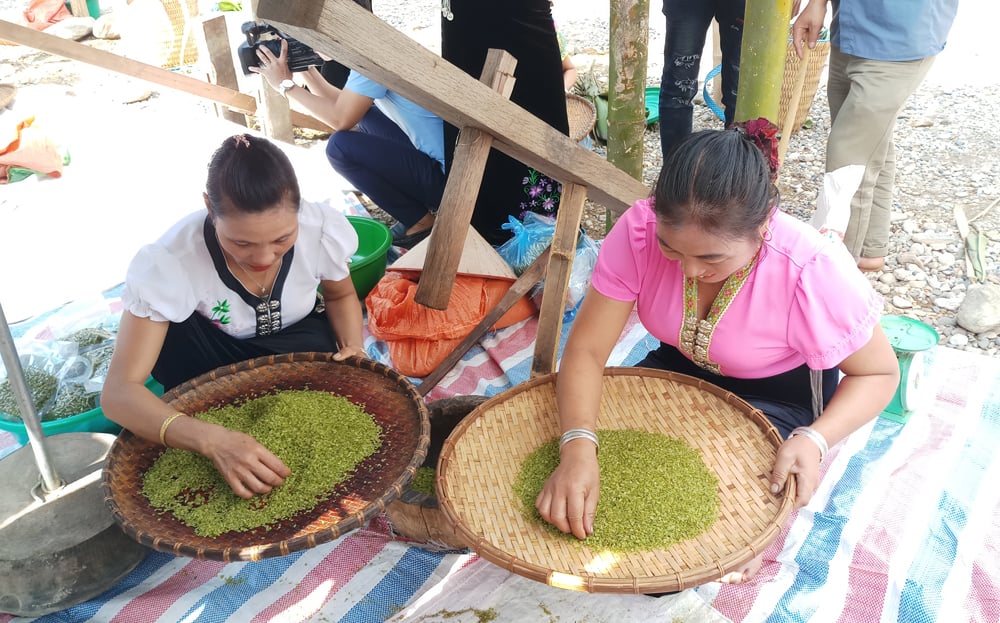 |
People in Tu Le commune, Van Chan district, make sticky rice flakes (com). |
Following a group of tourists to Muong Lo – the second largest rice granary in the Northwest region – everyone was amazed by the rustic beauty of the lush, verdant rice fields stretching as far as the eye could see. Nourished by the cool, refreshing streams, the rice grains here are plump, sticky, and fragrant, possessing a distinctive, rich, and unforgettable flavor. From this rice, the people of Muong Lo have created dishes and snacks such as five-colored sticky rice and black sticky rice cakes.
Tourist Nguyen Duc Vinh from Nghe An province said: "During our 3-day stay in Muong Lo, every day we enjoyed dishes cooked and presented exquisitely by the local Thai people. The five-colored sticky rice, with its white, red, green, purple, and yellow hues created from various forest leaves and roots, was very eye-catching and impressive. The sweet and fragrant flavor of the sticky rice combined with grilled meat marinated in spicy mac khen spice was truly a captivating culinary experience."
Not only in Muong Lo, but in many other localities throughout the province, people have transformed rice grains into processed products with high added value. In Tu Le commune, Van Chan district, products such as Tu Le sticky rice flakes and "khau hang" (a type of sticky rice cake) have become specialties of this highland region. Sticky rice flakes here are still produced to preserve the essence of traditional methods.
Rice must be harvested early in the morning, then soaked in cold water to remove the empty grains. The rice used for making puffed rice must be in the heading stage, with a little milk still in the grain, a slightly yellowish husk, and the grains not yet fully ripe. It must be processed on the same day it is harvested. After removing the empty grains, the rice is roasted in a large pan. The fire must be maintained evenly for about 30 minutes until the grains crack and release a fragrant aroma.
According to Thai tradition, this is a crucial step that determines the deliciousness of the roasted rice flakes. If the heat is too high, the flakes will become hard; if the heat is too low, they will lose their chewiness. After roasting, the rice is left to cool before being pounded in a stone mortar. Nowadays, Tú Lệ roasted rice flakes, after being produced using traditional methods, are vacuum-sealed and stored in the freezer, helping the product maintain its distinctive flavor, making it easy to buy as a gift, and allowing for long-term storage.
Ms. Ha Thi Sy, who has been involved in the rice flake making profession for many years in Nuoc Nong village, Tu Le commune, shared: "Before vacuum packaging, customers only bought a small amount to eat immediately. Now, with the application of traditional production methods and modern preservation techniques, tourists buy a lot. Almost every tourist group that comes to Tu Le during the rice flake season buys a few kilograms as gifts. Many groups even enjoy participating in the rice flake making experience."
Along with the aforementioned products, other processed products such as crispy fried dough sticks and fragrant longan-shaped cakes from Tu Le commune, Van Chan district; sticky rice cakes from the Mong ethnic group in various localities throughout the province; and brown rice noodles from Yen Thai commune, Van Yen district are also gradually establishing their position in the market.
The diversity in processing methods has expanded the consumer market, helping to spread Yen Bai 's traditional culinary culture throughout the country. In addition, to make processed rice products more successful and reach a wider market, local authorities and relevant departments in the province have built a strong connection between production and consumption.
Rice products are distributed through modern channels such as supermarkets, organic food stores, and e-commerce platforms, expanding their reach to large markets. In particular, trade promotion programs, food fairs, and tourism events related to rice, such as the Mu Cang Chai New Rice Festival, the Tu Le Rice Flake Festival, and the Dong Cuong Temple New Rice Festival, have been organized by local authorities, contributing to the widespread promotion of the image of Yen Bai's highland rice.
Thanks to the combination of tradition and modernity, and creativity, the rice grains from the highlands of Yen Bai have been enhanced in terms of flavor in each product. The flavor of each product has become a bridge connecting the beauty of highland cuisine to tourists from all over the world, opening up many new prospects and contributing to the solid progress of the agricultural economy and the preservation of cultural heritage.
Le Thuong
Source: http://baoyenbai.com.vn/12/347738/Nhan-len-gia-tri-hat-gao-vung-cao.aspx

![[Photo] General Secretary and President To Lam meets with National Assembly delegates from ethnic minorities.](https://vphoto.vietnam.vn/thumb/1200x675/vietnam/resource/IMAGE/2026/04/20/1776696701056_a1-bnd-8331-3342-jpg.webp)

![[Image] National Assembly discusses the implementation of the socio-economic development plan.](https://vphoto.vietnam.vn/thumb/1200x675/vietnam/resource/IMAGE/2026/04/20/1776696707422_ndo_br_img-20260420-185419-jpg.webp)
















































Comment (0)