Japan is adding computer science as a subject, while South Korea is exploring integrating it into the university entrance exam in the next few years.
In Japan, the university entrance exam typically includes Japanese language, natural sciences (physics, chemistry, biology), social sciences (history, economics , civics), and mathematics. Starting in January 2025, Japan will add Information 1 to the exam. This subject covers fundamental knowledge of programming, information networks, communication, and databases.
This move aims to provide students with a greater understanding of advanced technology, helping to meet the high demand for computer skills.
The Japanese Ministry of Education announced that Information Science I has become a compulsory subject in secondary schools since 2022. As of May last year, approximately 83% of information science teachers in public secondary schools nationwide held teaching certifications for this subject.
In South Korea, the Ministry of Education is proposing to integrate several elective subjects into the college entrance examination (CSAT), also known as Suneung, starting in 2028, to reduce pressure on test-takers. Test-takers will take Korean language, mathematics, social sciences, natural sciences, and vocational education—three fewer subjects than currently. Scores will be calculated on a scale of 1 to 9.
The integration aims to avoid situations where different subjects have varying levels of difficulty, thereby increasing fairness.
Specifically, currently, in the Math exam, candidates must complete two parts: general questions and optional questions. According to statistics, nearly half of the candidates taking the upcoming exam will choose Calculus because it is considered an easier subject to score well on compared to Probability and Statistics or Geometry.
"The barriers between subjects will be removed, and students will be assessed holistically to encourage critical thinking on the broader aspects of Natural and Social Sciences," said Lee Ju Ho, South Korea's Minister of Education.
Similarly, elective subjects such as Speaking and Writing, Language and Media will be integrated into the Korean language test.
The ministry also proposed creating an advanced mathematics subject, including Calculus 2 and Geometry, for the exam to identify and nurture talent for advanced industries.



Minister Lee Ju Ho stated that the reform of the college entrance examination aims to train human resources for the future in a rapidly changing society, helping students to orient their career paths and develop their strengths.
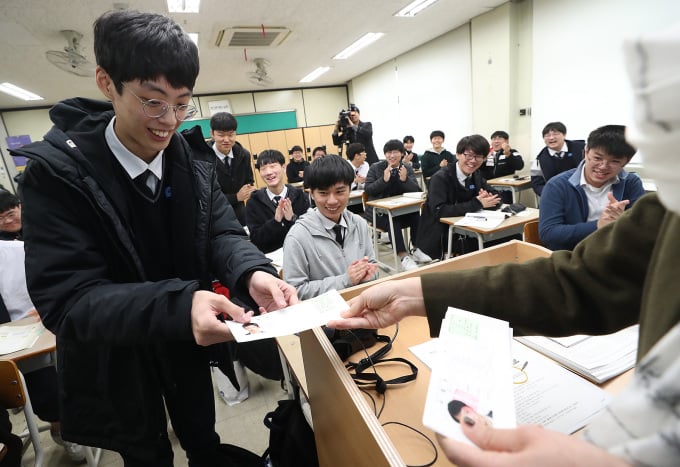
Students receive their identification documents before the 2019 university entrance exam in South Korea. Photo: Yonhap
Experts believe that Japan and South Korea's reforms to the university entrance exam are in line with global trends.
"It's no surprise that Japan and South Korea are reforming their national college entrance exams. This is part of a global trend; China has already changed its gaokao exam, primarily by reducing the focus on English," observes Philip Altbach, a professor at Boston University in the United States.
Hiroshi Ota, a professor at Hitotsubashi University in Japan, said the changes reflect the reality that relying solely on a single testing system to determine university admissions is no longer appropriate in the current context.
"This university entrance examination system will restrict the autonomy of universities. Universities should decide their own admissions," he said, noting that not many countries conduct university admissions through a nationwide exam.
Conversely, many are skeptical about the exam adjustments. Takuya Kimura, a professor at the School of Education at Kyushu University in Japan, fears that the goal of having all students study information technology will be achieved by adding this subject to the exam.
"Students often don't care about what they don't study for exams, even when they get into university. And the gap between students who are capable of learning information-based subjects and those who are not will only widen," he said.
Professor Altbach argues that changes are always controversial. "There has been a lot of criticism in the U.S. about the SAT and ACT college entrance exams, and these two tests have become optional at many universities or have even been omitted," he cited as an example.



In Japan, some universities, such as Hokkaido University, Tokushima University, and Kagawa University, are currently considering excluding Information Science I from the total score of applicants during the admissions process. The reason given is that during the transition period, the universities cannot predict exam trends, and the difficulty level of the exam is often inconsistent.
"Tokushima University plans to grade Information I from the 2027 entrance examination. We will review it after analyzing the actual academic performance of new students," a Hokkaido official said.
In South Korea, the Ministry of Education plans to finalize the reform of the university entrance examination by the end of this year, following further discussions with the National Education Commission and relevant stakeholders.
Similar to China, the university entrance exam in Japan and South Korea is the most important exam for high school students. Their future is considered to depend largely on these scores: from university admission to employment and income.
By Doan Hung (Based on THE, Japantimes, Korea Joongang Daily)
Source link



![[Photo] "Hanoi Lotus Festival" honors the lotus flower that has been associated with Vietnam for thousands of years.](https://vphoto.vietnam.vn/thumb/1200x675/vietnam/resource/IMAGE/2026/06/27/1782516943048_sen-ha-noi-2026-minh-duy-1-jpg.webp)