

The notoriously competitive university entrance exam in South Korea will be reformed to reduce the number of subjects, integrate different subjects, and include an advanced mathematics exam specifically for top-performing students.
The South Korean Ministry of Education announced on October 10th a plan to revise the content of the Suneung University entrance exam (or CSAT). To allow students and parents time to prepare, the plan will take effect after four years.
With the new examination format, the number of subjects is reduced through the integration of many elective subjects. University entrance exam subjects will include Vietnamese Language, Mathematics, Natural Sciences , Social Sciences, and Vocational Education. This integration aims to avoid situations where different subjects have varying levels of difficulty, thus increasing fairness.
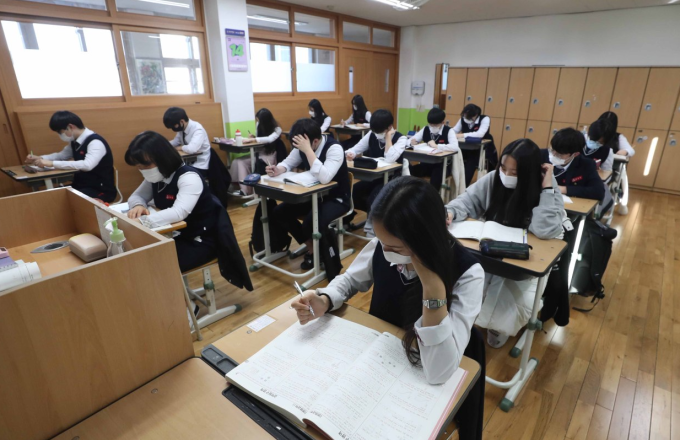
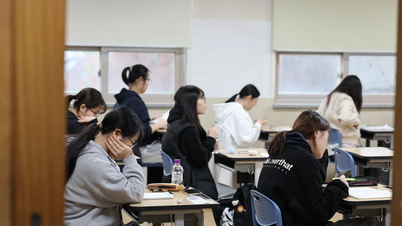
Students at Happo High School in South Gyeongsang Province, South Korea, prepare for the university entrance exam in November 2021. Photo: Yonhap
Specifically, currently, in the Math exam, candidates must complete two parts: general questions and optional questions. According to statistics, nearly half of the candidates taking the upcoming exam will choose Calculus because it is considered an easier subject to score well on compared to Probability and Statistics or Geometry.
"The barriers between subjects will be removed, and students will be assessed holistically to encourage critical thinking on the broader aspects of Natural and Social Sciences," said Lee Ju Ho, South Korea's Minister of Education.
Similarly, elective subjects such as Speaking and Writing, Language and Media will be integrated into the National Language exam.
Textbooks and curricula, including 17 elective subjects in natural sciences and humanities, are also integrated. The Ministry of Education will release sample exam questions based on the new structure in the second half of next year so that students can familiarize themselves with the new exam format.
50% of the questions in the Suneung exam are based on content taught on EBS, the national television channel specializing in education, allowing candidates to self-study without relying on private tutoring centers.
The ministry also proposed creating an advanced mathematics subject, including Calculus 2 and Geometry, for the exam to identify and nurture talent for advanced industries.
Minister Lee Ju Ho stated that the reform of the college entrance examination aims to train human resources for the future in a rapidly changing society, helping students to orient their career paths and develop their strengths.
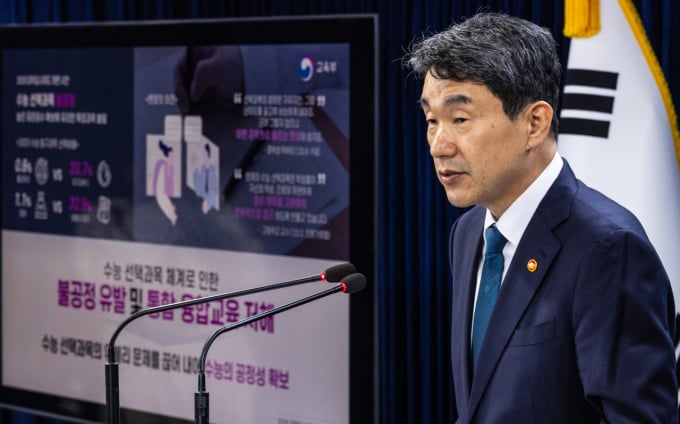
Education Minister Lee Ju Ho at a press conference on changes to the college entrance exam, October 10. Photo: Yonhap
As part of the reform plan, high schools are also undergoing a major change: from 2025, they will use a 5-point grading scale from A to E, instead of the current 9-point scale.
The new grading system will be based on specific criteria at each score threshold to help students more easily achieve an A grade. Currently, in each subject, scores classify students into 9 groups, and only those in the highest group (Group 1) are admitted to prestigious universities. The competition is very high, with only 4% of students being classified in Group 1, equivalent to an A+.
Furthermore, to eliminate clandestine dealings between public and private education institutions regarding the exchange and sale of university entrance exam questions, the National Exam Question Council will consist only of individuals with no connection to private educational institutions. They will be randomly selected from a vetted pool of candidates.
The Ministry of Education will request the National Tax Service to provide information on the tax returns of these members, to see if they have any other sources of income, such as from selling exam papers. Members of the exam board are also prohibited from receiving benefits from the private education sector for five years.
The South Korean Ministry of Education expects to finalize the content of reforms to the university entrance examination by the end of this year, after further discussions with the National Education Commission and relevant parties.
Phuong Anh (According to Korea Herald, KBS )
Source link


























































Comment (0)