Over 30 years of dedication to specialty coffee beans.
"Why is it that Arabica coffee, which is also Arabica, sells for the highest price in the world in Brazil , while in Son La, for many years, coffee beans have been struggling to find their place in the market?"
That question had haunted Mr. Nguyen Xuan Thao, Director of Bich Thao Coffee Cooperative, throughout his long journey with coffee cultivation. In the context of Son La's persistent efforts to restructure crop production on sloping land, maintaining and developing over 21,000 hectares of Arabica coffee – the largest area in the country – became a major experiment. And Mr. Thao chose to embark on that experiment with the aspiration to change the fate of Son La's Arabica coffee.

Arabica coffee grown on the sloping land of Son La. Photo: Tung Dinh.
Having been involved with coffee for over 30 years, Mr. Thao was dissatisfied with the fact that Son La Arabica, despite having equally favorable natural conditions, remained stuck in the low-price segment. It wasn't until he researched Brazilian coffee production methods – a country that had been growing coffee for nearly 250 years before Vietnam – that his concerns were finally addressed. The problem wasn't with the coffee plant itself, but with how people treated it. The key issue lay in processing, in the matter of product standards and quality.
It all started in 2016, when Mr. Thao founded the Bich Thao Coffee Cooperative, the first coffee cooperative in Son La province. Immediately, he began to change the way coffee is produced from the ground up. He shifted from traditional to organic production, from short-term fermentation to natural fermentation, and from mass-produced commercial coffee to specialty coffee.
He invited scientists to analyze the soil and provide technical advice, then traveled all the way to the Central Highlands to research and bring back new coffee varieties that were more resistant to climate change, less susceptible to pests and diseases, and had higher yields.

Mr. Nguyen Xuan Thao has always been deeply concerned about specialty coffee. Photo: Tung Dinh.
However, according to Mr. Thao, the biggest challenge is changing the habits of the local people. Previously, the harvesting, processing, and fermentation stages only took a little over ten hours, but now they take a minimum of 30-40 hours, depending heavily on the ambient temperature. After that, the coffee is carefully selected, dried to the standard moisture level, and then aged in a warehouse for about 60-90 days before hulling.
The new process is much more labor-intensive and time-consuming. But in return, the Bich Thao Coffee Cooperative is gradually perfecting its natural fermentation technique to highlight and develop the natural flavor layers in Arabica beans. This has resulted in different flavor profiles, suitable for various markets.

Coffee trees bloom amidst the mountains and forests of Northwest Vietnam. Photo: Trung Hieu.
To date, the Bich Thao Coffee Cooperative has developed over 150 hectares of specialty coffee plantations owned by its member households, along with 1,500 hectares under partnership with approximately 800 households. Each year, the cooperative purchases, processes, sells, and exports about 6,000 tons of green coffee beans, along with several batches of specialty coffee, at a common price of around 230,000 VND/kg. Bich Thao coffee products are present in more than 20 countries, with the US market accounting for a large proportion.
The essence of Son La Arabica and a cup of coffee in the early morning mist.
When mentioning Son La, the story of its coffee transcends the realm of a mere product to tell of the natural conditions, the people, and the aspirations of an entire region. Nature has bestowed upon Son La a rare climate and soil, sufficient for Arabica coffee plants to take root and thrive on slopes seemingly accustomed only to corn and cassava.
Before the 1990s, the livelihoods of the local people were mainly tied to short-term food crops, resulting in unstable incomes heavily dependent on the weather. When coffee plants began to be introduced to the hillsides, the initial economic benefits quickly showed a different direction. Compared to short-term crops, coffee yields higher income with lower investment and care costs, making it suitable for mountainous production conditions. Since then, coffee has gradually covered the hillsides, becoming a familiar part of the farming landscape of Son La.


The THA1 coffee variety is highly adaptable to harsh climatic conditions and grows vigorously. Photo: Duc Binh.
The mountainous terrain, interspersed with basins and plateaus, has created distinctive Arabica-growing regions. Son La coffee primarily grows on slopes at the foot of low mountains or on shallow hills, at altitudes ranging from 900 to 1,200 meters above sea level. The climate, with abundant rainfall, low temperatures, and a significant diurnal temperature range, allows the Arabica coffee plants to grow slowly, accumulating flavor and resulting in a unique quality.
It is no coincidence that Son La has become the second largest Arabica coffee-producing province in the country, after Lam Dong. Today, coffee is found throughout the hills and valleys, interspersed among fruit orchards, becoming an important industrial crop that contributes significantly to local economic development, provides stable livelihoods for farmers, and supplies raw materials for processing businesses.
Arabica coffee from Son La boasts a natural, fruity aroma, a refreshing acidity, a hint of mild bitterness, and a clean aftertaste. These characteristics are not only recognized by consumers but also protected by geographical indication, opening the door to increased value and gradually establishing its position on the world coffee map.
Arabica coffee brings high economic value to the people of Son La. Photo: Duc Binh.
According to data from the Son La province's agricultural sector, the current coffee growing area is nearly 20,800 hectares, of which more than 17,700 hectares are already producing crops. Along with stabilizing the planted area, the locality is aiming to expand the raw material area to approximately 25,000 hectares, focusing on developing sustainable coffee growing areas that meet standards, linked to deep processing and value enhancement.
Overcoming mountains and hills to reach the world.
If, on the hillsides of Son La, Arabica coffee needs its potential "awakened" through a different approach, then to go further, Mr. Nguyen Xuan Thao understands that Bich Thao coffee must embark on a new path, mastering the varieties, science, technology, and modern production techniques. Only through this path will Son La specialty coffee have the foundation to conquer and stand firm in the most demanding markets.

Bich Thao's pure ground coffee product has been recognized as a 5-star national OCOP product. Photo: Trung Hieu.
Instead of chasing quantity, Bich Thao chose a path focused on quality and sustainable development. In early 2021, the cooperative began construction of a coffee processing plant spanning nearly 1,120 square meters, with a capacity of 20 tons of green coffee beans per day and a total investment of 16 billion VND. The plant is designed with a closed-loop process, from preliminary processing to roasting and grinding, using modern machinery such as size and weight sieves, German and American color sorting machines, and a product storage and display area. This is considered the foundation for Bich Thao to consistently control the quality of each batch of coffee.
Alongside investing in the factory, the cooperative has persistently changed its cultivation and processing methods. Coffee is grown organically, using bio-fertilizers and minimizing the use of chemicals. After harvesting, the coffee beans are processed using a waterless method, dried in greenhouses, which helps preserve the essence of the bean while minimizing waste and reducing environmental pollution. As a result, Bich Thao green coffee beans always have a uniform color, stable quality, and high commercial value.
Starting from a clean production foundation, Bich Thao's coffee products are produced according to VietGAP standards and the technical requirements of importing partners such as Germany, the US, and France. But for Mr. Nguyen Xuan Thao, going further means not wasting any value of the coffee bean.
Recognizing international consumer trends, since 2018, the cooperative has received technology transfer from German and American experts to research and produce coffee bean tea from coffee husks. This product, also known as Cascara tea, is popular with consumers due to its natural sweetness and low antioxidant and caffeine content. After a trial period, Bich Thao's Cascara tea has been successfully exported to France, Germany, and the United States.

The coffee fruit tea product has been certified with OCOP 4-star rating. Photo: Tung Dinh.
The production process of coffee bean tea is strictly controlled from the harvesting stage. 100% of the coffee beans must be ripe red and harvested within a specific timeframe to preserve the natural sugar content in the husk. After washing and drying, the coffee beans are hulled using a waterless method, avoiding environmental pollution. The husks become the raw material for tea production, while the beans are further processed into honey coffee, creating a closed value chain.



Along with processing, Bich Thao places special emphasis on seed selection, a fundamental factor determining long-term quality. Since 2018, the cooperative has collaborated with the Western Highlands Agricultural and Forestry Science and Technology Institute to conduct trial plantings of 15 hectares of the new THA1 Arabica coffee variety under the National Coffee Development Program. Following initial positive results, in 2020, the area planted with the new variety was expanded by an additional 40 hectares with THA1, TN6, TN7, and TN9 varieties, bringing the total area of new coffee varieties to 60 hectares, of which 20 hectares have already yielded their first harvest.
To ensure a reliable source of seedlings for farmers, in 2021, the cooperative continued to invest in building a 1,000 m2 THA1 seedling nursery. According to Mr. Nguyen Xuan Thao, this new coffee variety has good adaptability to harsh climatic conditions, grows vigorously, is resistant to pests and diseases, especially rust disease, and produces larger and more uniform beans compared to the old variety.

Bich Thao coffee has gone global thanks to its quality. Photo: Trung Hieu.
Based on the new variety, cultivation techniques have also been adjusted towards organic farming. The entire coffee area of the cooperative members is fertilized with organic fertilizers and earthworm compost, helping the plants develop sustainably, improving yield and quality, and protecting consumer health. Because the THA1 variety produces many shoots, pruning and shaping must be done more frequently, but in return, it has good resistance to cold weather and pests, suitable for the mountainous conditions of Son La.
Starting with standardized raw material sources, Bich Thao continues to promote deep processing. The cooperative has successfully produced freeze-dried instant coffee from fully ripe THA1 coffee cherries, naturally fermented and dried in a greenhouse. This technology helps retain 97-98% of the original flavor, beautiful color, and long shelf life without additives, thus meeting the stringent requirements of the international market.
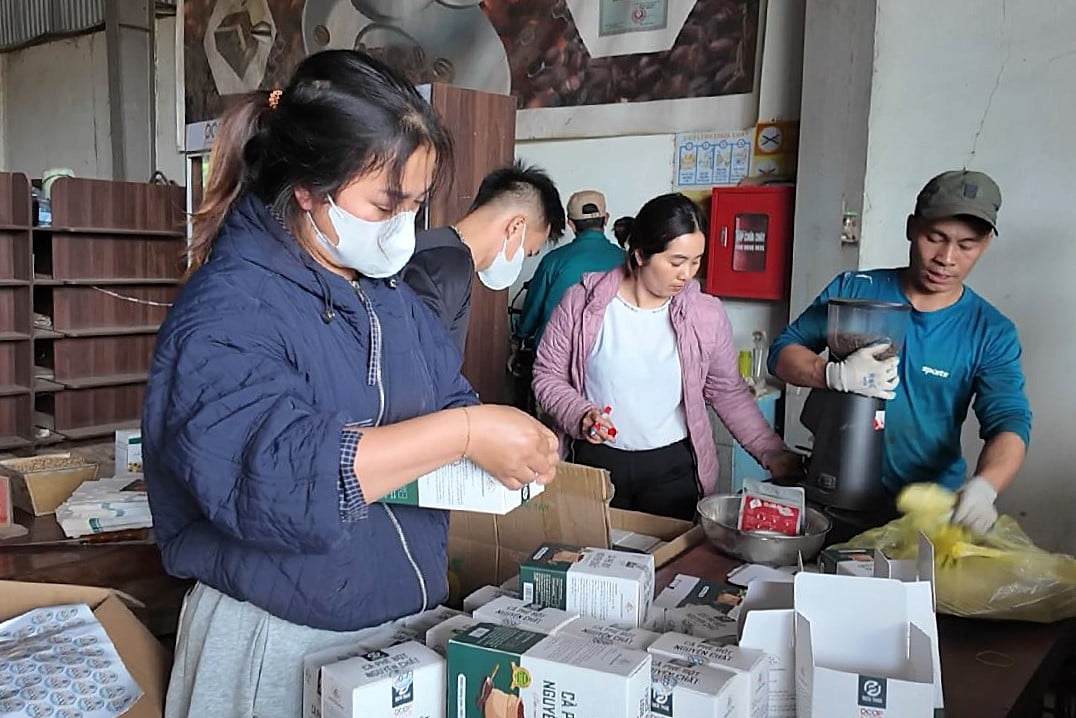
In 2019, Bich Thao Coffee Cooperative received OCOP 4-star certification for its coffee bean tea and pure ground coffee products.
In 2022, Bich Thao's pure ground coffee product was recognized as a 5-star national OCOP product, making it the only unit to achieve the highest OCOP standard at that time.
Source: https://nongnghiepmoitruong.vn/khat-vong-arabica-son-la-d790384.html








































![The Essence of the Viet Bac Villages: [Part 3] The Precious Fragrance of Nghinh Tuong](https://vphoto.vietnam.vn/thumb/402x226/vietnam/resource/IMAGE/2026/05/29/1780020600366_5237-tinh-tuy-ban-lang-viet-bac-bai-3-chuyen-o-nghinh-tuong-050626_700.jpeg)
![The Quintessence of Northern Vietnam's Villages: [Part 2] The Famous Cassava Noodles of Kunming](https://vphoto.vietnam.vn/thumb/402x226/vietnam/resource/IMAGE/2026/05/28/1779937455892_3929-3144-mien-dong-15-nongnghiep-023138.jpeg)