

GĐXH - In November, Nghe An Obstetrics and Pediatrics Hospital continuously received cases of severe measles complications requiring mechanical ventilation.
In November, Nghe An Obstetrics and Pediatrics Hospital continuously received cases of measles with severe complications, requiring mechanical ventilation.
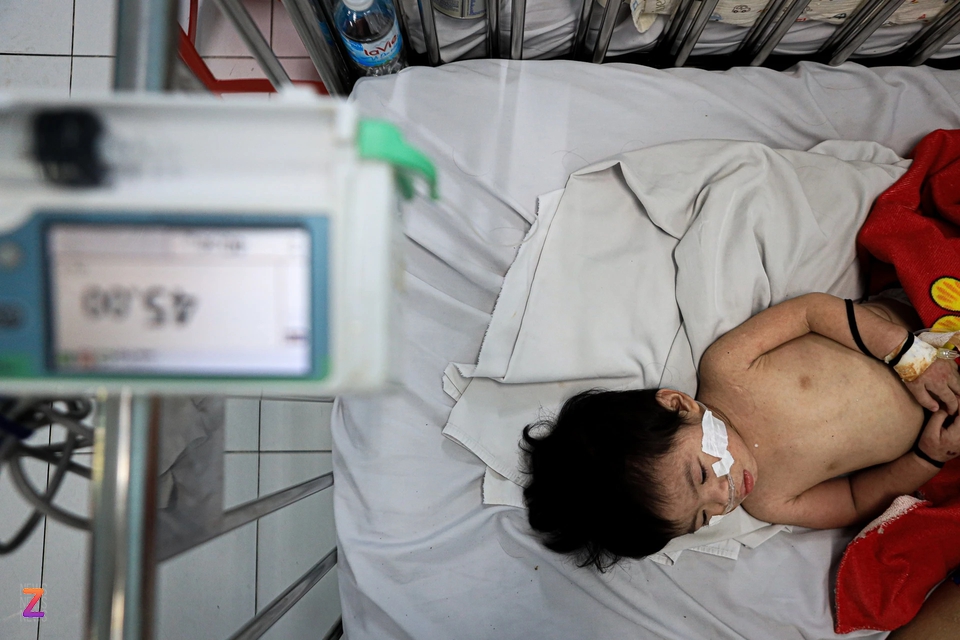
Measles can cause many dangerous complications if not treated promptly. Photo: Khuong Nguyen.
The first case is a 7-year-old child, D.TBT, residing in Huong Khe, Ha Tinh . The child was admitted to the hospital requiring manual ventilation via endotracheal tube, with a persistent high fever, a measles-like rash, and excessive eye discharge.
The child's family stated that the child has Down syndrome, a congenital heart defect, and has undergone surgery. The child had not been vaccinated against measles. Four days prior, patient T. exhibited symptoms of high fever at night and a rash that started on the face and then spread throughout the body.
The family bought fever-reducing medication and treated the child at home without success, so they took the child to the local hospital. At this point, the child's condition worsened, requiring intubation, maintenance of vasopressors (adrenaline), antibiotics, and emergency transfer to Nghe An Obstetrics and Pediatrics Hospital.
Here, doctors in the Intensive Care and Toxicology Department quickly provided emergency treatment, including shock management, sedation, and mechanical ventilation to ensure the child's vital signs. After examination and testing, the child was diagnosed with severe pneumonia and acute respiratory failure due to complications from measles.
The second case involves a child, LHĐ. (8 months old, residing in Duc Tho, Ha Tinh). The child was admitted to the hospital with fever, cough, shortness of breath, and severe pneumonia. The child also had a history of congenital heart disease, had undergone surgery, and had not been vaccinated against measles.
Child D. was diagnosed with acute respiratory failure, requiring mechanical ventilation and close monitoring. Currently, the child has been weaned off the ventilator, is stable, and will be discharged soon.
According to Dr. Nguyen Hung Manh, Head of the Intensive Care and Toxicology Department at Nghe An Obstetrics and Pediatrics Hospital, measles is an acute infectious disease caused by the measles virus. The disease is highly contagious, especially for unvaccinated or under-vaccinated children who come into contact with a source of infection.
Most deaths are due to complications of measles, most commonly pneumonia, encephalitis, vision loss, and otitis media. Symptoms of measles usually begin 10-14 days after exposure to the virus.
The rash is the most prominent and easily noticeable symptom. Initial symptoms, usually lasting 4-7 days, include: runny nose, cough, red and watery eyes, and small white spots inside the cheeks.
The rash begins about 7-18 days after exposure, usually on the face and upper neck, then spreads over about 3 days, eventually reaching the arms and legs.
Dr. Manh advises that when children develop a fever and rash, they should be immediately taken to a medical facility for treatment and isolation to prevent community transmission and minimize the risk of complications. The best way to prevent and control measles is to ensure children receive all measles vaccinations on schedule.
Source: https://giadinh.suckhoedoisong.vn/nhieu-ca-nhap-vien-do-mac-soi-bien-chung-nang-172241128093227459.htm




![[Image] A brilliant symphony and explosive power in the skies of Da Nang.](https://vphoto.vietnam.vn/thumb/1200x675/vietnam/resource/IMAGE/2026/05/31/1780196945787_anh-man-hinh-2026-05-31-luc-10-08-51.png)








![[Video] Sunset at Lap An Lagoon – Where the sun sets over the fishing nets](https://vphoto.vietnam.vn/thumb/340x192/vietnam/resource/IMAGE/2026/05/31/1780192137701_beach-landscape-sea-water-nature-grass-745871-pxhere-com.jpeg)













































































Comment (0)