

Returning to the Lim festival this spring, visitors can immerse themselves in an atmosphere filled with sweet, tender, and vibrant spring songs, and learn about the elegant and affectionate way of life and customs of the Quan Ho people...
Lim Festival - National Intangible Cultural Heritage
Historical sources indicate that the Lim Festival originated from the Dinh Ca village festival, then developed into the communal festival and the communal temple festival of the Noi Due district, eventually becoming the Lim Festival with its center at Lim Mountain (Hong Van Mountain). The development from the Dinh Ca village festival to the Lim Festival owes much to the contributions of the renowned figures and heroines of Dinh Ca - Noi Due, such as Duke Do Nguyen Thuy, General Nguyen Dinh Dien, and Bodhisattva Mu A... Therefore, the rituals of offering sacrifices, carrying books, and worshipping these figures and heroines are important aspects of the Lim Festival, vividly demonstrating the tradition of "drinking water, remembering the source," and simultaneously forming the distinctive identity of the Lim Festival.
 |
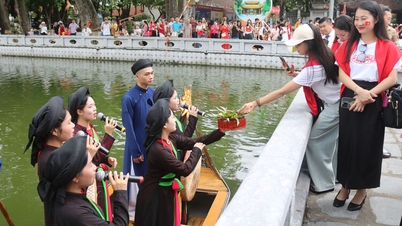
Quan Ho folk singing performances on boats at the Lim Festival. |
Over time, the Lim Festival has always held a special attraction for visitors from near and far. The vast space of Lim Hill stretches from the communal courtyard to the temple gate, from the pavilions and Quan Ho singing huts to the stage and boats; from the main festival area to the Quan Ho singing houses in the region. Throughout the villages of Lung Giang, Lung Son, Due Dong, Dinh Ca, Lo Bao, Due Khanh, Hoai Thi, Hoai Thuong, Hoai Trung, Bai Uyen… everywhere you look, you can see male and female singers leisurely attending the festival and singing.
As a display of Quan Ho folk singing prowess, the Lim Festival becomes a vibrant and lively showcase of the cultural essence of Bac Ninh Quan Ho folk songs – a UNESCO-recognized intangible cultural heritage of humanity. During the festival, Quan Ho singers from all over the region flock to sing, creating a joyful and bustling atmosphere. Besides the Quan Ho villages in the Lim area, there are also numerous artists, male and female singers from villages and hamlets along Kinh Bac, Vo Cuong, and Van Ha, as well as from Hanoi , Tu Son, and Tam Son. Groups, teams, and pairs come to the festival to meet, sing songs, and enjoy the spring, the festival, and the camaraderie. Many male and female singers bring their younger siblings to the festival to familiarize themselves with the art. Some pairs of singers, famous for their beautiful voices and unique songs, attract Quan Ho singers from other areas who seek to learn from them.
Cultural researchers affirm that the Quan Ho folk singing performances at the Lim Festival are more vibrant and lyrical than any other spring festival of Quan Ho villages. Therefore, at the Lim Festival, Quan Ho lovers of all ages and backgrounds are satisfied by the rich variety of practitioners of this heritage, including both seasoned artisans and young, aspiring singers.
The singing takes place in front of temples and communal houses, in huts, on hillsides, and on boats, echoing with simple, unadorned songs... In crowded gatherings, young men and women walk hand in hand up the stone steps to Hong An Temple to light incense, pray for peace, and then return to Lim Hill to linger with Quan Ho folk songs. Hundreds of melodies, resonating with captivating and poignant sounds, are sung by the male and female singers, expressing their feelings and emotions in various states and tones of affection, respect, gratitude, longing, and promises, possessing a powerful allure that leaves visitors mesmerized and irresistibly captivated...
Ready to open the festival
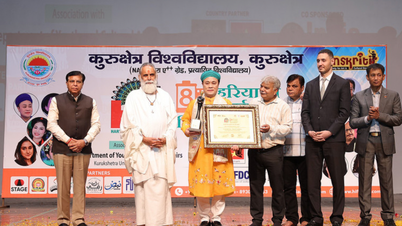
This year, the Lim Festival opens on Saturday (January 12th) and the main event takes place on Sunday (January 13th), so a high number of visitors is expected. A highlight is the ceremony to receive the Decision recognizing the Lim Festival as a National Intangible Cultural Heritage, affirming the unique and enduring value of a typical traditional cultural activity of the Kinh Bac region.
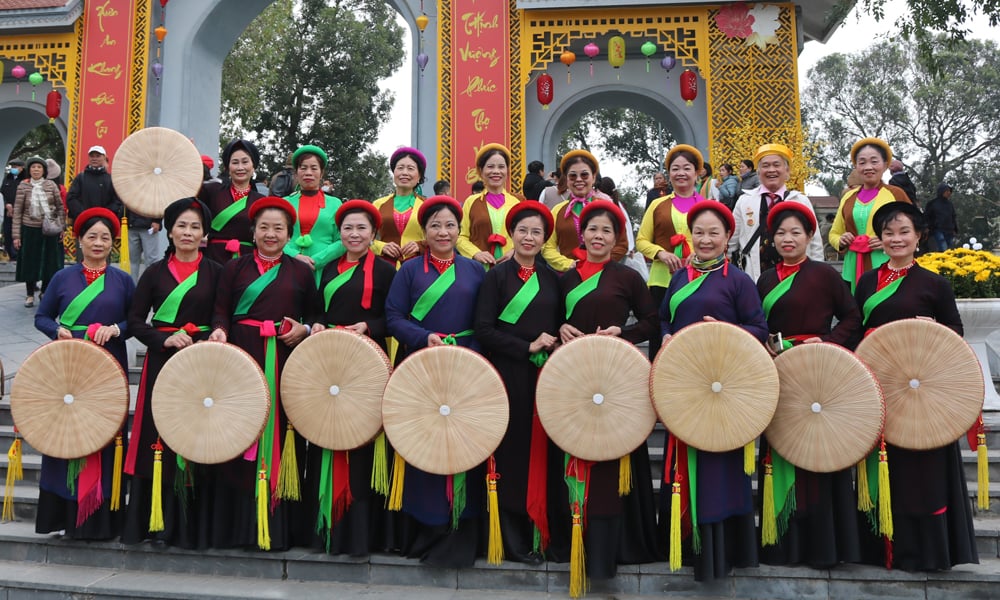 |
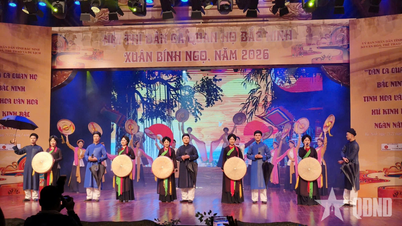
Quan Ho singers, dressed in their finest traditional costumes, attend the Lim festival. |
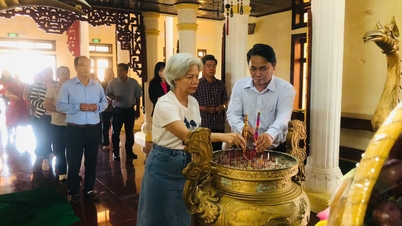
The ceremonial part of the festival was conducted solemnly and according to traditional rituals, with the opening incense offering ceremony at Hong An Pagoda and the sacrificial ceremony at the tomb of General Nguyen Dinh Dien. In addition, the procession of sacred objects, sacrificial ceremonies, and incense offerings took place at communal houses, temples, and pagodas in the villages of Due Dong, Due Nam, Due Khanh, Dinh Ca, Lung Giang, Lung Son, Lo Bao, etc., creating a sacred, respectful atmosphere and fostering community cohesion.
The festival space expanded to Lim Hill and the Van Tuong regulating lake area, with the participation of original Quan Ho villages, practicing Quan Ho villages, and Quan Ho clubs from within and outside the province. In addition, unique folk games such as: card games, calligraphy, poetry gatherings, swing games, blindfolded goat catching, pot smashing, human chess... along with several provincial-level sports competitions such as: Freestyle Wrestling Championship, Traditional Wrestling Championship contributed to recreating the vibrant and distinctive atmosphere of a traditional spring festival.
Recognizing the appeal of the Lim Spring Festival in the year of the Horse (Bính Ngọ), Tiên Du commune proactively implemented traffic management plans and prepared all necessary conditions regarding space, location, and infrastructure; developed plans to ensure security and order, fire prevention and control; and focused on maintaining environmental hygiene and ensuring food safety. The festival steering committee assigned specialized agencies to create planning maps for each space; and selected clubs to participate in singing exchanges and call-and-response performances at the Quan Họ singing huts and on the stage. In particular, attention was paid to ensuring that Quan Họ singing venues, when receiving tips from tourists, maintained cultural appropriateness, adhered to traditional values, encouraged the use of traditional musical instruments, and prohibited the singing of modern music, Chèo opera, Văn singing, Đồng dancing, and other inappropriate musical genres.
According to Mr. Tran Van Vinh, Secretary of the Party Committee and Chairman of the People's Council of Tien Du commune, organizing the Lim Festival is not only a traditional cultural activity but also an opportunity to promote the image of Tien Du homeland, contributing to preserving and spreading the value of Bac Ninh Quan Ho folk songs. With the perspective of placing people and tourists at the center, the Festival Steering Committee has requested relevant units and departments to develop detailed and scientific organizational plans; proactively coordinating closely with provincial departments and agencies to ensure synchronicity and effectiveness in every stage of preparation. To ensure the festival is solemn, safe, and rich in the cultural identity of Bac Ninh - Kinh Bac, from ensuring security and order, environmental sanitation, traffic management to organizing Quan Ho singing spaces, welcoming delegates and tourists, everything has been meticulously and carefully prepared. Through this, visitors can experience the elegant and hospitable beauty of the people of Tien Du in particular and the Kinh Bac region in general.
Source: https://baobacninhtv.vn/nho-ve-hoi-lim-postid440035.bbg
![[Image] Nearly 125,000 Hanoi students completed the Literature exam for the 10th grade entrance exam.](https://vphoto.vietnam.vn/thumb/1200x675/vietnam/resource/IMAGE/2026/05/30/1780117233041_ndo_br_thiet-ke-chua-co-ten-2-png.webp)






































































Comment (0)