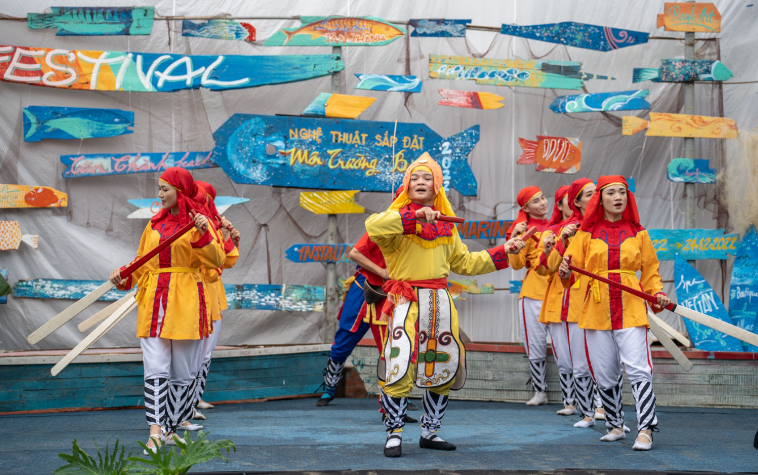
However, as the number of people who know how to sing "ba trao" (a type of folk song) dwindles over time, many traditional folk songs are facing the risk of extinction.
Oral memory
I met with Meritorious Artisan Nguyen Thuc, Chairman of the Nai Hien Dong Bài Chòi Club, in Son Tra ward as the late afternoon sun cast long shadows on the fishing nets. At nearly 70 years old, this man with a tanned complexion and a hearty voice still vividly remembers his youthful days of navigating the waves and the wind.
Leaving his birthplace of Quang Ngai to start a new life in Da Nang at the age of 25, the baggage that helped him keep the spirit of his homeland anchored in him was his continued seafaring and the melodies of the "ba trao" folk songs passed down through generations.
Blessed with a warm, strong, and expressive voice, Mr. Thuc was soon chosen by the elders of the fishing villages of Nai Hien, Man Quang, and Tan Thai to join the traditional boat rowing troupe. Initially, he was just a supporting rower, but gradually he memorized every chant, lament, and scene in the ancient boat rowing performances. During festivals, the members of the boat rowing troupe would gather in the courtyard of the Ông Temple to practice singing. Those who knew the songs taught those who came after. According to Mr. Thuc, in the past, to join the boat rowing troupe, one had to be diligent in listening and practicing.
“The elders would sing a line, and we would hum along. We had to memorize it before we were allowed to join the formation. Some songs were hours long, and if we got one line wrong, we’d be immediately reprimanded,” Mr. Thuc recalled.

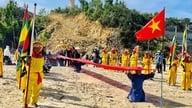

What's special about the "ba trao" folk opera is that each locality has its own variations. Even with the same fishing ritual, the chanting, the performance style, the lyrics, and the sequence of scenes can differ. Therefore, many ancient folk operas now only exist in the memories of a few elderly artisans.
Mr. Thuc explained that a traditional "ba trao" singing performance is essentially a reenactment of the journey of a seafarer, from setting sail and casting nets to encountering storms, being rescued by the God of the South Sea, and returning safely to shore. A complete program usually lasts from 90 to 120 minutes with many interwoven scenes of singing, spoken dialogue, and rowing movements simulating the life of fishermen.
Also residing in Son Tra ward, fisherman Cao Van Minh, after decades of traversing the fishing grounds of Hoang Sa and Truong Sa, has dedicated time to researching and transcribing ancient folk songs. He concludes that among the ancient folk songs commonly used in fishing festivals in Da Nang, the most popular is the "Long Than Ba Trao Ca" (Ông folk song), used in fishing ceremonies to praise the merits of the Whale God and to pray for a bountiful fishing season and a peaceful life.
Over time, many scenes, lyrics, and roles have gradually faded away. "In the past, each troupe had someone who knew every scene by heart. Now, many of the elders have passed away, and those who remain only remember parts of it. There are some traditional opera pieces whose names are still known, but almost no one remembers the original content anymore," Mr. Minh lamented.
The worry about "hybrid rowing" and the challenge of digitizing heritage.
This concern is also something that many researchers are worried about. Because the "ba trao" folk art form is a traditional oral art, its value lies not only in the lyrics or performance movements but also in the seafaring experience, folk beliefs, and community knowledge accumulated over many generations.
In his in-depth study of Quang Nam folk music, music researcher Tran Hong deciphered the unique structure of this genre. According to him, "ba trao" is a subtle blend of folk songs, traditional chants, and classical opera. The entire troupe's movements and turns are entirely based on commands issued from the "sanh tien" (a type of percussion instrument) and the sound of the opera drums. The rhythm of the "sanh tien" is sometimes rapid like waves crashing against the rocks, and sometimes leisurely like a boat sailing smoothly with the wind. Notably, "ba trao" has distinct variations and extremely strong local nuances. Each fishing village along the central coast has its own way of singing, chanting, and rhythmic tapping, creating distinct and rich cultural layers for each coastal region.


However, this oral tradition and diversity are also the weaknesses of the traditional Vietnamese opera (bả trạo) in the modern era. When the elderly artists pass away, the original, ancient opera melodies are lost forever. Researcher Trần Hồng, during his studies, also expressed great concern about the phenomenon of "hybridized opera." Due to the pressure of theatricalization and the generational gap, some places have introduced electronic instruments to accompany the traditional opera, or composed new lyrics based on hybrid melodies. For him, the most essential essence of the traditional opera lies in the off-key notes, the natural embellishments with the salty taste of the sea, which only those who have faced the storms of life can perform correctly.
If we compare "bả trạo" with "bài chòi," we will clearly see the paradoxical survival of these two forms of folk culture. Bài chòi, with its vibrant, joyful folk game, reflects the spirit of life and therefore has a more accessible stage. "Bả trạo," on the other hand, is a lament, an expression of reverence for the sacredness of people connected to the sea and indebted to the Whale God, making it less appealing to a wider audience. Without timely documentation, digitization, and transmission, one day, these calls to fellow oarsmen and the lamentations echoing from the sea will only remain as faint memories in the stories of the elderly fishermen.
Source: https://baodanang.vn/nhung-bon-cheo-con-sot-lai-3339598.html
![[Image] Ho Chi Minh City: Ma Lang area, Chicken-Rice Market about to change its appearance](https://vphoto.vietnam.vn/thumb/1200x675/vietnam/resource/IMAGE/2026/06/25/1782377698627_ndo_br_m1-jpg.webp)

![[Image] Schools organize meetings and introduce teaching models to students admitted to grade 10.](https://vphoto.vietnam.vn/thumb/1200x675/vietnam/resource/IMAGE/2026/06/25/1782368077271_ndo_br_z7970052192242-1ec8daeb77a6eed1a4e9f58c564ddd3e-jpg.webp)
![[Photo] General Secretary and President To Lam receives Palestinian Ambassador Saadi Salama](https://vphoto.vietnam.vn/thumb/1200x675/vietnam/resource/IMAGE/2026/06/25/1782365384740_a1-bnd-9423-8322-jpg.webp)