

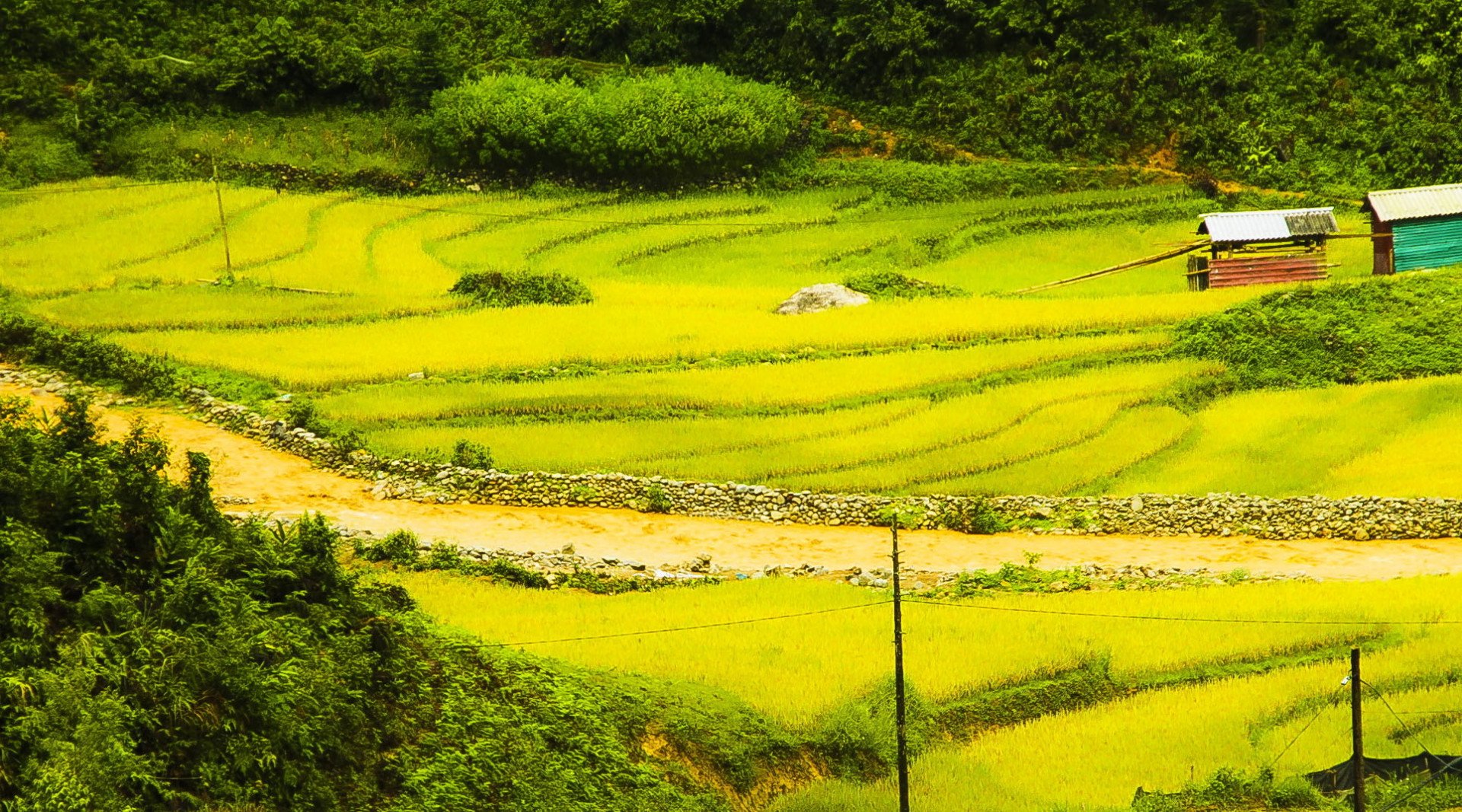
Rice paddies are found almost everywhere in the country, whether in the high mountains of the Central Highlands or the Northwest. During the rice harvest season, these rice paddies create an irresistible beauty, for example in Lao Cai and Yen Bai... and we cannot fail to mention the terraced rice fields in Sa Pa, La Pan Tan, and Mu Cang Chai... And we cannot forget the road to Hoi An, a beautiful road lined with straight rows of trees, with rice paddies on both sides during the harvest season, the yellow and green hues blending to create a vibrant feeling.
 |
In old Nha Trang, the section of Le Hong Phong road from Van Don to Phuoc Long was called Interprovincial Road 4. Fifty years ago, it was a small road, with the airport on one side and rice fields on the other. Back then, the rice fields were vast; you could see them during harvest season. Sometimes, smoke from burning fields would rise, creating a serene atmosphere. Now, those rice fields have become urban areas, with roads branching off in all directions. Even the 10-kilometer road from Nha Trang to Thanh Hoa City also passes through rice fields. The road was narrow then, with cars in both directions sometimes having to yield to each other. The golden ripe rice lined both sides of the road, and white egrets would fly in search of grains, but they had to quickly fly away because of scarecrows.
The ripening rice fields have a strange allure. As the train from Ho Chi Minh City to Nha Trang prepares to pull into the station, the entire rice field stretches out before your eyes through the train window. The road to Ninh Xuan and the roads through Van Gia are also lined with rice fields. Just the sight of ripening rice, the bundles of freshly harvested rice lying by the roadside, the image of farmers carrying their rice home – it's a very peaceful feeling. During the rice harvest season, you occasionally encounter golden carpets of rice along the road. Farmers are taking advantage of the summer sun to dry their rice, as if the rice will smell even more fragrant amidst the glare of the sun and the heat of the asphalt road.
During the rice harvest season, I remember as a child following my grandmother through the rice fields, gleaning rice. Farmers used sickles to neatly cut the rice stalks, leaving them there while others followed behind, bundling them up and transporting them to the shore. Those without land quietly followed the harvesters, also using sickles to gather any remaining rice stalks and picking up fallen ones, enough for a few meals. I remember my grandmother threshing each stalk of gleaned rice, as if afraid of losing any precious grains, and because there was so little, she only kept it in baskets drying in front of the house. She would also take the gleaned rice to the mill, and the miller would mill it for her free of charge. And I'm sure you've never eaten a meal made from gleaned rice? It's a mixed rice from many different fields, creating a unique flavor, seemingly tinged with the salty taste of sweat.
During the rice harvest season, I've set off countless times, riding my motorbike to Sa Pa, following the slopes to the valleys, or walking until I was drenched in sweat, just to admire the magical beauty of the terraced rice fields. I once sat behind a motorbike taxi driver in La Pán Tẩn, crossing a small, steep mountain road just to gaze at the shimmering golden rice paddies of Mâm Xôi Hill.
During the rice harvest season, farmers often eat a bowl of the first rice of the season as a way of thanking the heavens for the favorable weather that has brought a bountiful harvest. During the rice harvest, white egrets return to search for the fallen grains of rice.
KHUE VIET TRUONG
Source: https://baokhanhhoa.vn/van-hoa/sang-tac/202506/nhung-canh-dong-thom-mui-lua-chin-189254a/




































































Comment (0)