

When 32-year-old Zhang Chengying told her parents that she and her husband had decided not to have children, her parents were shocked and asked if there was something wrong with their daughter.
Zhang explained that she had no problem with it; it was just that she and her husband wanted to be a "DINK" couple, short for "Double Income, No Kids," meaning both partners earn income and choose not to have children.
"My mother says she's over 60 and would be ridiculed if she didn't have grandchildren," Zhang said. "But do I have to change my life so that my mother won't be ridiculed? No, I won't do that."
Zhang and her husband haven't yet achieved their goal of having two sources of income, but that will soon change. Having just graduated from a medical university in Shandong province, Zhang is waiting to apply for a research position at a hospital later this year. Her husband will soon become a civil servant as well.
Currently, the couple is enjoying their free time, traveling around, and being able to stay up late and sleep in without worrying about the children.
On July 20th, the couple embarked on a nearly 5,500 km journey . The trip, meticulously planned by the couple, took them through three provinces of China in almost three days.
"I certainly wouldn't have this much free time if I had children," Zhang said. "Because of the responsibilities of parenthood, some of my friends rarely have time to go out and see me."
China has ended nearly three years of strict restrictions to combat Covid-19, but the pandemic has had a lasting impact on the economy and people's mental health.
For many people, financial pressure and anxiety lead them to doubt the future, thus tending to avoid having children. This trend had already appeared in China before the pandemic, but became more prevalent when the country shut down, halted many activities, and faced widespread economic instability.
The reality of young couples being hesitant to have children was partly reflected in 2022, when China's population declined for the first time in 61 years. According to the National Bureau of Statistics of China, the country's population decreased by 850,000 people in 2022 compared to 2021. The fertility rate for first-time mothers decreased from 0.7 in 2019 to 0.5, and the average age of women having their first child increased from 26.4 to 27.4.
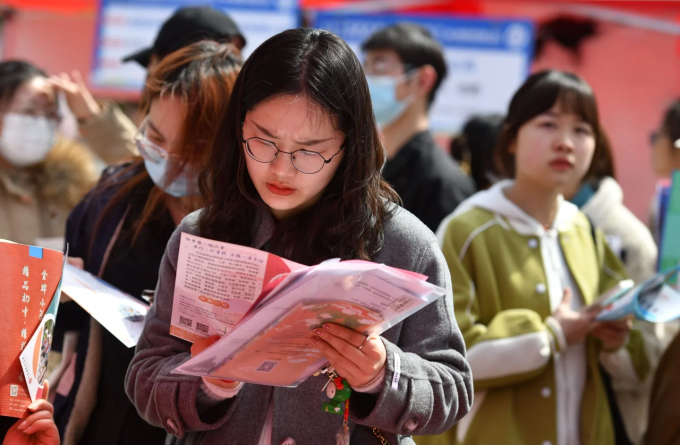
Young Chinese people at a job fair. Photo: China News
Yang Xiaotong, 26, a freelance worker in Shenzhen, shares Zhang's sentiment, as she is unwilling to give up her current lifestyle and freedom to raise a child.
She and her husband, who got married in April, said that the three years of lockdown had greatly affected their thinking. "We became more self-centered, while our parents thought we were becoming increasingly selfish," Yang said.
She expressed that she had faced a lot of pressure in running her own business. Some of Yang's friends had children, while others wanted to pursue a DINK lifestyle or didn't want to get married.
"I realized that I'd rather travel the world than be confined to an 80-square-meter apartment in Shenzhen with my children. Many young people are focusing on improving their quality of life because we cherish the time we have on this earth," Yang said.
Ren Yuan, a professor at the Institute of Population Studies at Fudan University, believes that the reality of many people being hesitant to have children and unwilling to marry will have long-term impacts on China.
"With marriage rates declining and the proportion of those who have never married increasing, China's birth rate is likely to remain low for decades to come," Ren said.
Rising costs of having children, coupled with the current economic downturn where one in five young people are unemployed, have led many couples to feel they cannot afford to raise children.
"After deducting rent and living expenses, my monthly income of 5,000 yuan (US$700) is barely enough," said Qu Yun, a 24-year-old nurse in Shandong province.
Qu Yun stated that the main reason she doesn't want children is the lack of both time and money, as she works 12 hours a day, often without even time for lunch.
Despite increasing subsidies from local governments and companies to encourage childbirth, Qu remains unwavering in his thinking. "It would be better if the government improved its protection of workers' rights, such as regulations on overtime and increased wages, instead of trying to convince people to get married and have children," Qu said.
Zhang, who is highly educated and could potentially earn a higher-paying job than Qu, also worries about not being able to provide enough for her child. Zhang shared that she has observed her relatives' spending habits, especially regarding raising children in the current volatile economic climate.
"The cost of education is too high, and I don't want my children to be born into such a stressful environment," Zhang said. "I don't know if I'll change my mind when I'm 40, but right now, I'm determined not to have children."
Chen Weimin, a professor at the Institute of Population and Development Studies at Nankai University, said that the "anti-child" mentality can reach extremes and many people may spread this on social media. However, according to the professor, China needs to ensure a society where people have many advantages when having children, with the goal of "building a child-friendly society."
"Young people's desire to have children has clearly decreased, and there is a general anxiety about having children in China," Chen said.
( By Hoang , according to SCMP )
Source link


























































![[Video] Sunset at Lap An Lagoon – Where the sun sets over the fishing nets](https://vphoto.vietnam.vn/thumb/1200x675/vietnam/resource/IMAGE/2026/05/31/1780192137701_beach-landscape-sea-water-nature-grass-745871-pxhere-com.jpeg)

































Comment (0)