

Each trip was unique, full of emotion and deep affection, and for the officials and reporters who participated in those long information-gathering journeys, after months of hard work and hardship, there was joy and pride, with meaningful memories that will forever remain in their minds.
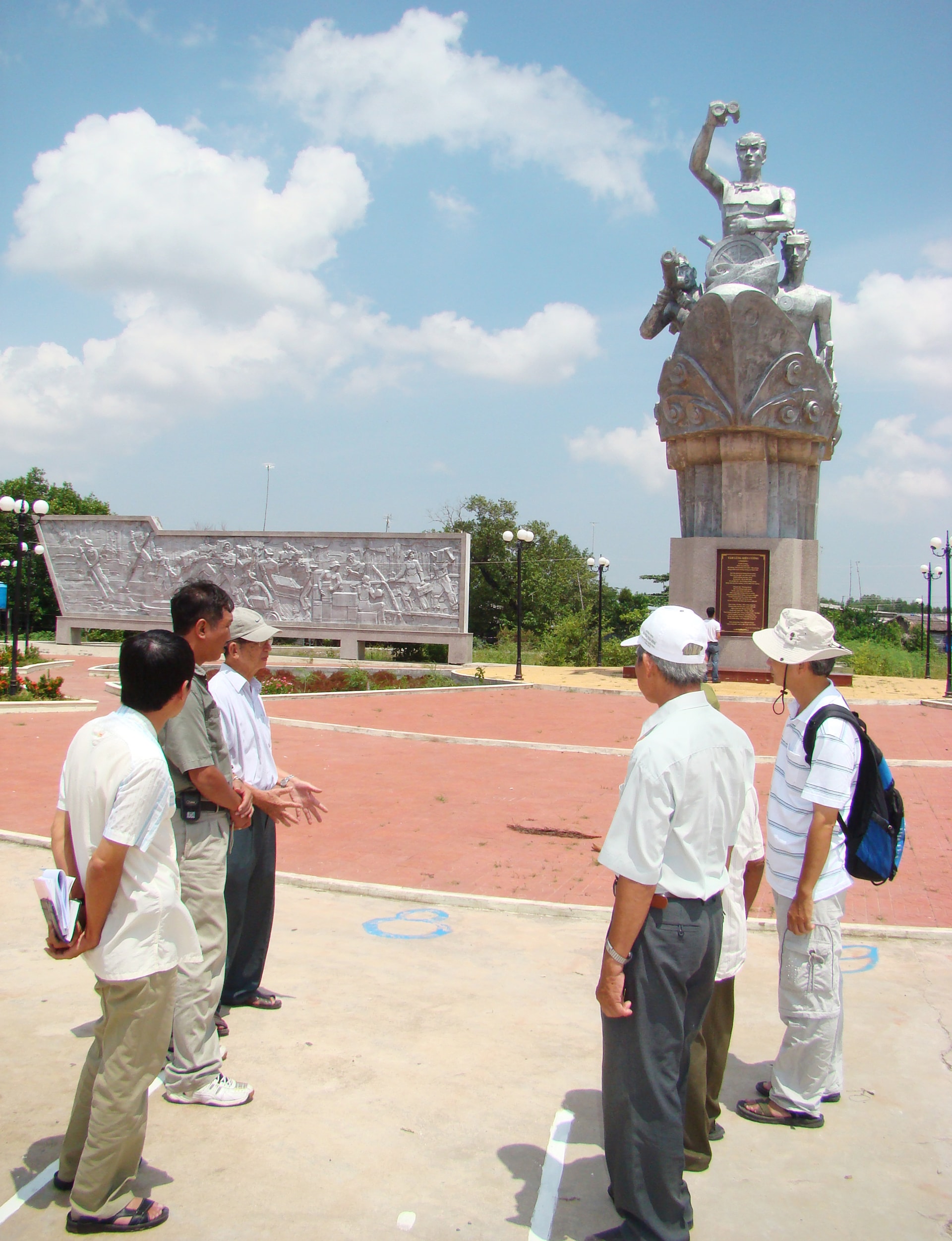
Develop a "battle plan".
In early July 2011, the editorial board of Hanoi Moi Newspaper assigned a team of reporters the task of finding witnesses to the "unnumbered" ships to produce a series of articles commemorating the 50th anniversary of the Ho Chi Minh Trail at sea. The propaganda plan was sent to the members, seeking collective opinions on the "planning" of the articles. In general, it had to focus on two main issues: the Ho Chi Minh Trail at sea, the path taken by the soldiers of Regiment 125 with unwavering faith in victory, regardless of sacrifice; and the ports of the people along the South Central and Southern coasts, where nearly half a century ago countless examples of selflessness emerged in welcoming ships carrying weapons to support the Southern battlefield. Ships and ports are like lips and teeth; a safe harbor is essential for ships to dock safely; no task is too small.
A few days later, the first two groups set off, 3-4 days apart. One group, consisting of Tran Chien and Xuan Truong, headed straight to South Central Vietnam, "scouring" from Quang Nam to Tuy Hoa, with a focus on the Vung Ro incident and the Duc Pho infirmary, along with the task of conducting initial research on the maritime economy and forming ideas for a new research topic. The area from Thanh Hoa to Da Nang was left to the second group, consisting of Ngoc Thanh, Duong Hiep, and Huy Anh, whose focus was on finding what remained of the Gianh River fishing group, the first group of Northern officers and soldiers recruited onto the "no-number" ships, and gathering information for their future research if they found places where life was good thanks to the sea. The main means of transportation for the entire group was a single car. Tran Chien and Xuan Truong chose to fly to Nha Trang and then take motorbike taxis and buses, leaving the car to the second group, giving the impression of being experienced "veterans" who could manage on their own.
Around the end of July, the Ngoc Tien and Nguyen An group took over, assigned to the Southeast region, Ho Chi Minh City, and continued implementing related tasks in Can Tho City, a place associated with the history of Unit 962 in charge of ports and docks, such as Colonel Khuu Ngoc Bay, and the fairytale love story of the couple Thang and Thuy, one on the docks, the other on the "numberless" ships for so many years.
The final trip was at the beginning of August. Ngoc Thanh and Huy Anh went ahead, traveling by car throughout Ba Ria and Vung Tau with the author of "Memories of the Unnumbered Ships" - female writer Ma Thien Dong - to find witnesses who participated in the sea voyage to the North to request weapons from the group of soldiers in Ba Ria. Then Nguyen Trieu, Le Hoang Anh, and Doan Anh Tuan took over the work in the Southwestern region, with nothing more than to learn about Unit 962, which deserved to be called heroic for its silent achievements in protecting the ports and landing sites for the "unnumbered" ships.
To summarize briefly, it actually took us over a month to be somewhat satisfied with what we had learned.
A journey of a thousand miles begins with a single step...
Most of the participants in this trip had been present during the two long-term propaganda campaigns in 2009 and 2010, and therefore had some experience.
The first two groups, after three days in Thanh Hoa, Nghe An, and Nha Trang, encountered some unexpected and noteworthy issues. From the South, Tran Chien called: "I heard stories from here about many fishermen on unregistered ships having bad luck, some are having quite a hard time. Remember to find out what's going on up there. When you go to Da Nang, find Mr. Vu Tan Ich and ask him about it." The following evening, Xuan Truong bombarded the phone: "I've been to a few places here, and I'm increasingly realizing that the maritime economy isn't just about fishing and how fishermen cling to the sea. It's also about policies to support them. What about fuel, guidance on new fishing grounds. The main thing is the maritime culture and mindset, not just the concept of symbiosis and helping each other in times of trouble. And then there's coastal urban planning. Remember to check on Hue and Da Nang up there."
Passing through Nghe An and Quang Binh, the two-person team called Nguyen Trieu and Doan Anh Tuan for their opinions. Even after arriving in Dong Hoi, they suggested returning south of the Ngang Pass to Canh Duong commune the next day to find newly emerged witnesses, and incidentally, to gather ideas that could help build a documentary about the fishing village. When they met the "owner" of the Canh Duong fishing port, and heard the story of two captains planning to pursue new fishing grounds near Truong Sa, they understood better what Xuan Truong had discussed the previous night: that the marine economy, or relying on the sea, is not just about keeping fishing fleets afloat and ensuring fishermen have regular trips. A grand policy requires long-term plans, creating the basic conditions for sustainable development of coastal areas... Late that evening, Duong Hiep continued driving to find witnesses for the "unregistered" ships, while Huy Anh went to the dock to see the fishing village welcome her husband and children back after a long trip offshore. Tong Ngoc Thanh rested, recovering from her long journey through Hong Linh, Can Loc, and Cam Xuyen in Ha Tinh province.
The group's trip to the Southeast region, Ho Chi Minh City, and Can Tho was successful but arduous. Ngoc Tien was afflicted with malaria and had to be admitted to Cho Ray Hospital, probably just a day or two after finding reliable witnesses in Ho Chi Minh City, leaving Nguyen An alone in a car to go to Can Tho to meet the veteran couple Thang and Thuy.
The last group to go to the Southwestern region was probably the luckiest, even though Nguyen Trieu wasn't well. He mainly guided the younger members, focusing on specific issues, despite spending many consecutive days on the road, with irregular meals and rest periods. Once the work was done, they were on the road again. After all, they got to visit Ca Mau Cape to pay respects to the hero of the "numberless" ship, Bong Van Dia, and hear stories about welcoming ships in Thanh Phu - Ben Tre... Le Hoang Anh and Doan Anh Tuan were so busy, going from villages to the sea to search for old harbors, sometimes traveling through four or five provinces in a single day.
Later, upon returning to the capital, many realized that the trip had brought them far more valuable lessons than they had imagined. The Ho Chi Minh Trail at sea was not only home to captains and political commissars, but also to other unsung heroes—mechanics, sailors, radio operators—who have yet to be mentioned. The fierce battle was not just about ships arriving safely at port; it also included those who sacrificed their lives, those brave but unfortunate individuals, some still alive but perhaps having lost many others.
Thinking about them makes me realize I need to live a better life.
On the way back to Hanoi, whether crossing the majestic A Roàng peak in the Trường Sơn mountain range, waiting for the ferry across the large river near Hàm Luông wharf, or simply stopping along the way, the topic of finding witnesses to the "unnumbered" ship often came up in the minds of the HanoiMoi reporters.
I still remember the moments I spent with veteran Nguyen Van Vinh, a shipwreck veteran, in My Thuy, Vinh Linh, Quang Tri. His small house nestled in the white sand, three people supporting each other through the burden of debt from a small loan taken out to repair the house. I wanted to help them a little, something insignificant, but I didn't dare ask because of the pride of the veteran's family.
I still remember the image of Captain Pham Quoc Hong's wife in Canh Duong, Quang Binh, her back bent, her hair white after years of carrying her child and begging for food while her husband was away on the "numberless" ships. I still remember the image of Mrs. Muoi Riu, the mother of veteran Le Ha, who was on the boat from Ba Ria to the North years ago to request weapons, and who, without hesitation, spent ten gold bars to buy a boat for her children to cross the sea to return to the North. I remember the small, frail veteran in Cam Xuyen, who, despite facing life and death situations, is now living in borrowed accommodation. I remember the words of veteran Nguyen Dinh Sin in Nghe An, that they don't want anything extravagant, only a priority medical examination when the weather changes, and that society remembers those who are still suffering...
In the midst of everyday life, memories resurface as if they happened yesterday, alongside those heroes who once sacrificed themselves for the country but are now less fortunate, unable to achieve the same success. Suddenly, I feel a duty to live a better life.
Source: https://hanoimoi.vn/nhung-dieu-con-mai-706284.html


![[Photo] Announcement Ceremony of the Art Program “Light Concert – Welcoming the New Year 2026”](/_next/image?url=https%3A%2F%2Fvphoto.vietnam.vn%2Fthumb%2F1200x675%2Fvietnam%2Fresource%2FIMAGE%2F2026%2F01%2F27%2F1769514762857_le-cong-bo-ct-hoa-nhac-anh-sang-1772-9042-jpg.webp&w=3840&q=75)
![[Photo] Commemorating the unwavering friendship between Vietnam and Laos](/_next/image?url=https%3A%2F%2Fvphoto.vietnam.vn%2Fthumb%2F1200x675%2Fvietnam%2Fresource%2FIMAGE%2F2026%2F01%2F27%2F1769518372051_ndo_br_1-jpg.webp&w=3840&q=75)


![OCOP during Tet season: [Part 3] Ultra-thin rice paper takes off.](/_next/image?url=https%3A%2F%2Fvphoto.vietnam.vn%2Fthumb%2F402x226%2Fvietnam%2Fresource%2FIMAGE%2F2026%2F01%2F28%2F1769562783429_004-194121_651-081010.jpeg&w=3840&q=75)


![OCOP during Tet season: [Part 2] Hoa Thanh incense village glows red.](/_next/image?url=https%3A%2F%2Fvphoto.vietnam.vn%2Fthumb%2F402x226%2Fvietnam%2Fresource%2FIMAGE%2F2026%2F01%2F27%2F1769480573807_505139049_683408031333867_2820052735775418136_n-180643_808-092229.jpeg&w=3840&q=75)
![OCOP during Tet season: [Part 1] Ba Den custard apples in their 'golden season'](/_next/image?url=https%3A%2F%2Fvphoto.vietnam.vn%2Fthumb%2F402x226%2Fvietnam%2Fresource%2FIMAGE%2F2026%2F01%2F26%2F1769417540049_03-174213_554-154843.jpeg&w=3840&q=75)




Comment (0)