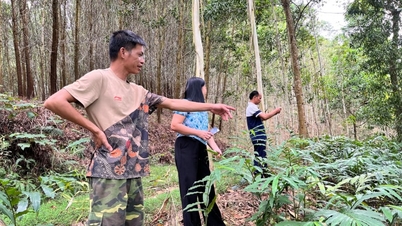
Mr. Nguyen Ngoc Trang takes care of his durian trees after harvesting. Photo: LE TRUNG HIEU
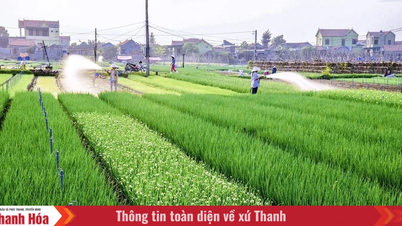
According to Nguyen Hoang Giang, Vice Chairman of the People's Committee of Binh Hoa commune, the locality is focusing on promoting the restructuring of the agricultural sector towards the application of high technology and adaptation to climate change, aiming to enhance the value of agricultural products in a sustainable manner. The commune actively mobilizes, disseminates information, and provides support in terms of farming methods and preferential loan capital to help farmers convert unproductive garden land and low-yield rice fields into vegetable and fruit cultivation and livestock farming, gradually improving their quality of life.
In the first six months of 2026, agricultural production in Binh Hoa commune achieved relatively high productivity and quality. The total cultivated area reached over 5,972 hectares, achieving 71.6% of the annual plan. Rice cultivation covered nearly 5,190 hectares, with the area applying the "1 must, 5 reductions" program reaching 72%, and the "3 reductions, 3 increases" program reaching 97.5% of the area. The commune has over 946 hectares participating in rice production under the "Sustainable Development of 1 Million Hectares of High-Quality and Low-Emission Rice Specialization Associated with Green Growth in the Mekong Delta by 2030" project, achieving 176.8% of the plan.
Many farmers have boldly shifted their crop structure, forming linkages and cooperating in production and business, yielding high economic efficiency, which the locality has maintained and replicated. Typical examples include seedless lemon cultivation using an automatic sprinkler irrigation system powered by solar energy; durian cultivation using an automatic sprinkler irrigation system; and Thai jackfruit cultivation using an automatic sprinkler irrigation system…
With the support of the local government and his own research and learning, Mr. Nguyen Ngoc Trang, from Phu Hoa 1 hamlet, boldly invested in an automatic sprinkler irrigation system for his durian orchard of over 1 hectare, with 138 Ri6 and Musang King trees, to save on irrigation costs. Mr. Trang has just finished harvesting his durian orchard, yielding about 10 tons, which he sold at prices ranging from 35,000 to 90,000 VND/kg. After deducting expenses, he earned a profit of over 100 million VND.
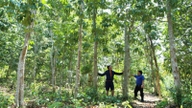

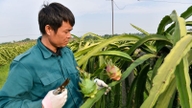
According to Mr. Trang, growing durian with high yield and quality requires a whole process of care. Immediately after harvesting, growers need to remove weeds, loosen the soil around the base of the tree, prune branches, and apply organic fertilizer to support the tree's growth after the fruiting period. During the flowering and fruiting stages, it is necessary to provide sufficient water, fertilizer, and pesticides, and especially to skillfully prune the fruit to achieve high yields without depleting the durian tree.
Mr. Trang has invested in an automatic sprinkler irrigation system for his 1-hectare durian orchard. He is currently planning to invest in a new, larger, and more modern sprinkler system, as the old one is overloaded with the 6-year-old durian trees. Mr. Trang shared: “If there is a lack of water, durian trees are susceptible to pests and diseases such as mealybugs and fungi, causing leaves to wilt, turn yellow, and roots to dry out, potentially leading to mass flower or young fruit drop. Therefore, in addition to regularly monitoring for pests and diseases to prevent and treat them promptly and providing sufficient organic fertilizer, ensuring adequate water supply is extremely important in determining the yield and quality of the durian.”
In the first six months of 2026, Binh Hoa commune planted over 671 hectares of crops, including 108 hectares of paddy fields and nearly 112 hectares of fruit trees. “The conversion of inefficient rice cultivation land to vegetable and fruit tree cultivation has been positively received by farmers. Many farmers are quick to adapt and innovate in production, boldly investing in new farming models and bio-secure livestock farming, bringing high economic efficiency,” said Mr. Phung Ngau, an agricultural extension officer in Binh Hoa commune.
Besides efficient farming in the agricultural sector, farmers in Binh Hoa commune have also boldly implemented many new livestock models that bring high economic value, such as breeding deer for antler harvesting, raising snakehead fish for drying, and raising frogs for breeding and commercial purposes. With technical support and breeding stock from the Provincial Agricultural Extension Center, Mr. Nguyen Hoang Son, residing in An Phu hamlet, utilized his previous goat farm to raise deer for breeding and antler harvesting. The model he implemented in September 2025 has yielded over 250g of antlers, selling for nearly 3 million VND. After a period of raising them, Mr. Son said that deer are easier to care for than goats. Breeders only need to provide sufficient grass, and the deer thrive.
Typically, deer antlers are harvested every 6 months. Mature deer, 2 years of age or older, begin producing antlers, yielding between 250g and 500g. Antler production gradually increases with age and the deer's condition. Mature deer (5-7 years old and older) reach their largest antlers, yielding from 1kg to over 3kg, depending on the breed and care.
According to Mr. Son, for deer to grow well and produce high-quality antlers, it is necessary to select healthy breeds, build well-ventilated enclosures, provide proper nutrition, and perform antler harvesting using the correct technique. From the time the antlers sprout until harvest takes about 50 days. "After harvesting the antlers, the deer need to have their wounds carefully treated to prevent infection and need rest, clean water, and a diet rich in protein and vitamins, especially young grass, to quickly recover their strength," Mr. Son said.



Mr. Nguyen Hoang Giang stated that Binh Hoa commune focuses on developing and replicating models that yield high economic efficiency, linked with consumption, and ensuring stable outlets for agricultural products. The commune collaborates with specialized departments to strengthen the transfer of scientific and technical advancements to farmers for effective application in the production process, aiming to reduce investment costs, increase productivity and quality, and ensure stable outlets for local agricultural products.
Source: https://baoangiang.com.vn/nhung-mo-hinh-lam-an-hieu-qua-o-binh-hoa-a488832.html