

In Binh Duong, spring is the season when rubber trees shed their leaves, bloom, and bear fruit. When people think of rubber trees, they usually only think of their sap (also known as latex) and wood. Unless you're from a region where these trees are grown, you might not realize that rubber trees also have such beautiful clusters of flowers. Not as famous as the crape myrtle or plum blossoms in the North, rubber tree flowers possess a familiar and simple beauty, much like the people of the red soil region of the East. Rubber tree flowers are intertwined with my childhood and the romantic memories of the past.
Rubber tree blossoms are most beautiful on moonlit nights. I still remember those high school years in Tan Uyen, when a classmate casually sang a few lines from Phan Huynh Dieu's song "The Fragrant Night of Song Be," which I still remember to this day. "As the moon rises, the rubber tree blossoms gently release their fragrance, perfuming your hair, intoxicating in the night breeze, calling spring to come." It was probably from that moment that every weekend when I went home, I would often go to the backyard and look up at the rubber tree canopy to admire the white blossoms, "like countless stars, swaying with dew drops staining the young green leaves." That was the first time I felt longing for someone, and all my innocent future plans were painted under the pure canopy of rubber tree blossoms. In the eyes of that schoolgirl, there was also a sparkle under the young leaves, her dress having just changed for a new spring.
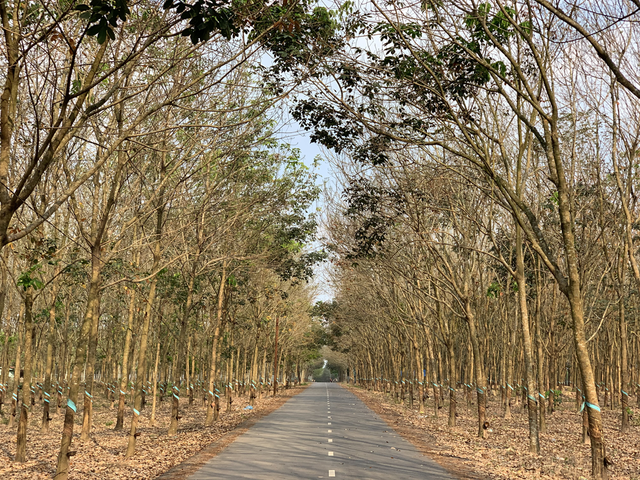
Rubber tree leaf-shedding season
In my hometown, every family planted rubber trees, each on their own garden land, not belonging to any state farm. To increase production, my family also utilized the empty land around the garden to plant a few dozen more trees. So back then, my house was nestled in the middle of a rubber plantation, cool and pleasant all year round. Near Tet (Vietnamese New Year), the rubber leaves would fall everywhere. Every morning, my mother would sweep them up into piles and burn them. I would often sit there warming myself before going to school, the smell of smoke from the fallen leaves still lingering on my old woolen sweater. The rubber plantation was also very beautiful when it first shed its leaves, in various shades from withered to yellow and then red. That was when they stopped harvesting the sap; after the old leaves fell, the rubber trees would sprout new leaves, and then clusters of flowers would bloom profusely.
Even with just a few dozen more trees, the amount of latex harvested was significant. Combined with the harvest from the main plantation, rubber latex was the primary source of income for my family back then. Thanks to those white sap streams, likened to mother's milk, my siblings and I grew up. Therefore, in my homeland, the love for rubber trees is like the love for parents and one's hometown. While the tree trunks yield latex throughout their harvesting years, when they age, they also provide valuable timber. Not to mention the dried rubber fruits and branches, which are also used for fuel in daily life. And for romantics like me, the rubber tree blossoms evoke the most cherished memories of my childhood.
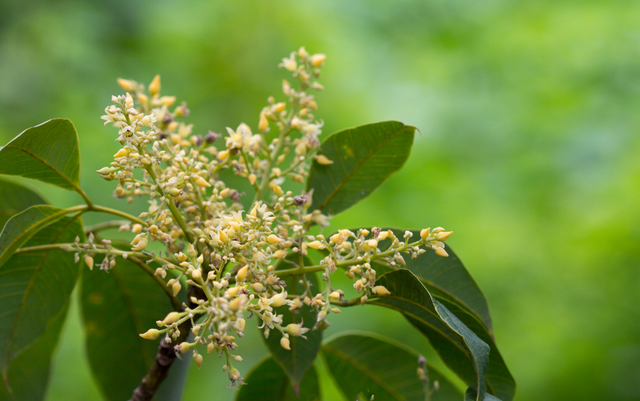
rubber tree flowers
On those moonlit nights, clusters of rubber tree blossoms gently released their fragrance. I wrote naive, dreamy poems of my school days. Studying under the flickering lamp by the window, I was distracted by each passing breeze carrying the scent that stirred the heart of a girl as young as the moon itself. Unable to resist the urge to be closer to those blossoms, I stepped outside to bask in their pure fragrance. During my university years far from home, what I missed most were those rubber tree blossoms, unique to my hometown. I wrote in my diary on nights like those, entrusting my youthful dreams to those blossoms. I also had sad stories that only the moon, the wind, and the flowers understood. The year my old classmate sent me a pink wedding invitation coincided with the time the rubber tree blossoms bloomed. That night, I stood outside in the mist for a long time, my young heart seemingly skipping a beat; I couldn't describe the nameless emotions I felt. I could only silently sink into a space that had long sheltered me like a mother's womb. Similarly, later on, I could only silently watch as the lumberjack cut down the last rubber trees, making way for the planned construction project.
The rubber tree blossoms don't have the strong fragrance of milkwood flowers; their scent is very light, gentle in the silvery moonlight—the moon of spring, and my youth within it. A youth filled with songs of pride about love and my homeland. "On a quiet night, I hear the gentle breeze stirring the moon. The pollen carries a cool fragrance. Who knows if anyone's heart still lingers? Like you waiting for me, tenderly nestled among the green leaves. Silently, through the years, the longing remains. The vibrant green of my homeland forever…"
I've experienced seasons of rubber tree blossoms like that. Every year, around January and February, the flowers seem to bloom in clusters, evoking memories of springs gone by.
120 million VND in prize money for the "Spirit of the Eastern Region" writing contest.
The "Eastern Spirit" writing contest, organized by Thanh Nien Newspaper in collaboration with Phu My 3 Intensive Industrial Zone, is an opportunity for readers to share their deep feelings about the land and people of the southeastern provinces (including Ba Ria-Vung Tau, Dong Nai , Binh Duong, Binh Phuoc, Binh Thuan, Tay Ninh, and Ho Chi Minh City), and to contribute best practices, new models, and creative, dynamic thinking of the people of the Eastern region. Authors can submit entries in the form of essays, personal reflections, notes, or journalistic reports. Entries must be written in Vietnamese or English (for foreigners) and should not exceed 1,200 words. For journalistic reports, the limit is 1,500 words. Including accompanying illustrations by the author or copyrighted images provided by the author is encouraged.
Entries must be original works, not previously used or published in any mass media or publications, and not posted on websites, blogs, or social media platforms such as Facebook, Twitter, etc., of any organization or individual. Entries must not be included in the author's own book or anthology until the competition concludes.
The total prize value amounts to 120 million VND.
Please send your entries to haokhimiendong@thanhnien.vn or by mail to the Thanh Nien Newspaper Editorial Office: 268-270 Nguyen Dinh Chieu Street, Vo Thi Sau Ward, District 3, Ho Chi Minh City (please clearly indicate on the envelope: Entry for the "Hao Khi Mien Dong" Contest). The contest will accept entries until November 15, 2023. Articles selected for publication in the Thanh Nien daily newspaper and the Thanh Nien online newspaper (thanhnien.vn) will receive payment according to the editorial office's regulations.
The detailed rules are posted on thanhnien.vn/van-hoa/hao-khi-mien-dong.

Source link


![[Photo] Close-up view of the most modern multi-level boarding school in the border region.](/_next/image?url=https%3A%2F%2Fvphoto.vietnam.vn%2Fthumb%2F1200x675%2Fvietnam%2Fresource%2FIMAGE%2F2026%2F01%2F31%2F1769825352253_z7485066371145-45cccc741d77ee89a371005bcaa2e314-7270-jpg.webp&w=3840&q=75)


![[Photo] General Secretary To Lam receives the Special Envoy of General Secretary and President of China Xi Jinping](/_next/image?url=https%3A%2F%2Fvphoto.vietnam.vn%2Fthumb%2F1200x675%2Fvietnam%2Fresource%2FIMAGE%2F2026%2F01%2F30%2F1769759383835_a1-bnd-5347-7855-jpg.webp&w=3840&q=75)


![OCOP during Tet season: [Part 3] Ultra-thin rice paper takes off.](/_next/image?url=https%3A%2F%2Fvphoto.vietnam.vn%2Fthumb%2F402x226%2Fvietnam%2Fresource%2FIMAGE%2F2026%2F01%2F28%2F1769562783429_004-194121_651-081010.jpeg&w=3840&q=75)


![OCOP during Tet season: [Part 2] Hoa Thanh incense village glows red.](/_next/image?url=https%3A%2F%2Fvphoto.vietnam.vn%2Fthumb%2F402x226%2Fvietnam%2Fresource%2FIMAGE%2F2026%2F01%2F27%2F1769480573807_505139049_683408031333867_2820052735775418136_n-180643_808-092229.jpeg&w=3840&q=75)




Comment (0)