


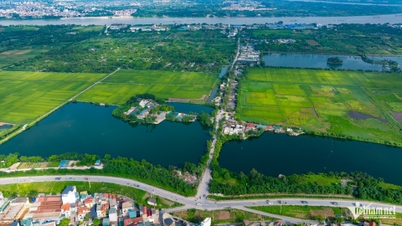
The coastal area of Kim Son is blessed with a coastline stretching over 18.5km, along with the two estuaries of the Day and Can rivers. Annually, alluvial deposits create an additional 80 to 100 meters of tidal flats, forming large sandbanks ideal for aquaculture. Based on this foundation, clam farming quickly developed and became the primary livelihood for many households.
Mr. Nguyen Van Quang, a clam farmer in Kim Dong commune, said that ASC-certified clams are harvested regularly and strictly here, ensuring they reach the correct marketable size and minimizing environmental impact. After harvesting, the clams are cleaned with treated seawater, removing impurities, and sorted before packaging...
According to Comrade Pham Huy Trung, Head of the Economic Department of Kim Dong commune, the entire commune has 226 households participating in clam farming. The area for commercial clam farming in the commune currently covers about 1,200 hectares, concentrated from the area outside the Binh Minh III dike to Con Noi, with a production of nearly 28,000 tons per year. Clam farming has become the main source of income and provides stable jobs for local people.
According to data from the Fisheries and Aquaculture Inspection Sub-Department (Department of Agriculture and Environment), the province's clam farming area currently reaches approximately 3,600 hectares, with an annual production of about 72,000 tons. The main cultivated clam species is the Ben Tre clam (Meretrix lyrata), accounting for about 85%, while native oil clams and other species account for about 15%, mainly concentrated in the alluvial plains outside the dike in the communes of Rang Dong, Giao Ninh, Giao Minh, Kim Dong, Binh Minh, etc.
Besides providing a stable source of income, clams also play a significant role in the province's aquatic economic structure. One notable highlight is the focus by localities, businesses, and clam farmers on reorganizing production into a linked supply chain.
Over the past period, the Department of Agriculture and Environment has collaborated with organizations such as the Center for International Cooperation in Sustainable Aquaculture, the Center for Research on Resources and Rural Development, and businesses to implement production linkage projects according to international standards.
Comrade Pham Huy Trung, Head of the Economic Department of Kim Dong commune, added: "Applying the international ASC standard helps control water quality, diseases, and minimize waste, protect the alluvial ecosystem, and at the same time demonstrate the origin, quality, and sustainability of the products."
In large-scale integrated farming areas, households participate in production following a common process from seed selection and care to harvesting. Products are strictly controlled and meet stringent market standards. In fact, clams with ASC international certification are valued 2 to 3 times higher than ordinary commercial clams. This is a significant impetus for people to change their mindset, shifting from spontaneous production to collaborative farming. Alongside commercial farming, the province is paying special attention to developing the production of clam and mollusk seeds.
Currently, the province has 365 clam and oyster seed production facilities covering nearly 400 hectares. By 2025, the production of clam seeds is expected to reach approximately 85.5 billion, meeting the needs of the province and supplying many other localities. Proactively securing a source of high-quality seeds not only reduces investment costs but also contributes to improved farming efficiency and minimizes risks.
Despite its achievements, clam farming also faces numerous challenges. Climate change, environmental pollution, and complex disease outbreaks have caused mass clam deaths in some farming areas. Furthermore, siltation at river mouths has caused some farming areas to rise, rendering them unsuitable for clam cultivation.
Faced with these challenges, the Department of Agriculture and Environment has strengthened its management and monitoring efforts. Annually, specialized agencies organize 15 to 18 environmental monitoring sessions, collecting samples for analysis of physical, chemical, microbiological, and heavy metal parameters to provide timely warnings to farmers. As a result, in recent years, the province's aquaculture areas have basically controlled diseases well, limiting losses.
Furthermore, food safety control is strictly implemented. The harvesting, preliminary processing, and processing of clams are supervised according to regulations, ensuring compliance with European market standards. This is a crucial condition for the province's clam products to participate more deeply in the global supply chain.
At the same time, the province is calling on businesses to invest in promoting deep processing and product diversification, increasing added value, and developing new products from clams to meet the diverse needs of the market. The formation of closed value chains from seed production to consumption will help improve economic efficiency and stabilize output for the people.
According to assessments by relevant authorities, the province still has over 2,000 hectares of potential land for clam farming. This represents significant room for expanding raw material areas, serving processing and export purposes. However, expansion must be accompanied by sound planning, ensuring environmental and technical conditions are met.
In the coming period, the Department of Agriculture and Environment will continue to encourage localities, businesses, and clam farmers to promote the application of science and technology in production, improve farming processes, and enhance product quality. Simultaneously, specialized agencies will strengthen training and workshops to help people change their mindset and adopt modern production methods.
With the comprehensive solutions being implemented and its existing potential, Ninh Binh clams have every opportunity to expand into the international market, contributing to the socio-economic development of the locality.
Source: https://baoninhbinh.org.vn/ninh-binh-phat-develop-sustainable-clam-farming-area-260513084333418.html





















































































Comment (0)