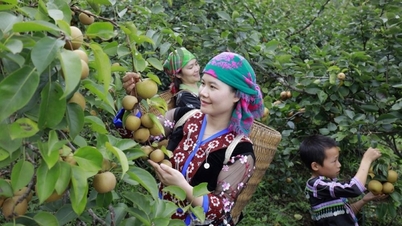
For many years, custard apple has been a staple crop, providing a stable income for many households in An Sinh ward, Quang Ninh province. However, along with intensive cultivation, custard apple growers also face numerous challenges from pests and diseases, soil degradation, and the increasingly demanding requirements of the market.
The implementation of integrated crop health management (IPHM) training courses is opening up a new approach, helping farmers improve their knowledge and change their production methods towards sustainability.
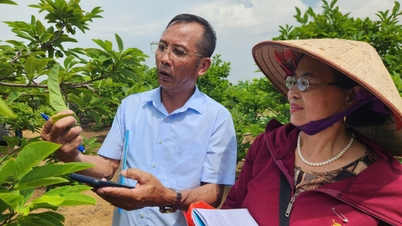
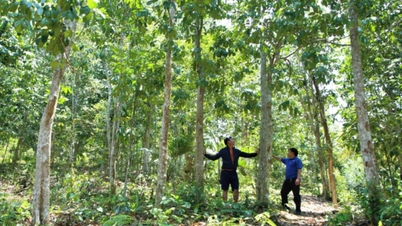
Having been involved in custard apple cultivation for over 25 years, Mr. Nguyen Van Khoa, residing in Tan Thanh 1 area, An Sinh ward, is a model producer in the locality. On an area of approximately 5,000m², his family currently maintains the production of the native custard apple variety and is gradually developing high-quality hybrid varieties.

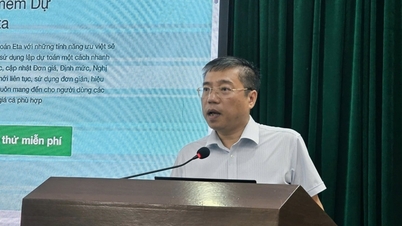
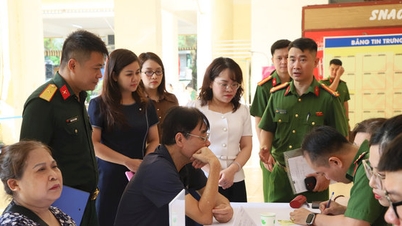
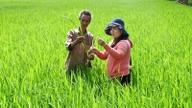
Mr. Nguyen Van Khoa and the trainees of the IPHM training class practice inspecting custard apple trees for pests and diseases. Photo: Nguyen Thanh.
According to Mr. Khoa, custard apple is a fruit tree with economic value but is also quite "fussy". If not regularly monitored and the correct technical measures are not applied, pests and diseases can easily arise, directly affecting yield and fruit quality.
"Custard apple trees are often infested with pests such as thrips, red mites, and mealybugs. These are common pest groups that affect the growth, development, and quality of the product if not controlled in time," Mr. Khoa said.
Previously, most people produced crops based on traditional experience, mainly learning from each other. The failure to detect pests and diseases at the right time, and the unbalanced use of fertilizers, resulted in low production efficiency. After many years of continuous cultivation, the soil showed signs of compaction and decreased fertility, increasing the risk of pest outbreaks.

Mr. Khoa shared that the current market not only demands custard apples that are visually appealing and delicious, but also places special emphasis on food safety. This creates pressure but also motivates custard apple growers to change their production methods towards a more scientific and sustainable approach.
These practical requirements have helped the IPHM training course at An Sinh receive a positive response from the people. Unlike previous IPM (Integrated Pest Management) courses that mainly focused on pest control, IPHM takes a more comprehensive approach, from soil health management and plant nutrition to pest monitoring and protection of the field ecosystem.
"Our people are very excited to participate in the training course. The new knowledge helps people better understand the nutritional needs of plants at each stage, learn how to monitor pests and diseases to treat them at the right time, and limit the use of pesticides when not really necessary," Mr. Khoa said.

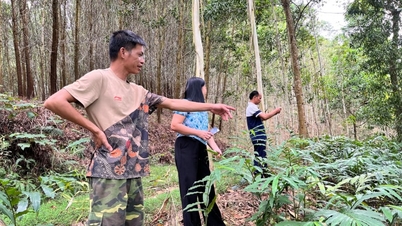
Each IPHM class has 30 students participating. Photo: Nguyen Thanh.
IPHM is an approach that the Ministry of Agriculture and Environment is encouraging to be widely implemented in agricultural production. This model not only helps reduce input costs but also contributes to environmental protection, improves the quality of agricultural products, and meets the increasingly stringent requirements of the market.
In recent years, Quang Ninh has promoted the application of safe agricultural production processes, VietGAP, organic farming, and integrated pest management on many key crops. Among these, custard apple trees in the Dong Trieu and An Sinh areas have been identified as one of the specialty products with potential for development into high-quality commercial goods.
Beyond simply improving the knowledge of individual households, the IPHM training courses aim to build a community of producers who learn together and apply technological advancements. After participating in the courses, many farmers committed to sharing their experiences and practical results with neighboring households.



"For now, we will apply all the knowledge we've learned to our own orchards. Once we see clear results, we will share it with other custard apple growers in the area so they can all adopt it," Mr. Khoa said.
According to the Quang Ninh Department of Crop Production and Plant Protection, in 2026, the province's agricultural sector will continue to organize IPHM training courses on many key crop groups. Specifically, courses will be implemented for rice in Quang Tan commune, Lien Hoa ward and Dong Trieu ward; fruit trees in An Sinh ward; and vegetables in Hiep Hoa ward. Each course will have approximately 30 participants.
The expansion of IPHM training courses demonstrates Quang Ninh's agricultural sector's determination to improve farmers' farming skills, gradually shifting from a production-oriented mindset to an agricultural economic mindset. When farmers are equipped with sufficient knowledge of plant health management, agricultural production will not only achieve higher yields but also ensure sustainability, creating safe products that meet the increasingly high demands of consumers.
Source: https://nongnghiepmoitruong.vn/nong-dan-hoc-cach-bat-benh-cho-cay-na-d814300.html