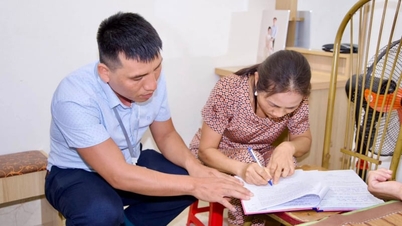
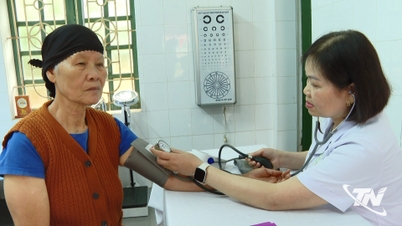
The demand for caregivers for the elderly is increasing. Photo: BAC SON
Demand is increasing rapidly.
At 7 a.m., the vehicles of Bach Nien Thien Duc Nursing Home (Tay Ho Ward, Hanoi) begin picking up elderly residents registered for daycare services. After being dropped off at the facility, the residents participate in various activities such as rehabilitation exercises, regular health check-ups, cultural activities, reading, or chatting with caregivers before returning home in the late afternoon.
Ms. Nguyen Thi Hong, 72 years old, residing in Cau Giay ward ( Hanoi ), said that her son and daughter-in-law both work all day, and her grandchildren are at school, so she spends most of her time at home alone. “At the center, I have someone to talk to, my health is monitored, and I can participate in group activities. Most importantly, my children and grandchildren feel more at ease,” Ms. Hong shared.
Meanwhile, Ms. Nguyen Mai Lan, 46, residing in Thanh Xuan ward (Hanoi), said that the pressure of caring for her elderly father-in-law often overwhelms her. Her husband frequently travels for work, her two children are of school age, and her job at a foreign-invested company takes up most of her time. “I really need the support of professionals in the elderly care industry. But currently, it’s very difficult to find suitable people,” Ms. Lan said.
According to Dr. Truong Xuan Cu, Vice President of the Central Committee of the Vietnam Association of the Elderly , while the number of elderly people is increasing rapidly, the traditional model of multi-generational families living together is gradually declining. Fewer and fewer elderly people are living with their children and grandchildren, leading to a growing need for professional care. Opening daycare models would be less expensive than full-day (residential) care centers and suitable for many elderly people who are still able to move around independently. Not only does this contribute to maintaining physical and mental health, but it also creates opportunities for the elderly to socialize and share experiences with their peers, thereby reducing feelings of loneliness and helping them live happier and healthier lives.
Shortage of skilled personnel.
Despite rapidly increasing demand, the development of elderly care centers still faces many challenges. According to observations at several nursing homes in Hanoi and Ho Chi Minh City, the biggest difficulty currently is the lack of properly trained personnel.
Statistics show that the country currently has nearly 135,000 volunteers providing healthcare for the elderly, but these are mainly population collaborators and the majority lack professional training. Meanwhile, the number of healthcare workers trained or educated in geriatrics is only about 7,849.



Mr. Nguyen Tuan Ngoc, Director of the Bach Nien Thien Duc Elderly Care System, said that caring for the elderly is not simply about assisting with meals or daily activities. Caregivers must have knowledge of nursing, psychology, rehabilitation, nutrition, and handling medical emergencies. “We can recruit general laborers, but it’s very difficult to find people with the right expertise. After recruitment, the center usually has to retrain them from scratch,” Mr. Ngoc said.
Recruiting nurses and caregivers is difficult, but retaining them is even more challenging. “The elderly are different from other groups. They often suffer from multiple chronic illnesses simultaneously, their health changes rapidly, and they have very specific psychological needs. Nurses not only assist with eating and personal hygiene but also need to engage in conversation, provide emotional support, and handle health emergencies. The job demands a high level of patience and responsibility, while the income isn't truly attractive, so many young people don't stay in the profession long-term,” shared Mr. Nguyen Tuan Ngoc.
In reality, this is not a problem unique to one facility. According to the Director of the Population Department, Le Thanh Dung, the number of doctors, nurses, and medical staff specializing in geriatrics is currently insufficient to meet demand. At the grassroots level, most commune and ward health workers, population collaborators, and social workers have not received specialized training in elderly care.
Notably, to date, Vietnam still lacks a formal workforce of "elderly care workers," a professional code, and official training programs at the intermediate, college, or university levels. This is considered a significant gap in the context of rapidly increasing long-term care needs.
According to population projections, the number of elderly people in Vietnam is expected to continue increasing rapidly between 2025 and 2030, from approximately 14.2 million in 2024 to nearly 18 million in 2030. While the average life expectancy is currently 74.7 years, the number of years lived in good health is only about 65.4 years. This means that, on average, each Vietnamese person spends about 8 years living with illness or functional decline. Notably, about 70% of elderly people suffer from two or more diseases.
The mechanism is also lacking.
Besides the human resources challenge, elderly care centers also face many difficulties regarding finances and operational mechanisms.
According to Dr. Truong Xuan Cu, by 2024, the whole country will only have over 300 elderly care centers serving approximately 11,000 people. This number is still very modest compared to the more than 14 million elderly people currently living in the country. Meanwhile, the current care facilities are unevenly distributed, mainly concentrated in Hanoi, Ho Chi Minh City, and a few other major cities. More than 70% of elderly people living in rural areas still face difficulties in accessing professional care services.
Mr. Ta Van Ha, Vice Chairman of the National Assembly's Committee on Culture and Social Affairs, contributed that localities should proactively build elderly care facilities at the ward and commune levels; and at the same time, utilize surplus facilities after administrative unit reorganization to develop community care models. Experts also suggested that the State needs stronger incentive mechanisms to attract the private sector to participate in investment.
Professor Giang Thanh Long from the National Economics University believes that for businesses to participate in this sector, clear policies on land, taxes, infrastructure standards, and human resources are needed. At the same time, services must be diversified to suit the affordability of different groups of people.
According to experts, population aging is no longer a story of the future but a reality of the present. Therefore, developing a system for caring for the elderly should be considered a new pillar of social security policy. "It is necessary to soon include the profession of elderly care in the national occupational list, establish a formal training program code, and standardize professional skills," said Le Thanh Dung, Director of the Population Department.



Ms. Dang Huyen, Head Representative of the United Nations Population Fund (UNFPA) in Vietnam, also suggested that caregivers need to receive thorough and in-depth training at each level, tailored to the needs of the elderly. Training should be standardized and enhanced with practical application to meet the requirements of care models in homes, communities, and specialized facilities.
According to Associate Professor Pham Tien Nam, from the School of Public Health, along with mobilizing social resources, it is necessary to focus on building a care network right in the family and community, helping the elderly to have their health monitored, receive rehabilitation, and participate in appropriate cultural and spiritual activities. Looking at international experience, daycare centers for the elderly have been quite successfully implemented in the UK, the US, Singapore, and the Netherlands. The common feature of these models is the combination of healthcare, mental support, and maintaining social connections for the elderly.
In Vietnam, the development of daycare centers, daycare centers, or community-based care is considered a suitable direction in the context of a rapidly aging population and changing family structures. However, for these models to truly become a new pillar of social security as expected, it is crucial not only to build more care facilities but also to prepare a workforce that is sufficient in number, strong in expertise, and has a sustainable operating mechanism.
According to Nhandan.vn
Source: https://baoangiang.com.vn/nut-that-nhan-luc-cham-care-nguoi-cao-tuoi-a488326.html