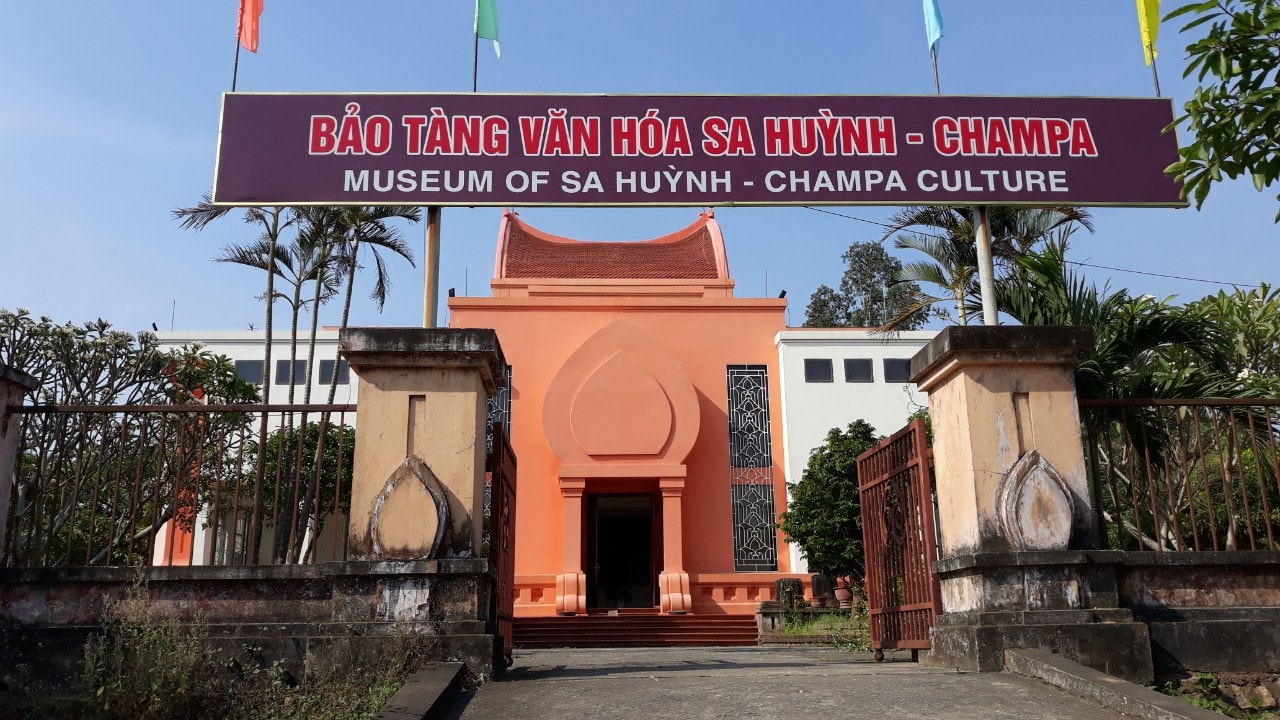
Sa Huynh - Champa Culture Museum. Photo: archival material.
1. The location of the Sa Huynh - Champa Culture Museum is right next to the Iron Bridge, in Kieu Chau village, just a few steps from Tra Kieu citadel.
Last night, I sat with my high school math teacher, Mr. Tran Van Chau, and he reminded me of... an old debt from several years ago.
When I asked the priest, speaking from the perspective of a resident of Tra Kieu, what was different about the lives of the parishioners there, he said, "Go and write about it yourself - it's that every child, from birth, has a foster father who stays with them until he passes away."
That's a beauty that ordinary people don't possess. It's like everything else in Tra Kieu.
The explanations, however appealing and logical, always leave a final, persuasive note: along with the teachings of the Bible, this place is full of strange things that have existed for a very long time.
I wandered around, lost in thought after what the teacher had said.
Ultimately, history is the convergence of transformations. As the years pass, layers of life cover the earth, burying the face of yesterday.
Ten years ago, I visited Triền Tranh, located in the Chiêm Sơn valley in Chiêm Sơn village, Duy Trinh commune, when archaeological excavations were underway there.
Subsequent reports were published. The artifacts were brought back and assembled here at the museum.
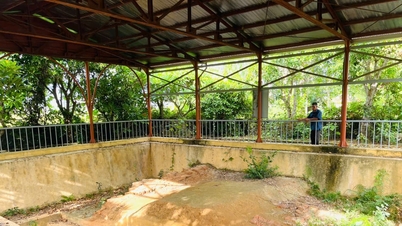
In 2024, Phi Thanh, a reporter from Duy Xuyen TV station, and I returned. Right next to the highway, the exploratory pits had been fenced off to preserve the site after numerous artifacts were discovered, including architectural materials, pottery, stoneware, and earthenware of various types.
I remember the experts saying that there were still too many mysteries beneath the ground. And that highway was built on top of what were believed to be palaces, castles, villages… but we had no choice, because we couldn't stop building the road.
For now, it can be confirmed that this may have once been a place for teaching practice. Accordingly, every year, from the capital of Tra Kieu, the king would gather the clergy at Trien Tranh to practice teaching scriptures, rehearse worship rituals and ceremonies, and observe fasting before performing rituals at My Son Sanctuary and other temple complexes in the region.
I looked at the stones arranged in order from smallest to largest, and imagined them as an inverted Cham tower. What's wrong with that? It's a painting that reverses the usual way of appreciating things, forcing one to read it with a different mindset.
And I remember my teacher's words, a detail that is not new but never outdated, that on the southern bank of the Thu Bon River - the land of Duy Xuyen - there will forever remain, both present and silent, beneath the surface, strange, mysterious voices, as familiar as food and drink, yet sometimes fleeting, sometimes revealing themselves and scratching. Those rocks are an example.
Let's say from Tra Kieu to My Son, everywhere you look you see rocks, everywhere you dig you stumble upon Cham bricks, and they're not just lying there isolated. Occasionally, there's a sudden discovery of archaeological artifacts related to Sa Huynh - Champa... Then we dig and stop. Like a moment of rest. For me, as a researcher and archaeologist specializing in Champa, just cultivating this land is enough to last a lifetime.
2. It's too early, no one has opened the museum yet.
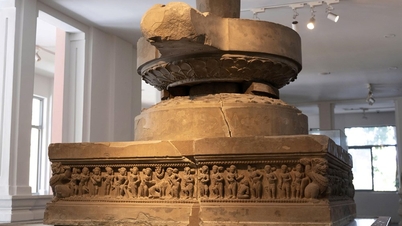
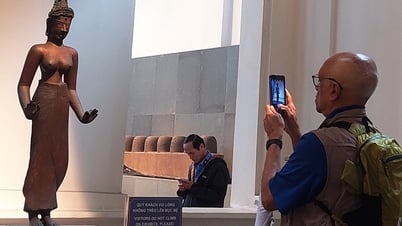
As many as 400 artifacts from the Sa Huynh - Champa period are on display here. Each has its own voice, its own face, creating a brilliant symphony before the grand concert completely disappears from the face of the earth.
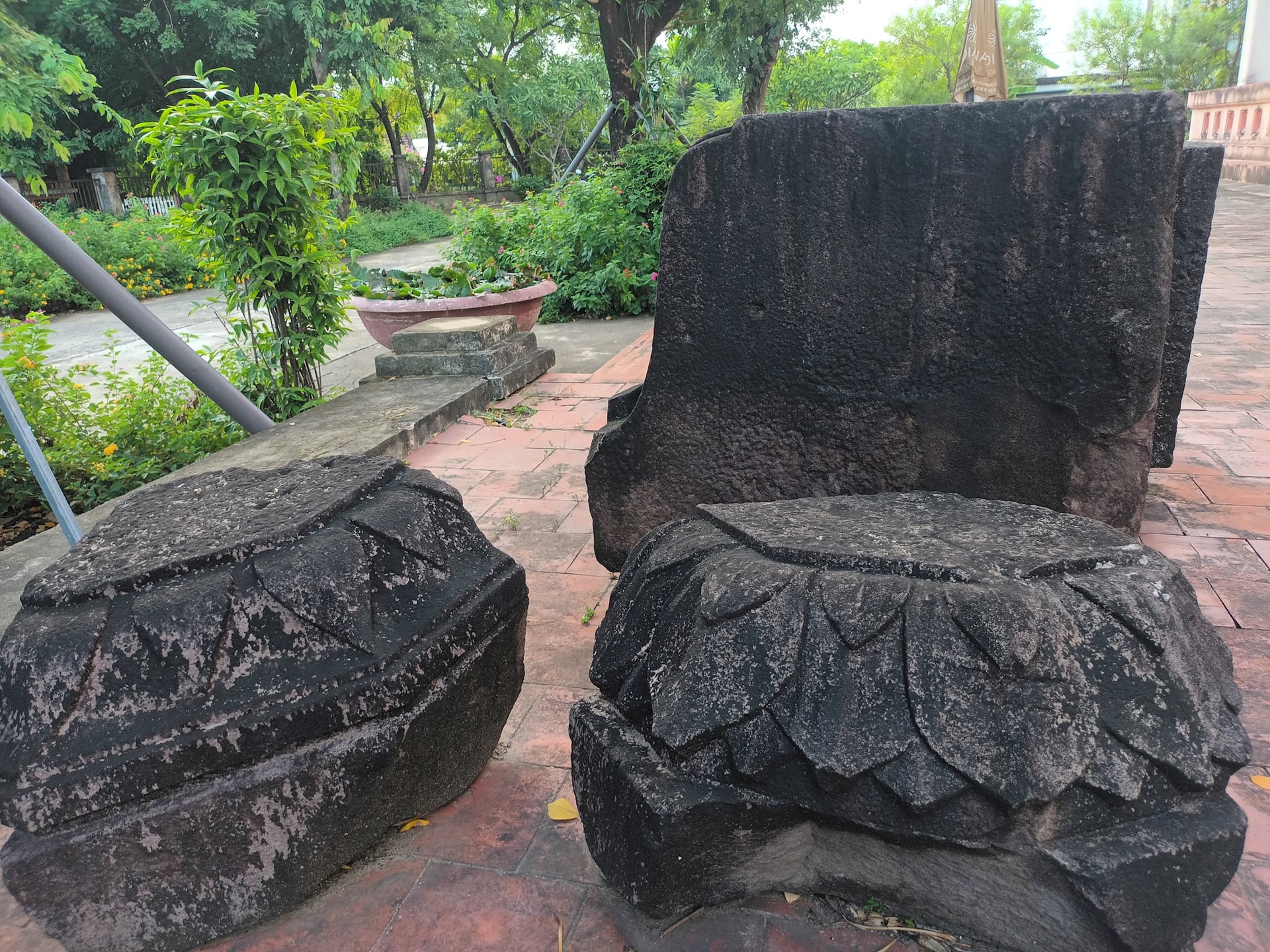
A stone slab in the grounds of the Sa Huynh - Champa Culture Museum. Photo: TV
The remaining site, like My Son, is listed as a World Heritage site, but I believe, as people have said, it is the unknown that truly astonishes the world! What it is, only time will tell. It lies deep underground, in the fields and gardens, beneath the foundations of houses, in the fading memories of the elderly, and even in the hasty notes of those who have experienced moments of stunned wonder...
There are two rows of exposed stones in the courtyard, where I linger, their dark color resembling half of a yin-yang symbol. A large stone pedestal is carved with the image of a lotus bud.
And over there are the two largest blocks: perpendicular lines as if precisely machined, and curves like silk in the wind. Looking closely, they resemble a waterfall.
Column bases. Verandas. Steps. Stories from millennia ago, yet they feel like they happened just yesterday. Footage of open-air museums around the world floods back to me, and I can't help but chuckle softly.
For example, if we were to start from Tra Kieu Citadel, run all the way to My Son, demolish all the houses and structures, and excavate until nothing remains, surely nowhere else would have a museum as large, magnificent, mysterious, and full of stories about temples, people's lives, religion, and even the chaotic swords and spears of a bygone era as this place?
You mentioned that you were talking to someone from the south, and that your father was frail and hadn't been back to his hometown for a long time. One day, he suddenly brought up an old topic: he said that people up there probably still perform the ritual of offering sacrifices to the earth deity in February. After saying that, he fell silent.
He's living with memories. He doesn't remember everything else, only the essential fish sauce that must be present during the offering, then putting everything into a folded banana leaf and hanging it outside or throwing it into the river. My friend and I both laughed.
But I believe it is the heartfelt gratitude of a lifetime of people from Quang Nam province who diligently toiled in their fields, entrusting their faith in peace and happiness, as well as their gratitude to the divine, to the land.
Perseverance lasted throughout their lives. A whetstone for sharpening knives. A pillar base. Road paving. House construction. Corn and cassava grew on the rocks. Then died buried in the rocks.
3. Whether Cham or Hoi, the chilling stories told from the rocky fields or from within the My Son towers, from the misty Chua Mountain, are stories they dare not whisper in the middle of the night, but in the morning, everything seems forgotten, because it is their rice field, their village well.
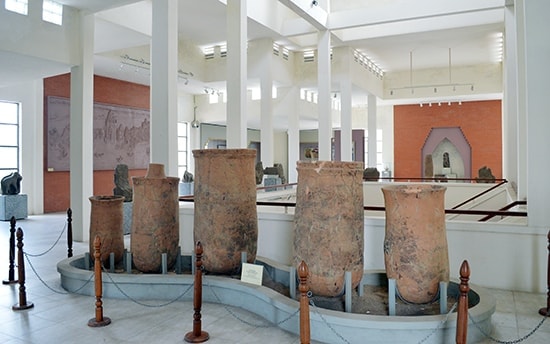
Artifacts on display at the Sa Huynh - Champa Museum. Photo: archival material.
Champa bricks and stones are my way of life. As for the rest, I only know that it's better to be safe than sorry.
It's a cultural lesson that doesn't require a textbook, but those who seek and practice it surely harbor a profound admiration for heaven and earth, which they will express when the opportunity arises.
Never before has the call to "return" to nature and live in harmony with it been as fervent as it is now. There are widespread calls for this, from farming practices to behavior. You hear them everywhere you go.
It was inevitable, or rather, it's the present moment; people are bearing the consequences of yesterday and the day before, throwing their rage and ambition into so many things without any measure or benchmark.
To be frank, Vietnamese people have a major flaw: very few of us do anything perfectly. The same goes for our culture.
The borrowing, patching, and reconstruction... all look somewhat similar and rudimentary.
And even after restoring its original form from yesterday, it only lasts for a short while before it transforms again.
My Son and the Cham bricks and stones are fortunate because these are "mysteries" that no one is capable of solving completely, and the question of when the mystery will end is uncertain; it is not certain that this century will be able to answer it.
A single stone in hand, thousands of years later, future generations will never be able to replicate it exactly.
A majestic temple, weathered by sun and rain, stands like an endless, fearless, and unwavering prayer before the pleading, tormented eyes of those who follow, yearning to know its innermost thoughts.
I gazed at the cold, gray stone pedestal, like the fossilized remains of an enlightened monk who had passed into the realm of Buddha. There was only silence and more silence.
The only way to know what the stones will say tomorrow is to ask them. What is it?
A gentle breeze wafted by. The dry leaves rustled in the corner of the garden. Autumn had arrived.
Source: https://baodanang.vn/o-do-da-noi-loi-ngay-mai-3300870.html


![[Photo] General Secretary and President To Lam and the President of the Philippines hold talks.](https://vphoto.vietnam.vn/thumb/1200x675/vietnam/resource/IMAGE/2026/06/01/1780286997787_anh-man-hinh-2026-06-01-luc-11-09-43.png)

![[Photo] Reception to welcome General Secretary and President To Lam and his wife on their State visit to the Philippines](https://vphoto.vietnam.vn/thumb/1200x675/vietnam/resource/IMAGE/2026/06/01/1780295488620_vna-potal-chieu-dai-chao-mung-tong-bi-thu-chu-tich-nuoc-to-lam-va-phu-nhan-tham-cap-nha-nuoc-toi-philippines-8798060-7855-jpg.webp)































































Comment (0)