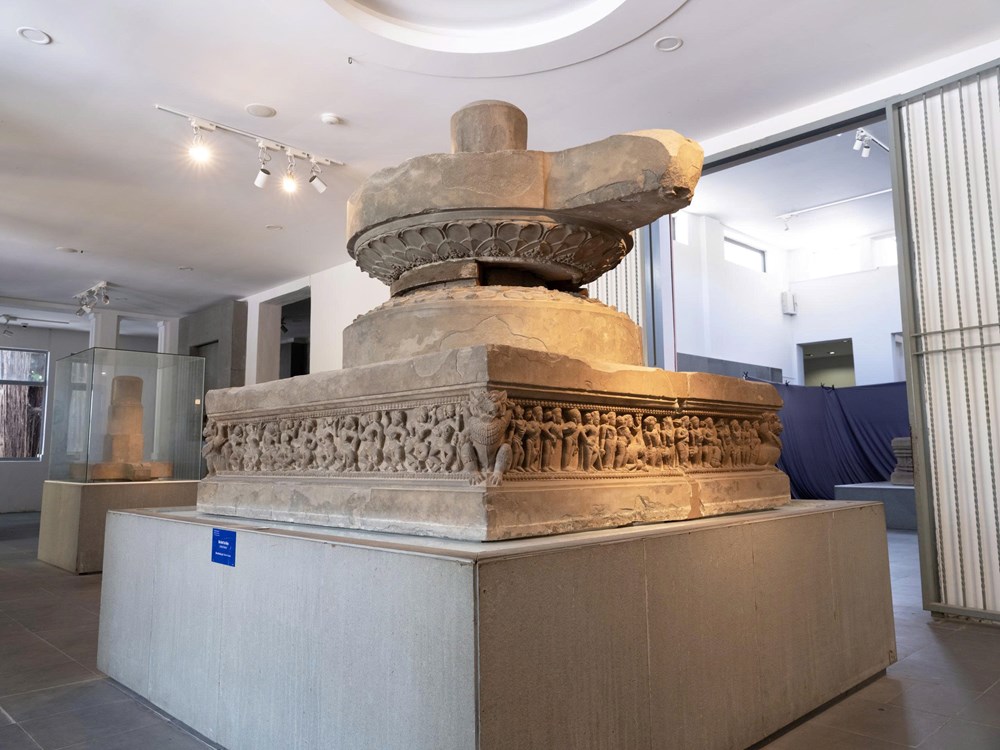
The Tra Kieu altar is currently preserved at the Da Nang Cham Sculpture Museum. Dating from the 7th-8th centuries, the altar is made of sandstone and measures 128cm high, 190cm long, and 190cm wide.
A masterpiece that "challenges" posterity.
The Tra Kieu altar was discovered in 1918 at the main tower of the Tra Kieu capital (formerly Quang Nam province) and was recognized as a National Treasure in 2012.
This is a prime example of Champa sculpture from the 7th-8th centuries. However, this artifact did not appear intact from the beginning, but is the result of a process of assembly and adjustment that lasted more than a century.
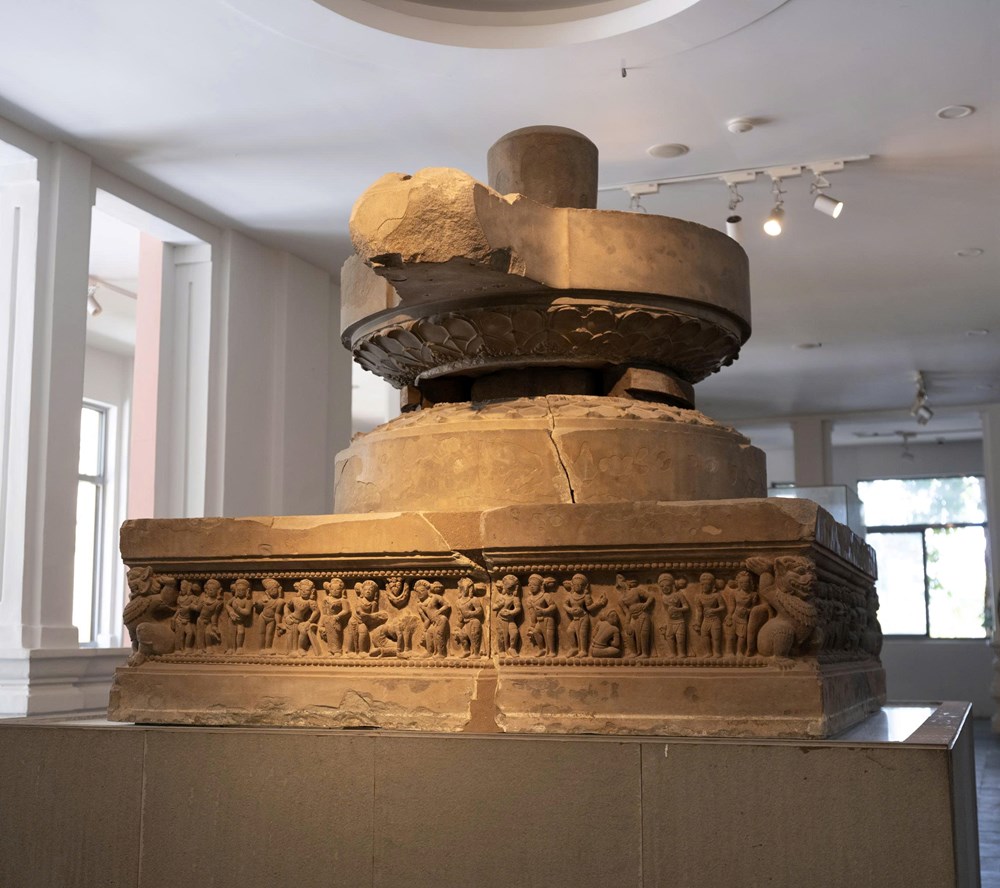
The Tra Kieu altar is a prime example of Champa sculpture from the 7th-8th centuries.
This very discontinuity has made the content of the carvings a subject of intense debate. Previously, scholars often tried to place these figures within the framework of Hindu mythology (such as the love story of Rama and Sita or the god Krishna), but no hypothesis has consistently explained the entire composition of the altar.
Based on interdisciplinary research, a new interpretation can be proposed: the Tra Kieu altar is essentially a stone epic about the life of the Buddha. Accordingly, the carved panels are deliberate slices, organized according to a unified ideological structure.
Side A: The display of power by a great man (The Manifestation)
The story begins with the "Archery Competition" - where Prince Siddhārtha must prove his status as a perfect Kshatriya to dispel the doubts of his wife's family.
On the sculpture of the Tra Kieu Altar (side A), the ancient artisans skillfully depicted this dramatic moment. Prince Siddhārtha tried to draw an ordinary bow, but as soon as he raised it, the tip snapped. He turned to ask his father, King Śuddhodana, if there was a more suitable bow. King Śuddhodana then ordered strong men to carry out the legendary Simhahanu bow.

Side A of the Tra Kieu Altar. Source: Cham Sculpture Museum.
The prince's act of lifting the bow, which his opponents could not budge, and shooting an arrow that pierced seven palm trees and embedded itself deep in the ground, clearing the stream, was an affirmation of the Bodhisattva's absolute power in the three realms before he embarked on his journey to negate it.
Side B: The Great Renunciation (The Exodus)
If side A represents the cloak of fame and glory, then side B, the Tra Kieu Altar, is a painful stripping away of that cloak. Seeing the weary state of the palace maids as they slept, the Crown Prince realized that the palace was essentially a "living graveyard" and resolved to leave.

Side B of the Tra Kieu altar. Source: Cham Sculpture Museum.
On the Tra Kieu Altar sculpture (side B): On the solemn stone surface, the image of Prince Siddhārtha riding his horse Kanthaka, along with his trusted servant Chandaka, silently leaving the palace is vividly recreated, marking the first steps into the great darkness in search of light.

Discover 19 national treasures on display at the Cham Sculpture Museum.
VHO - For the first time, locals and tourists have the opportunity to be introduced to and admire the full images of 19 national treasures at the thematic exhibition "National Treasures - Heritage in the Heart of Da Nang" held at the Da Nang Cham Sculpture Museum.
On the banks of the Anoma River, he performed the ritual of "social suicide": removing his jewelry, cutting his hair, and exchanging his silk garments for a faded robe, completing the transformation from "having everything" to "having nothing."
Side C: The earth-shattering reunion (The Transformation)
After attaining enlightenment, the Buddha returned to his hometown to transform his family. Instead of going straight to the palace, he took his alms bowl and went begging for food, causing a great shock to his father and affirming that his true legacy was the "Buddha lineage," not royal lineage. But the most moving moment was the reunion with his wife, Yaśodharā.

Side C of the Tra Kieu Altar. Source: Cham Sculpture Museum.
On the sculpture of the Tra Kieu Altar (side C): The sculptural art here reaches a level of subtle symbolism. Yaśodharā's wife kneels and kisses the feet of Prince Siddhārtha. The presence of the Buddha is depicted in an "aniconic" style – not a human figure, but only represented by a garland suspended high above, suggesting a sacred and transcendent presence.
Side D: The Song of the Universe
The arduous journey concludes with the universe's honoring of the perfect transformation.
On the sculpture of the Tra Kieu Altar (side D): Graceful Apsara dancers dance, scattering lotus flowers to celebrate the perfect attainment of enlightenment.

Side D of the Tra Kieu Altar. Source: Cham Sculpture Museum.
Based on the above arguments, it can be concluded that the three events of Archery, Departure, and Return depicted on the altar surfaces are not disjointed, but form a complete dialectical structure.
From affirming the greatest self (Manifestation), He moves to the complete negation of that self (Renunciation), and finally returns (Transformation) with a new being, a perfect harmony between transcendence and worldliness.
Source: https://baovanhoa.vn/van-hoa/ban-truong-ca-da-ve-cuoc-doi-duc-phat-190707.html


![[Image] Hanoi Police officially crowned champions of V-League 2025/2026](https://vphoto.vietnam.vn/thumb/1200x675/vietnam/resource/IMAGE/2026/05/31/1780244769054_ndo_br_039d561b692be875b13a-jpg.webp)
![[Photo] Solemn bathing ceremony and Buddha procession in Hue](https://vphoto.vietnam.vn/thumb/1200x675/vietnam/resource/IMAGE/2026/05/31/1780228263543_1-jpg.webp)
![[Photo] Admire the coral "masterpiece" amidst the million-year-old heritage of Dak Lak province.](https://vphoto.vietnam.vn/thumb/1200x675/vietnam/resource/IMAGE/2026/05/31/1780221235105_anh-man-hinh-2026-05-31-luc-16-53-27.png)
![[Photo] The General Secretary, President and his wife begin their state visit to the Philippines.](https://vphoto.vietnam.vn/thumb/1200x675/vietnam/resource/IMAGE/2026/05/31/1780230559452_anh-man-hinh-2026-05-31-luc-19-28-11.png)















![[Video] Sunset at Lap An Lagoon – Where the sun sets over the fishing nets](https://vphoto.vietnam.vn/thumb/340x192/vietnam/resource/IMAGE/2026/05/31/1780192137701_beach-landscape-sea-water-nature-grass-745871-pxhere-com.jpeg)





























![[Photo] Admire the coral "masterpiece" amidst the million-year-old heritage of Dak Lak province.](https://vphoto.vietnam.vn/thumb/402x226/vietnam/resource/IMAGE/2026/05/31/1780221235105_anh-man-hinh-2026-05-31-luc-16-53-27.png)






















Comment (0)