


That flag wasn't sewn on a special day.
There was no formal award ceremony.
There was no music.
The flag was folded neatly and placed in the backpack of a young soldier, as it departed the mainland on a ship at midnight.
The sea was dark and the waves were high. On the deck, the soldier leaned against the railing, clutching his backpack tightly, as if afraid a sudden wave might sweep away something very important. Later, I learned that inside that backpack was the flag that would be raised at the most remote island he had ever set foot on.
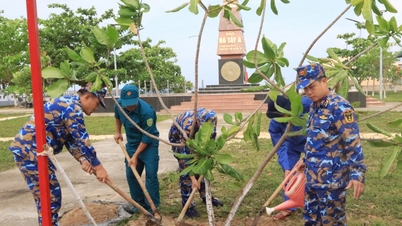
On Da Tay Island, the wind was strong that morning. The national flag fluttered in the sunlight, stretching to its fullest extent, a breathtakingly vibrant red. A young soldier stood at attention beneath the flagpole, his eyes unblinking. His name was Nguyen Van Thanh, a soldier from the 4th Naval Region. This was his first time on an extended duty on the island.
"We're used to raising the flag at the barracks, but it's very different out here. Every time I look at the flag, I think of home," soldier Thanh confided.

The national flag flies high over the islands of our homeland.
In this place at the forefront of the waves, the flag not only marks sovereignty but also bridges seemingly vast distances: between the island and the mainland, between soldiers and their families, between the present and history. Sovereignty, it turns out, begins with the feeling of not allowing oneself to relinquish it. The flag is raised in the wind but is preserved by the people.
In a small house in Da Nang , Mr. Phan Van Du, a veteran who served in the Paracel Islands, opened an old wooden box. Inside was a worn piece of red cloth. "That's the flag we used to hang on the island," Mr. Du said. Mr. Du didn't say much about the day he left the Paracel Islands, only saying, "We left without a chance to look back."
People like Mr. Du may no longer have the opportunity to return to the islands, but they have never left Hoang Sa from their memories. They are living witnesses, affirming that Vietnam has been present, managed, and exercised sovereignty over the islands from a very early, long time, and completely peacefully . Despite all false arguments and denials of history, the memories of these people are an undeniable truth.
In the Spratly Islands, I met a soldier doing a job that few people pay attention to: inspecting the flagpole. His job was to observe it daily, measure its tilt, and tighten the screws when the wind was strong. The soldier told himself, "If the flagpole is tilting, I feel uneasy."
No one asked him to do it so often. But he still did it, out of habit. Perhaps, maintaining sovereignty isn't always achieved through grand moments, but through small, repeated actions that become reflexive.
On the fishing boat of Tran Quoc Phuc from Quang Ngai, the national flag flies at the bow. He ventures out to the Hoang Sa and Truong Sa islands, fully aware of the risks, but he still goes. Not to prove anything significant, but because: "That's the sea our ancestors sailed, so we should go too." And for him, the national flag is a close companion. Boats like Phuc's, flying the flag and staying at sea, are "mobile landmarks," present peacefully, continuously, and persistently.
Millions of national flags from the "Millions of National Flags for Fishermen Staying at Sea" program, now known as the "Proud of the National Flag" program of the Nguoi Lao Dong Newspaper, have been spreading across provinces and cities, reaching fishermen in every coastal region and along every border. This is a symbol of patriotism and national pride.
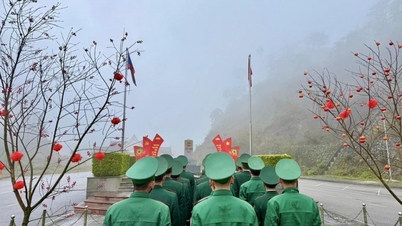
At a border outpost in the northern mountains, it was early morning, and the weather was calm. The flag was raised, standing proudly against the vast sky. A young soldier said, "It's sacred, sir!"
In the border region, small roads now feature "National Flag Roads" stretching through villages. The border is silent, without the sound of waves, yet possesses an enduring resilience much like the open sea.
At an international conference, a Vietnamese diplomat recounted that sometimes, even a slight change in wording can lead to misunderstandings about sovereignty. Defending the country today is not just about physical presence on the ground, but about reason, law, perseverance, and prudence. The strategy of protecting the homeland "early and from afar" means preventing conflict but also ensuring that the truth is not violated.
In a primary school class in Ho Chi Minh City, the children drew the national flag to send to the islands. Some children colored the five-pointed star unevenly, others drew flagpoles too tall for the paper. The teacher encouraged them: "Just keep drawing, the people on the islands will understand." Perhaps, sovereignty is nurtured from those imperfect drawings.
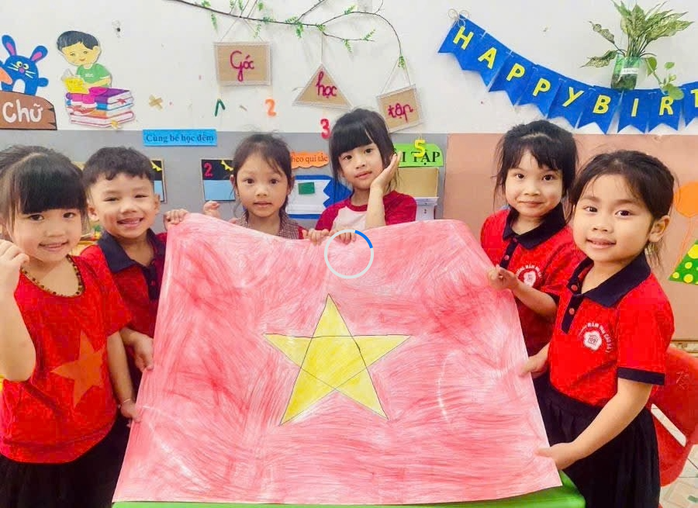
Elementary school students drew the national flag to send as a gift to soldiers on the island.
2025 marks the 50th anniversary of national reunification. The war is over, but defending the country is never a thing of the past. The flag that once rested in the soldier's backpack has faded, but it remains neatly folded and placed in the most prominent spot on the island.
The sea is still awake.
The forest remained silent.
And those people—from soldiers, fishermen, and diplomats to children drawing flags—embraced their homeland.

Source: https://nld.com.vn/om-tron-to-quoc-vao-long-19626011720270575.htm
![[Photo] Prime Minister Pham Minh Chinh receives the Director General of TASS News Agency (Russian Federation)](https://vphoto.vietnam.vn/thumb/1200x675/vietnam/resource/IMAGE/2026/02/25/1772024599891_dsc-8041-jpg.webp)
![[Photo] Prime Minister Pham Minh Chinh presides over the meeting of the Steering Committee for the Development of Science, Technology, Innovation, Digital Transformation and Project 06.](https://vphoto.vietnam.vn/thumb/1200x675/vietnam/resource/IMAGE/2026/02/25/1772024613089_1772024091685-jpg.webp)






















































![[Photo] Lung Phinh is covered in white plum blossoms.](https://vphoto.vietnam.vn/thumb/402x226/vietnam/resource/IMAGE/2026/02/25/1772036291497_tl-z7563533595318-d0f6815e01d4b292632a5f65d005af7d-8745-jpg.webp)












Comment (0)