

According to the Ministry of Agriculture and Environment , there is no need to worry too much about the falling price of rice because the situation will return to normal when countries increase rice imports.
On March 7th, in Can Tho City, Deputy Prime Minister Tran Hong Ha chaired a conference on rice production and market; and drought and salinity control in the Mekong Delta. Attending the conference were leaders from various ministries, sectors, provinces and cities in the Mekong Delta region, as well as associations and businesses involved in rice trading and export.
Farmers are still making a profit.
Over the past two months, domestic rice purchase prices have tended to fall sharply compared to the last months of the year and the same period in 2024.
In the Mekong Delta region, the price of fresh IR 50404 rice is currently only 5,400 - 5,500 VND/kg; OM 5451 is 5,600 - 5,800 VND/kg; Dai Thom 8 and OM18 are being purchased by traders at only 6,200 - 6,300 VND/kg; ST24 is priced at 8,200 - 8,300 VND/kg. Rice prices have decreased by about 2,200 - 2,700 VND/kg compared to the average price of 2024.
At the conference, Deputy Minister of Agriculture and Environment Tran Thanh Nam stated that rice prices have fallen amidst a projected planting area of 7 million hectares this year – a decrease of 132,000 hectares compared to 2024.
Regarding rice, in the first two months of the year, export volume is estimated at 1.1 million tons, an increase of 5.9%, but the value is only $613 million, a decrease of 13.6%. In the early days of March, export rice prices continued to fall sharply, reaching $310/ton for 100% broken rice; $393/ton for 5% broken rice and $367/ton for 25% broken rice. The Philippines, Ivory Coast, and Ghana are the three largest export markets for Vietnam.
According to Mr. Tran Thanh Nam, the price of rice has fallen due to factors such as: increased global supply, putting pressure on the global market, while import demand from other countries has decreased and shows no signs of recovery in the short term. In addition, India has ended its rice export ban and returned to the market with abundant production.
Minister of Agriculture and Environment Do Duc Duy stated that domestic rice prices are returning to 2023 levels before any sudden spikes in 2024, including export prices. However, with current export and domestic rice prices, there's no need to worry too much. This is because, with IR 50404 paddy prices at 5,400-5,500 VND/kg and production costs at only 3,800-4,300 VND/kg, farmers still earn a profit of around 30% or more.
According to Minister Do Duc Duy, the situation may return to normal after about 3 months, or in the middle or end of the second quarter of 2025, when the demand for rice imports from other countries is projected to increase again. In addition, assessments by the US Department of Agriculture indicate that this year, indicators for rice production, demand, and inventory levels are still increasing.
Responding to farmers' concerns about the drop in export rice prices leading to a decrease in paddy prices, Mr. Le Thanh Tung, Vice Chairman of the Vietnam Rice Industry Association, said this is normal and there is no need to worry too much. "Price increases or decreases are not due to rice shortages or surpluses, but simply seasonal situations in the region. We have observed that rice exporting companies have continued to increase their purchases in the first few months of this year," he stated.
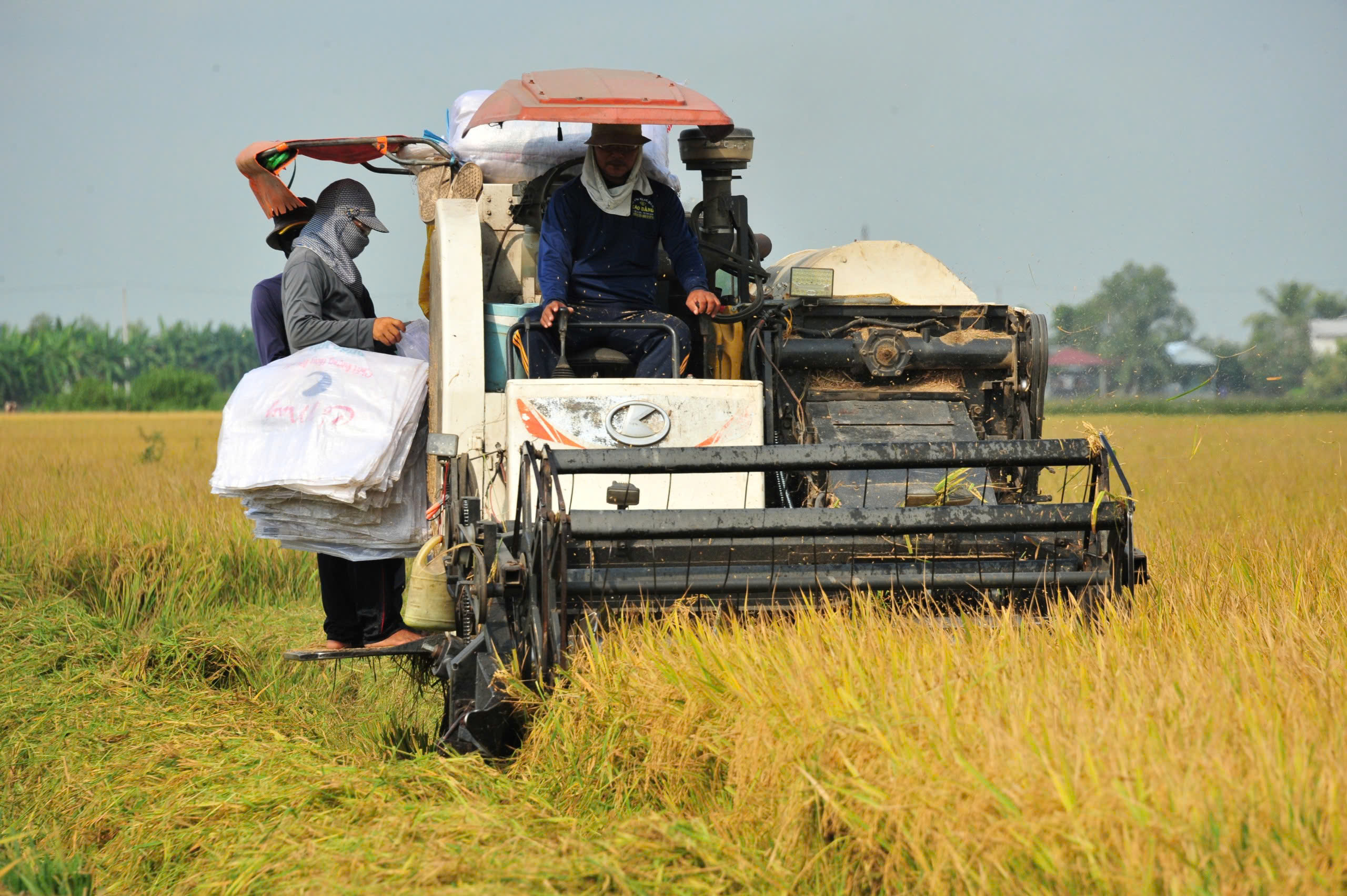
Although rice prices have fallen this year, farmers are still making a profit. (Photo: Hoang Vu)
Strengthening support for businesses
Mr. Nguyen Ngoc Nam, Chairman of the Vietnam Food Association (VFA), believes that the decrease in rice prices is due to global trends. Notably, high-quality rice accounted for 80% of the 1.1 million tons exported in the past two months. Therefore, in this high-quality rice market segment, Vietnam does not face much competition from India and Thailand.
"The crucial issue right now is to remove obstacles for businesses, especially regarding capital. Businesses offering low prices are due to short loan terms and credit limits, forcing them to sell to generate working capital and lacking funds for purchasing reserves," Mr. Nguyen Ngoc Nam analyzed.
Mr. Tran Tan Duc, General Director of Southern Food Company (Vinafood 2), offered an optimistic view, stating that the current rice price of 5,400 - 5,500 VND/kg represents an increase of 200 - 300 VND/kg compared to February.
Recently, Vinafood 2 negotiated with the Government of Bangladesh to supply 100,000 tons of rice, to be distributed among 157 VFA members. This has contributed to the increase in rice prices in recent days.
Mr. Duc suggested: "Winter-spring rice is the highest quality rice of the year, so we should boldly buy and stockpile it. If the summer-autumn crop is affected by rain and there is no rice for export, businesses can use the winter-spring rice reserves to fulfill orders."
In his concluding remarks at the conference, Deputy Prime Minister Tran Hong Ha assessed that the policy response to developments in the rice market has been timely. However, providing information to the public and businesses about weather developments, production activities, and exports in the world market remains a weakness. Nevertheless, forecasts and assessments of global rice demand indicate good prospects for Vietnamese rice, which has its own brand and market segment.
The Deputy Prime Minister stated that farmers everywhere face great hardship and significant risks due to climate change and weather conditions. This issue has persisted for a long time, so solutions must be implemented immediately. First and foremost, it is necessary to ensure that farmers who have invested in production in the context of a difficult market receive support from the government through mechanisms and policies.
Regarding the recent sharp drop in rice prices, the Deputy Prime Minister requested the Ministry of Industry and Trade to investigate whether or not businesses are providing inaccurate information to manipulate purchase prices. The Ministry of Industry and Trade must urgently advise on amending and supplementing Decree 107/2018/ND-CP on rice business and export to remove difficulties and obstacles for businesses.
Regarding the request for loans from businesses, the Deputy Prime Minister suggested that the State Bank of Vietnam provide interest rate support in the agricultural sector. In addition, the banking sector needs to have policies for low-interest loans in agriculture.
Production and export plans have not yet been adjusted.
According to Minister of Agriculture and Environment Do Duc Duy, it is necessary to clarify why the price of Vietnamese rice has fallen more sharply than in other countries? Is there unfair competition, panic selling, or traders going through multiple layers of intermediaries to lower prices?
As the Mekong Delta is in the midst of harvesting its winter-spring rice crop, the Minister of Agriculture and Environment stated that both short-term and long-term solutions are needed to maintain and develop a sustainable market. Despite the difficulties, we should not be pessimistic to avoid being pressured by importers to lower prices.
In the short term, the Ministry of Agriculture and Environment (MARD) has requested that localities in the Mekong Delta region ensure production targets are met according to plan; adapting to climate change, natural disasters, and drought and salinity intrusion. Minister Do Duc Duy affirmed that, to date, the MARD has not considered adjusting the production and export plan for 2025.
Mr. Duong Duc Quang - Deputy General Director of the Vietnam Stock Exchange (MXV):
Expectations for a recovery in rice export prices.
Importers from the Philippines are returning to purchase Vietnamese rice, believing that prices have hit rock bottom. In the medium and long term, as demand from importing markets stabilizes – especially from traditional partners like the Philippines, Indonesia, and Malaysia – and Vietnamese businesses improve production processes and brand positioning, the prospect of maintaining or recovering export rice prices is plausible.
Currently, in the context of sharply falling export rice prices due to global oversupply, timely monitoring of price developments and supply-demand trends will help businesses adjust their production, business, and export plans accordingly.
Aiming to build a stable and sustainable rice industry in general, and rice prices in particular, businesses should cooperate with localities, cooperatives, and farmers to build high-quality production chains. The government and businesses need to help farmers improve their knowledge and implement closer linkages to overcome the situation of small-scale, fragmented production and shift their production mindset towards an industrial economic mindset. Once the input chain of the industry is high-quality, and rice production is stable and of good quality, the entire rice industry, including processing and exporting businesses, will benefit and develop sustainably.
Mr. Nguyen Thai Viet Huy, Chairman of the Board of Directors of Saty Holding Investment Joint Stock Company:
We need to rethink the rice industry.
Vietnamese rice is delicious, but currently has the lowest price in the world because businesses lack the capacity to wait for prices to rise. Their capacity, including capital and infrastructure for storing goods, is weak, so when rice prices are low, they have to "dump" prices to sell.
In my opinion, we need to rethink the rice industry, diversify markets, and focus on deep processing, only producing when there are orders. We also need to reconsider the industry's goals: ensuring global food security, maintaining our position as one of the world's top rice exporters, or ensuring profitability for farmers. Furthermore, we need mechanisms to encourage rice production models based on orders and guaranteed output. Only then will farmers feel secure in growing rice.
Recorded by L. Thúy and N. Ánh
Source: https://nld.com.vn/on-dinh-thi-truong-lua-gao-196250307232823731.htm


![[Photo] National Assembly Chairman Tran Thanh Man meets with General Secretary and President of Laos Thongloun Sisoulith](/_next/image?url=https%3A%2F%2Fvphoto.vietnam.vn%2Fthumb%2F1200x675%2Fvietnam%2Fresource%2FIMAGE%2F2026%2F01%2F26%2F1769424443676_ndo_br_bnd-2007-jpg.webp&w=3840&q=75)


![OCOP during Tet season: [Part 1] Ba Den custard apples in their 'golden season'](/_next/image?url=https%3A%2F%2Fvphoto.vietnam.vn%2Fthumb%2F402x226%2Fvietnam%2Fresource%2FIMAGE%2F2026%2F01%2F26%2F1769417540049_03-174213_554-154843.jpeg&w=3840&q=75)





Comment (0)