

To ensure that 9th-grade students in the three regions (formerly Ho Chi Minh City, Binh Duong, and Ba Ria-Vung Tau) are uniformly and optimally prepared for the 10th-grade entrance exam in the 2026-2027 school year, the Ho Chi Minh City Department of Education and Training has announced a third exam subject: a foreign language, along with the orientation and scope of knowledge for the exam.
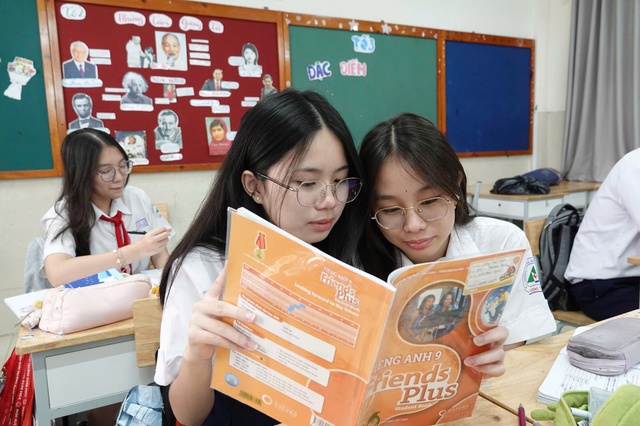
The Ho Chi Minh City Department of Education and Training has announced that the third subject for this year's 10th grade entrance exam will be a foreign language.
PHOTO: DAO NGOC THACH
MATH SUBJECT: ENHANCE PRACTICAL SKILLS AND THINKING, AVOID ROTE-LEARNING
According to Mr. Dang Huu Tri, head of the mathematics department at Nguyen Du Secondary School (Ben Thanh Ward, Ho Chi Minh City), the sample exam for the 10th grade entrance exam in Ho Chi Minh City in 2026, released by the Department of Education and Training, maintains the same structure as last year, consisting of 7 questions with familiar math types. The first two questions are at a basic level; questions 3 to 6 are practical math problems, and question 7 is plane geometry. Overall, it's "easier" than last year, but requires students to have a solid understanding of the subject, enhance their practical skills and critical thinking, and avoid rote memorization. Students who are overconfident may make mistakes as early as question 2b – a question testing basic knowledge.
The four practical problems clearly differentiate the difficulty levels of each question, with question 6 being the most challenging. Each question also has a finely divided point system, making it easier for students to score well. However, these practical problems still demand high levels of problem-solving skills and the ability to apply knowledge to real-world situations.
One point to note is that this year the level of application in the sample exam has decreased compared to last year (from 40% to 30%). This reduction in the level of application is considered appropriate given the context of the first exam after the merger, but it still requires students to have solid knowledge, good test-taking skills, and a reasonable level of reasoning ability to achieve high scores.
For students, right from the beginning of the second semester, it's advisable to systematically review foundational knowledge in the form of topics and specialized subjects. Develop a suitable learning plan for each timeframe and divide the review and practice sessions into scientifically structured phases. Avoid cramming everything into the last few days before the exam, as this will be too late.
Teacher Tri reminded students during their review process to pay close attention to the structure of the sample exam, and not get bogged down in "unusual and difficult" types of exercises. Because the exam tends to innovate in assessing the development of abilities for each student, having "solid knowledge, proficient skills, and good thinking" is sufficient to meet the requirements of the mathematics subject for the 10th grade entrance exam.
LITERATURE SUBJECT: MASTERING KNOWLEDGE AT THE SECONDARY SCHOOL LEVEL
Mr. Nguyen Duc Uy, head of the Literature Department at Tran Van On Secondary School (Tan Dinh Ward), commented that the structure of the 10th grade entrance exam in Literature not only focuses on literary knowledge but also comprehensively assesses students' language and thinking abilities, more accurately reflecting their learning capacity. This guides students towards the holistic development of language skills, critical thinking, and creativity.
The format and assessment guidelines for students announced by the Department of Education and Training show that students cannot rely on rote learning or memorization, but need to have a solid grasp of secondary school knowledge, especially Vietnamese language knowledge from grades 6 to 9.
According to Mr. Uy, with the exam format based on the 2018 General Education Program, students must grasp the methods and characteristics of each genre. Since the materials are outside the textbooks, the advice for candidates taking the 10th grade entrance exam is to read extensively on themes guided by their teachers. For example, works on themes of love for one's homeland, family, teachers, and friends...
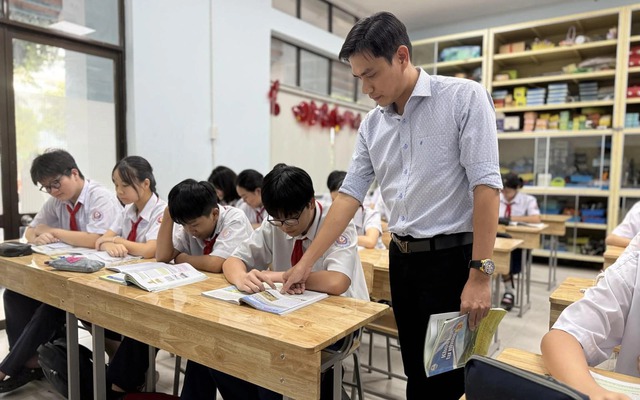
Mr. Nguyen Duc Uy, from Tran Van On Secondary School (Tan Dinh Ward, Ho Chi Minh City), guides 9th-grade students in preparing for the upcoming 10th-grade entrance exam.
Photo: BC
FOREIGN LANGUAGES: ASSESSING LINGUISTIC THINKING SKILLS
Regarding the third subject, foreign language, Mr. Nguyen Huu Thanh, Deputy Principal of Tran Quoc Toan Secondary School (Binh Trung Ward), said that the orientation and structure of the exam will be suitable for students studying different sets of textbooks. This is especially important given that this is the first exam applied to students in the three merged areas.
The sample exam shows a shift in requirements from testing memorization to assessing genuine linguistic thinking, so students need to undertake a "revolution" in their study methods.
Teacher Thanh instructed students to abandon rote learning and cultivate "dictionary thinking." The new question type, requiring students to identify words based on definitions, is the "nemesis" of the "English word = Vietnamese meaning" learning approach. To excel, students need to familiarize themselves with English-English dictionaries (such as Oxford or Cambridge). They should develop the habit of explaining word meanings in English, mastering the system of synonyms, antonyms, and word forms. This is the core foundation for handling questions requiring a deep vocabulary.
Grammar must "live" in context, so current exams eliminate trick questions and instead require students to understand the essence of the subject. "Instead of doing hundreds of isolated multiple-choice questions, students should review grammar through reading comprehension and sentence writing. When doing the test, ask yourself: Why use this structure in this context? Understanding the context is the only key to achieving maximum points in the application section," Mr. Thanh emphasized.
Instead of passively focusing on keyword "hunting," students should proactively engage with everyday texts (leaflets, advertisements, announcements) and popular science articles. In particular, they should narrow down their reading sources to core themes such as the green environment, community, culture and heritage, and future technology...
This learning method helps students both accumulate vocabulary in depth based on specific topics and develop logical thinking skills to flexibly handle all types of texts.
In addition, Mr. Thanh also guided students to turn technology into a "personal tutor." In the digital age, self-learning is an extremely important skill. Make the most of learning applications and AI (artificial intelligence) tools to help correct writing errors, explain difficult structures, and practice foreign language reflexes. Applying smart technology will make the review process more proactive, personalized, and significantly more effective.
Structure of the 10th grade entrance exam in Ho Chi Minh City.
The Ho Chi Minh City Department of Education and Training has announced the structure of the 10th grade entrance exam, which will be held in June and will cover three subjects: mathematics, literature, and English.
The Literature subject consists of: Part 1 (5 points): Reading comprehension of literary texts and writing a paragraph of 2 sentences, including: Sentence 1 (3 points): Reading comprehension; Sentence 2 (2 points): Writing a paragraph.
Part 2 (5 points): Reading comprehension of argumentative or informational texts and writing a social commentary essay, including: Question 1 (1 point): Reading comprehension; Question 2 (4 points): Writing a social commentary essay.
Mathematics: The exam consists of 7 questions, of which questions 1 and 2 are purely basic math problems about functions, graphs, equations, and Vieta's formulas; questions 3 to 6 are practical math problems of varying difficulty levels, still related to the knowledge students have learned; question 7 is a geometry problem.
The exam content is based on the 2018 General Education Program for Mathematics at the lower secondary level, covering the following areas: Geometry and Measurement; Numbers and Algebra; Statistics and Probability.
English subject: The assessment focuses on specific language skills, with specific goals for each knowledge area, consisting of 4 sections and 40 questions.
Part 1 (1 point): Phonetics; Part 2 (3 points): Vocabulary, grammar, communication; Part 3 (4 points): Writing the correct form of words; Writing appropriate phrases based on given information; Writing sentences; Part 4 (3 points): Reading comprehension: Reading and filling in the blanks; Reading comprehension and answering questions.
There are two new questions about writing appropriate phrases based on given information. These questions test the ability to read dictionary annotations to find linguistic information and apply knowledge.
Source: https://thanhnien.vn/on-thi-lop-10-theo-cach-ra-de-moi-185260111180636666.htm


























































































Comment (0)