Bringing public services closer to the people.
From June 15th to July 15th, 2026, the Da Nang City Land Registration Office will pilot the decentralization of signing and issuing land use right certificates and certificates of ownership of assets attached to land at four regional land registration offices, including: Region I (Hai Chau - Thanh Khe), Region II (Son Tra - Ngu Hanh Son), Region X (Thang Binh), and Region XVIII (Que Son).
This is one of the solutions to implement the policy of promoting administrative reform in the land sector as directed by the Chairman of the Da Nang City People's Committee, Nguyen Manh Hung. The decentralization is expected to reduce intermediaries, shorten processing times, create favorable conditions for citizens and businesses, and thereby contribute to the socio -economic development of the city.

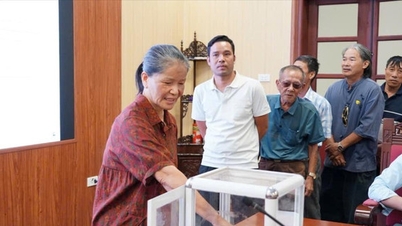
Residents of Hai Chau ward complete land registration procedures at the one-stop service department of the Land Registration Office, Area I. Photo: LA
According to observations at the Hai Chau Ward Public Administrative Service Center, from the very beginning of its implementation, the Regional Land Registration Office Branch I assigned two permanent staff members to the One-Stop Service counter to directly receive and process applications. On average, the counter receives about 30-40 applications per day; during peak periods when the system was first implemented, this number sometimes reached 70-80 applications per day. The majority of these were procedures for registering mortgages, canceling mortgages, transferring ownership, gifting, and transactions related to land certificates already issued to households and individuals.
Applications are received directly at the ward's Public Administrative Service Center; guidance and posting of procedures are also done on-site, helping people reduce travel time and making the application process more convenient.
According to Mr. Phan Huu Phung, Vice Chairman of the Hai Chau Ward People's Committee, instead of having to transfer documents to the City Land Registration Office for signing as before, the branches are now given the authority to handle them directly, making the process faster and reducing the number of trips people have to make.

Da Nang hopes that the decentralization model will improve service quality and bring public land-related services closer to the people.

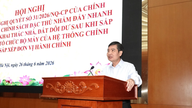

Local authorities have proactively arranged workspaces, network infrastructure, equipment, and necessary conditions for Land Registration Office staff to perform their duties; and have coordinated with and guided citizens in the process of receiving applications.
“After nearly half a month of implementation, the model has initially shown effectiveness in shortening the time it takes to process documents. In particular, the branch's staff have many years of experience in the area, so they are familiar with the documents, land origins, and management processes, contributing to faster processing. Citizens coming to complete procedures are also guided directly at the One-Stop Service Department through the on-duty staff, the automated search system, or a dedicated information counter,” Mr. Phụng said.
Improve the process to enhance the effectiveness of decentralization.
According to the head of the Land Registration Office Branch in Region I, in the initial phase of implementation, the unit assigned 8 staff members to work in 4 wards to receive and process administrative procedures related to land. Coordination between the Branch, the People's Committees of the wards, and the Public Administrative Service Center generally proceeded smoothly, as the localities proactively prepared adequate facilities, equipment, and workspaces for the staff.
However, the land sector involves many complex cases related to land origin and usage history, so resolution must still strictly adhere to legal regulations. Many cases require consultation with relevant agencies, and regular monitoring and follow-up are necessary to ensure timely notification to citizens and minimize repeated trips.
According to Mr. Vo Huy Thac, Director of the Land Registration Office Branch Area I, the effectiveness of the model will be evaluated after the pilot phase ends and all feedback from the units is fully compiled. Through this, the city will identify difficulties and obstacles to develop solutions for improvement before scaling up. Currently, coordination between units basically meets requirements, but verification of complex files still takes a long time due to the shortage of staff at the commune and ward levels after the implementation of the two-tiered local government model.

Following the pilot phase, Da Nang plans to implement the decentralized model uniformly across all 20 branches of the Land Registration Office from August 1, 2026. Photo: LA
To improve the efficiency of administrative procedures, the Branch proposes that the City People's Committee review and adjust the implementation time in the coordination regulations to suit the reality; and at the same time, clearly define the responsibilities of each agency in each stage of certificate issuance. This will help to clearly identify the unit responsible if the application is delayed, instead of the majority of responsibility still being concentrated on the Land Registration Office as is currently the case.



Following the pilot phase, from August 1, 2026, Da Nang will uniformly implement the decentralized model for signing and issuing land use certificates at all 20 branches of the Land Registration Office in the city. This transfer of authority aims to reduce intermediaries, shorten document processing times, and enhance the responsibility of each unit and individual according to the "six clear principles": clear person, clear task, clear time, clear responsibility, clear authority, and clear results.
According to the Da Nang City People's Committee, decentralizing authority and further reducing the time for processing administrative procedures is an important step in building a service-oriented administration, using the satisfaction of citizens and businesses as a measure of the effectiveness of state agencies, while improving the quality of public service delivery in the land sector.
The Da Nang City Land Registration Office will take the lead in reviewing and reducing the processing time for four groups of land-related administrative procedures by 1 to 1.5 working days. Accordingly, the processing time for issuing and exchanging land use certificates will be reduced to no more than 4 working days; reissuing certificates due to loss will be reduced to no more than 8.5 days; registering or changing assets attached to land will be reduced to no more than 7 days; and land subdivision and consolidation will be reduced to no more than 11 working days.
Source: https://nongnghiepmoitruong.vn/phan-cap-giup-ho-so-dat-dai-bot-di-vong-d818401.html