

Previously, over 50% of households in Jắt A village were poor, transportation was limited, and production methods were backward. Now, however, all aspects of life have changed significantly thanks to investment from the government and the self-reliance of the villagers.
Mr. Y Như Byă, Head of the Front Committee and a respected figure in Jắt A village, shared that the majority of the people in Jắt A village are Êđê ethnic minorities, with many generations closely connected to this land. Before development, the villagers maintained traditional farming methods and were often hesitant and timid, leading to a lack of employment and very difficult living conditions.
 |
| Mr. Y Như Byă regularly encourages the people of Jắt A village to develop their economy and increase their income. |
Since 2005, when he was the head of the Jắt A village farmers' association, Mr. Y Như has persistently encouraged villagers to participate in training courses, vocational training, and technology transfer. He also took advantage of friendly gatherings in the village, using everyday conversations to explain to the villagers the government's concern and preferential treatment for the village, and to emphasize the responsibility of utilizing these invested resources rather than waiting and relying on them.
Since then, in the double-cropping rice fields of Jắt A village, the villagers have boldly switched to varieties suitable for market demand, invested in fertilizers, mechanization, and rational pest and disease control. The average rice yield in Jắt A village has now reached 8 quintals - 1 ton of dry rice per sao (approximately 1000 square meters). With economic development, the villagers have gradually become more confident and assertive. During periods of agricultural inactivity, they often take on work in neighboring areas, diligently saving up to buy more land and fields, strongly spreading the emulation movement in labor and production. Over time, the number of well-off households has increased, and now the entire village has only one poor household and no more temporary or dilapidated houses.
 |
| The infrastructure and investment resources in Jắt A village are being managed and utilized effectively. |
Since 2020, when the locality intensified the emulation movement to build new rural areas, Mr. Y Nhu has also worked alongside the Party branch committee and the self-governing board to mobilize people to relocate gates and fences and donate land to expand roads.
Initially, many families disagreed because they had to move their fences and gate posts back 1-1.5 meters. Mr. Y Nhu took the lead and then enlisted the help of exemplary and proactive households in the village to go to each house and explain the changes to the villagers so they would follow suit. As a result, 100% of the roads in the village were widened, and the villagers also proactively repaired their houses and fences, making their living conditions increasingly more presentable.
Similarly to Jắt A village, in Tà Đỗq village, where the majority of the population are Bru - Vân Kiều ethnic minorities, Mr. Nguyễn Xuân Hiệu, a respected figure in the village, always emphasizes his role in motivating and guiding people to change their mindset and practices, and eliminate outdated customs. Having experience in the People's Council and commune militia in his hometown of Quảng Bình , upon arriving in this new area, Mr. Hiệu was assigned to be the head of the production team and also the head of the Party cell in the village.
 |
| Mr. Nguyen Xuan Hieu regularly accompanies and shares his experience in mobilizing the people with young cadres. |
In the 1990s, life was very difficult in many aspects, and many people were illiterate and had low levels of education, which made them feel inferior and shy. Mr. Hieu had to constantly encourage them and translate policies, laws, and regulations from the common Vietnamese language into the Bru-Van Kieu language so that they could understand. When they needed to complete paperwork or procedures, they would come to him for guidance and assistance.
With his reputation, sincerity, and dedication, he persistently encouraged the villagers to work hard, actively learn about science and technology to diversify crops and livestock, and gradually increase their income. In the new rural development movement, he went to each house to encourage people to donate land for road construction, working alongside local Party committees and authorities to overcome obstacles in infrastructure development, and leveraging resources from the collective efforts of the people in ethnic minority areas.
After the implementation of the two-tiered local government system, Ea Phê commune covers an area of over 86.6 km² , with 23 ethnic groups living together. The people of these ethnic groups have always upheld the spirit of solidarity and sharing, working together to build a better life, from the hardships of the post-war years to the prosperous and comfortable life they enjoy today.
For example, in Phuoc Hoa 1 village, home to all eight ethnic groups: Tay, Nung, Tho, Hoa, Gia Rai, Dao, Thai, and Ro Ngao. Mr. Vy Tran Kon, village head and respected figure in Phuoc Hoa 3 village, shared that the people here always uphold the spirit of solidarity and mutual support, without distinction of ethnicity or religion.
Through his role and influence as a respected figure, Mr. Kon maintained mutual support and assistance for villagers in times of illness or death. He also mobilized the people's efforts in the new rural development movement, notably the 760-meter concrete road from the main road to the cemetery, entirely funded by contributions from the villagers. Security and order in the village were also consistently maintained, allowing the villagers to work and produce with peace of mind, improving their living standards and income.
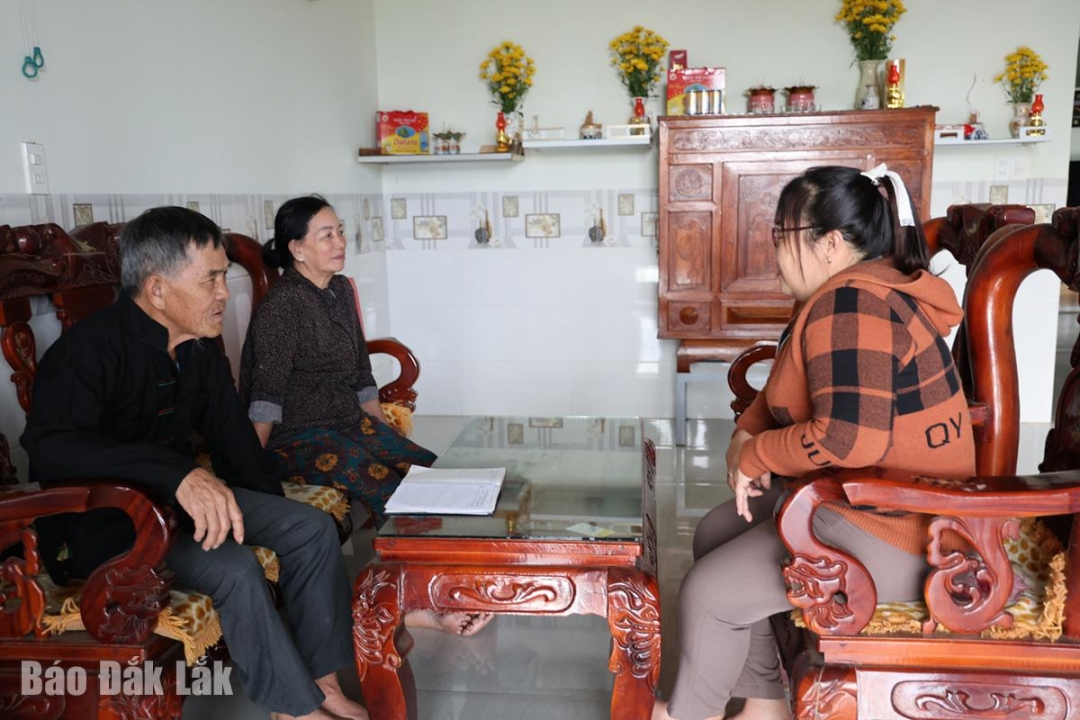 |
| Mr. Vy Tran Kon (far left) shares information about the living conditions of the ethnic communities in Phuoc Hoa 1 village. |
According to Pham Tien Dung, Vice Chairman of the People's Committee of Ea Phe commune, the selection of influential individuals is entirely based on their long-standing commitment to the villages, their deep understanding, and their sustained contributions through their role as role models, gathering and leading the people in ethnic minority areas. Over time, this group of influential individuals has truly become an "extended arm" of the local Party committee and government; a pillar of support and guidance for the villages in all movements and activities.
In this new phase of development, Ea Phê commune has always clearly identified that any task, in order to succeed, requires the crucial element of the people's strength and the strength of national unity. Therefore, the local Party committee and government will continue to pay attention to and encourage influential individuals; regularly organize exchange and meeting activities to understand their concerns, promote their role as a bridge, and strengthen social consensus.
Source: https://baodaklak.vn/xa-hoi/202512/phat-huy-bong-ca-buon-lang-c4213d5/
![[Photo] General Secretary To Lam attends the inauguration ceremony of Si Pa Phin multi-level boarding school.](/_next/image?url=https%3A%2F%2Fvphoto.vietnam.vn%2Fthumb%2F1200x675%2Fvietnam%2Fresource%2FIMAGE%2F2026%2F01%2F31%2F1769840655651_ndo_br_z7486540481209-f37c7e00a962aec2a061c64b7db569ef-jpg.webp&w=3840&q=75)


![OCOP during Tet season: [Part 3] Ultra-thin rice paper takes off.](/_next/image?url=https%3A%2F%2Fvphoto.vietnam.vn%2Fthumb%2F402x226%2Fvietnam%2Fresource%2FIMAGE%2F2026%2F01%2F28%2F1769562783429_004-194121_651-081010.jpeg&w=3840&q=75)


![OCOP during Tet season: [Part 2] Hoa Thanh incense village glows red.](/_next/image?url=https%3A%2F%2Fvphoto.vietnam.vn%2Fthumb%2F402x226%2Fvietnam%2Fresource%2FIMAGE%2F2026%2F01%2F27%2F1769480573807_505139049_683408031333867_2820052735775418136_n-180643_808-092229.jpeg&w=3840&q=75)


Comment (0)