

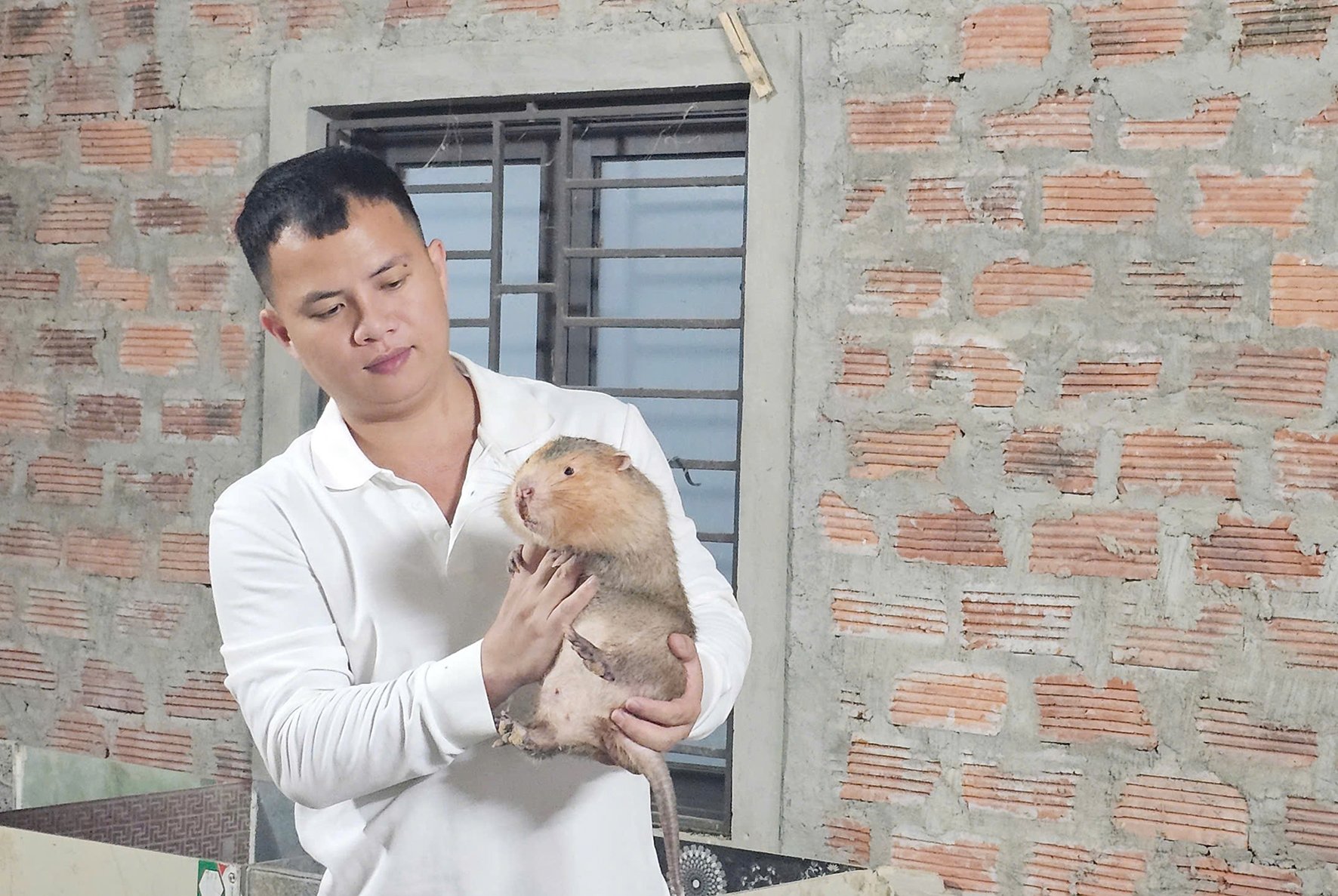
Mr. Lam introduces his family's guinea pig farming model - Photo: NP
We visited Mr. Lam's breeding facility at a time when he was busy instructing workers on installing the lighting system, completing the final step before putting the new guinea pig farm into operation. Although called a "farm," it was actually a house built with four enclosed sides and a cement floor. The square pens were separated by large, irregularly sized decorative bricks.
Mr. Lam shared: “This type of cage for raising bamboo rats saves space while ensuring good ventilation, dryness, and easy cleaning. Furthermore, it prevents bamboo rats from digging burrows to escape and keeps harmful animals like rats and snakes from entering. Depending on the age of the bamboo rats, I will arrange them in appropriately sized compartments. Currently, there are bamboo rats ready to fill the new cage.”
Thus, after nearly 7 years of breeding, Mr. Lam has expanded his bamboo rat farming operation to 3 farms with a current number of 250 adult bamboo rats and 50 young bamboo rats.
Looking back on his entrepreneurial journey, Mr. Lam said he "fell in love" with raising bamboo rats in 2018. After a period of supplying wild bamboo rats to restaurants and eateries in the area, he received advice and decided to import 20 pairs of pink-cheeked bamboo rat breeding stock.
However, since these are wild animals, their lack of adaptation to the weather, climate, and food, coupled with Mr. Lam's inexperience, led to the bamboo rats getting sick and some dying in the beginning. Undeterred, he proactively searched the internet for successful bamboo rat care methods from successful breeders to learn and gain experience for himself.
"The enclosure is one of the first factors determining success or failure in raising bamboo rats. This animal thrives best in a quiet, peaceful environment with minimal noise and limited direct sunlight. It's essential to prioritize locations that are cool in the summer and warm in the winter when building the bamboo rat enclosures," Mr. Lam explained.
This change in care helped his bamboo rats gradually adapt to their new environment. After more than 8 months of care, he began breeding them. It is known that bamboo rats have a gestation period of about 45 days before giving birth. Each year, they breed 3 times, with 4-5 offspring per litter. Baby bamboo rats can be separated from their mothers after 2.5 months and can be raised for another 2 months before being sold as breeding stock.
According to Mr. Lam, the demand for bamboo rats is currently quite high due to the delicious quality of their meat. These rodents are also very easy to raise, require little care, and grow vigorously if breeders know how to properly care for them. Their main food sources are fresh bamboo stalks, fresh sugarcane, corn kernels, sweet potatoes, cassava, leftover rice, and elephant grass, which are inexpensive and ensure a safe food supply.
Currently, Mr. Lam mainly breeds these animals to supply customers both within and outside the province. Depending on their weight, the price of the bamboo rats varies, ranging from 4 to 5 million VND per pair. The demand for bamboo rats is high, with people frequently coming to his house to inquire about purchasing them, so he is not worried about sales.
Throughout our conversation, Mr. Lam had to pause several times because customers kept calling to place orders for seedlings. On average, this model brings him an income of over 300 million VND per year, while also providing regular employment for 3-4 workers.
With the desire to expand and develop this economic model, Mr. Lam is always ready to share his experience in raising bamboo rats with anyone who needs it.
“Currently, the market for commercial bamboo rats is experiencing a supply shortage. Bamboo rats are considered a delicacy, so they are highly sought after by discerning diners. Therefore, besides selling breeding stock, I am happy to share my experience with anyone who comes to learn so they can succeed with this model even on their first attempt,” Mr. Lam confided. In the future, if the breeding continues to yield good results, he will expand the scale of production and increase the herd to provide more breeding stock and commercial bamboo rats to the market.
Southern
Source: https://baoquangtri.vn/phat-trien-kinh-te-tu-nuoi-dui-192822.htm


![[Photo] National Assembly Chairman Tran Thanh Man successfully concludes his participation in IPU-152](https://vphoto.vietnam.vn/thumb/1200x675/vietnam/resource/IMAGE/2026/04/18/1776502638199_vna-potal-chu-tich-quoc-hoi-ket-thuc-tot-dep-chuong-trinh-tham-du-ipu-152-8709975-jpg.webp)









































































Comment (0)