In mid-April 2025, after returning from a military trade union training course, my husband, Lieutenant Colonel Le Dinh Long, former Chairman of the Trade Union of Factory X61 (Chemical Corps), felt unusually tired, so I took him for a check-up at the Central Military Hospital 108. When I received the results, I couldn't believe my eyes. He was always healthy, active, and loved sports ... yet he was suddenly facing a life-threatening disease: hepatocellular carcinoma.
The doctor called me into his office, his voice low: “The patient needs surgery to remove two-thirds of his liver. The surgery will be very complicated. We will do our best, but the family should also prepare for the worst-case scenario.” My ears buzzed, my heart tightened, and images of my two children, still of school age, flashed through my mind. If the worst happened, what would become of my children and me? Stepping out of the doctor’s office, I wiped away my tears, trying to maintain a calm expression as I returned to my husband.
Lying in his hospital bed, he asked me anxiously, "What did the doctor say? Do I need surgery right away?" Suddenly, his voice choked up: "Having this disease... is like receiving a death sentence."
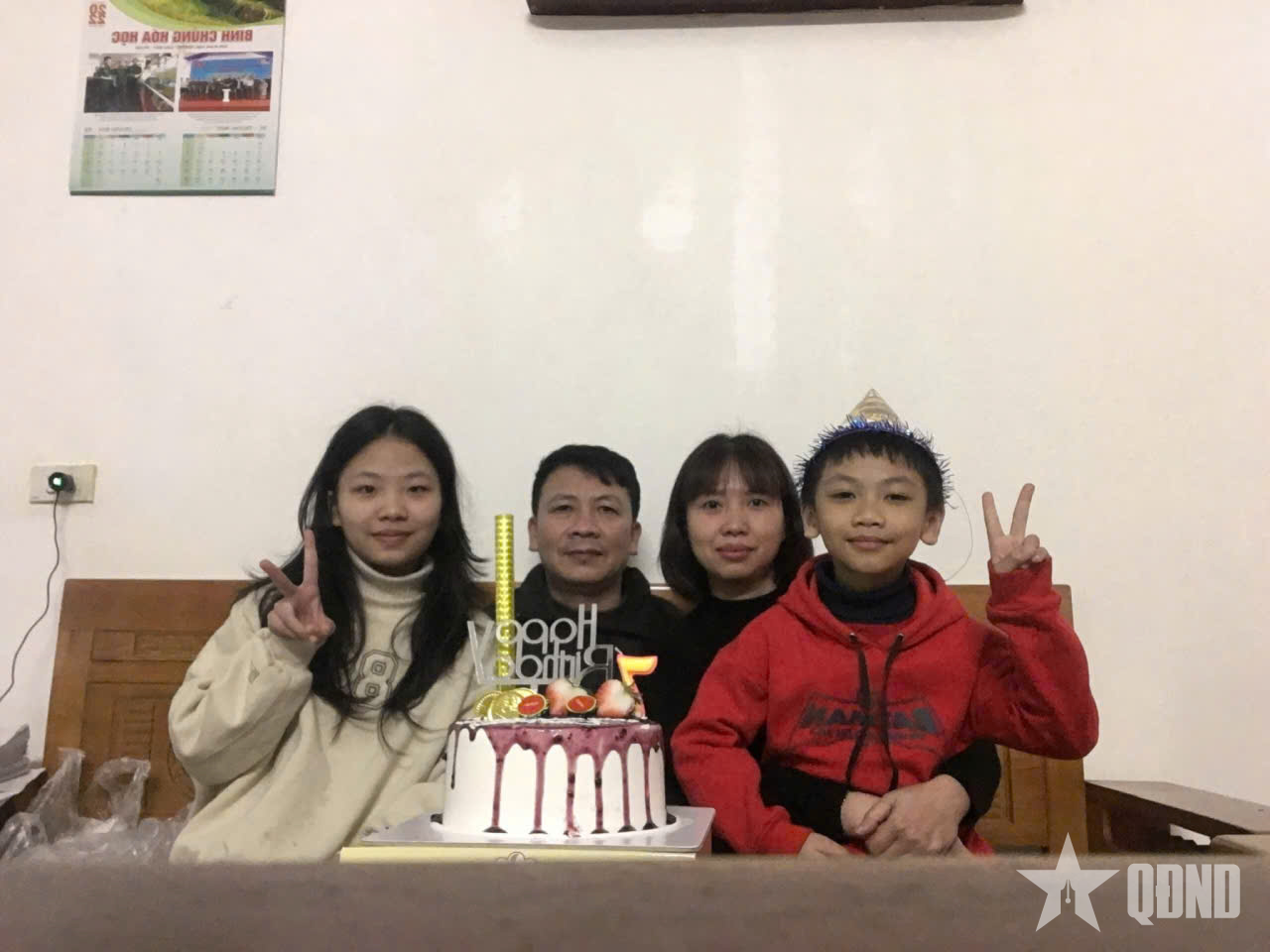 |
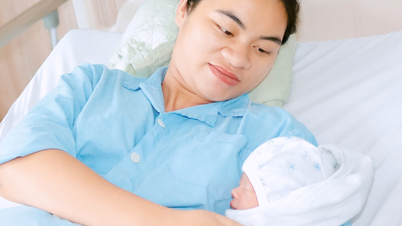
The joy of family love after a long day of waiting for my husband's treatment. |
Those words were like salt in my wound. Before that, the doctor and I had only told him he had a hemangioma. But with his intuition, he sensed something very serious. He held my hand, telling me to prepare myself and the children, just in case something bad happened.
The days waiting for surgery were the longest time of my life. Feeling sorry for my weak and tired husband, I asked him what he wanted to eat most so I could bring it to him.
He said, "If possible, could you make me a bowl of water spinach soup with peanuts?"
It's a very simple, rustic dish from my hometown; during those difficult times, my mother-in-law often cooked it. For him, the sweet, refreshing taste of water spinach combined with the nutty aroma of fresh peanuts is not just a dish, but also a whole realm of childhood memories.
The soup was quite simple to prepare, consisting of fresh, washed water spinach, a small amount of crushed fresh peanuts, and seasonings. To cook, sauté the onions until fragrant, then add the water spinach and stir-fry briefly. Next, sprinkle in the crushed peanuts, stir quickly, then add water and simmer for a few minutes. However, the problem was that my house was over 50km from the hospital. If I cooked the soup at home and brought it to the hospital, it would get cold, and my husband wouldn't enjoy it. After much thought, I decided to bring the ingredients to the hospital and boldly asked if I could cook it in the canteen kitchen.
After hearing my explanation, the kitchen staff exchanged sympathetic smiles. The head cook nodded and said, "Alright, go ahead and cook for him."
Holding a small pot in my hands, standing in the middle of an unfamiliar kitchen, I cooked while trying to hold back my tears. I understood that at this moment, what he needed was not just a bowl of soup, but emotional support, a reason to keep trying and not give up.


When I placed the steaming bowl of soup in front of him, he gazed at it for a long time, two silent tears rolling down the corners of his eyes. He ate slowly, spoonful by spoonful, as if savoring each familiar taste, then softly said, "It's delicious! Just like the taste of my hometown." For the first time in many days, I saw him eat with such relish. Each spoonful of soup seemed to soothe his pain, giving him renewed energy and faith to overcome the challenging road ahead.
I held his hand tightly and encouraged him, "Be optimistic! Trust the doctors and nurses! For you, for our family, I believe you will overcome this!"
On April 21, 2025, my husband went into the operating room.
I sat in the hospital hallway, my heart heavy. Never before had time seemed to drag on so slowly. The surgery started at 7 a.m. and lasted until almost 3 p.m. When the doctor came out and announced that the operation was successful, I nearly collapsed. After days of trying to be strong and suppressing my fear, only at that moment did I dare to cry.
Over a week after the surgery, he lost nearly seven kilograms. The long incision made walking extremely difficult. Yet he still smiled, trying to reassure me: "Don't worry, I'll recover quickly." His strength filled me with both pity and admiration.
At the end of that month, he was discharged from the hospital to continue his treatment at home. My whole family was overjoyed to be able to gather around the family dinner table again. I carefully prepared each meal, cooking his favorite dishes, light and healthy options to help him recover quickly.
Three months later, his health had improved significantly. He said, "Once I'm completely healthy, I'll do moderate exercise and come home early every day to have dinner with my wife and children on time."
From then on, every evening, our family dinner table was filled with laughter. On days when we had water spinach soup with peanuts, he would joke with the children: "This is Dad's life-saving medicine!"
The mischievous eldest daughter retorted, "Dad's medicine is actually Mom's love. This soup is just a catalyst!" The whole family burst into laughter.
My two children also grew in their thinking from those meals. They no longer demanded fast food from restaurants like before, but instead asked their mother to teach them how to cook water spinach soup with peanuts. One would grind peanuts, the other would pick vegetables and peel onions, their laughter echoing throughout the small kitchen. At mealtime, without anyone saying a word, the older sister would serve her father, the younger sister would serve her mother, both eagerly awaiting their parents' feedback on the dishes they had prepared themselves.
Seeing my husband happier and more cheerful each day, I felt that all my hard work in helping him overcome his serious illness had been worth it.
Looking back on that difficult time now, I understand that, after life's biggest events, what keeps people together is sometimes just the smallest things: a warm meal, a familiar bowl of soup, a waiting gaze, or a well-timed word of encouragement. And perhaps, it is this quiet and enduring love that is the most miraculous "medicine," giving people the strength to overcome illness, misfortune, and life's harshest challenges.



Day after day, a bowl of water spinach soup with peanuts regularly appears on my family's dinner table. Not because it's so delicious, but because it has become a gentle reminder of life-or-death situations, of gratitude to the doctors and nurses, of the power of sharing, and above all, of family bonds and the miracle of love.
One day, during a meal, my youngest son suddenly asked:
"Dad, when you were sick, if Mom hadn't been there, would you have been able to get through it?"
He smiled softly, his voice warm: "There will never be a ', my child. Because Mom is the reason Dad wants to live!" Then he looked at me affectionately: "Thank you, my dear wife! You are not only my pillar of support, but also the one who keeps the flame alive in our family, so that every meal is always warm and full of love!"
Listening to him speak, my eyes welled up with tears, and a gentle feeling of happiness filled me completely.
Source: https://www.qdnd.vn/van-hoa/van-hoc-nghe-thuat/phep-mau-cua-yeu-thuong-1046557

![[Photo] National Assembly Chairman Tran Thanh Man attends the Conference to announce the Master Plan for Hanoi Capital City with a 100-year vision.](https://vphoto.vietnam.vn/thumb/1200x675/vietnam/resource/IMAGE/2026/06/29/1782709639728_ndo_br_1-jpg.webp)
![[Photo] General Secretary and President To Lam works with the Party Committee of the Government on the work of preventing and combating storms, floods, extreme natural disasters and climate change.](https://vphoto.vietnam.vn/thumb/1200x675/vietnam/resource/IMAGE/2026/06/29/1782729441945_a1-bnd-0385-9454-jpg.webp)
![[Image] A look back at the capital's preparations for the century-long master plan.](https://vphoto.vietnam.vn/thumb/1200x675/vietnam/resource/IMAGE/2026/06/29/1782750453122_quy-hoach-100-nam-minh-duy-1-2118-jpg.webp)
























































![[Image] Building an elevated road through the Ma Da forest.](https://vphoto.vietnam.vn/thumb/402x226/vietnam/resource/IMAGE/2026/06/29/1782724737750_anh-man-hinh-2026-06-29-luc-16-18-43.png)