

More than 50 years after the Apollo 11 moon mission, astronaut Michael Collins is still remembered as a silent hero with the nickname "the loneliest man."
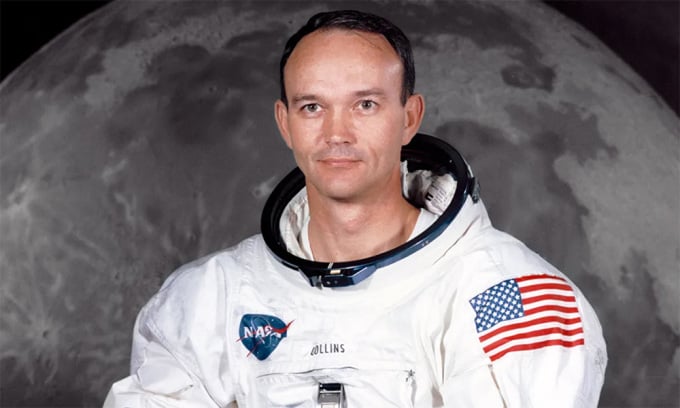
Astronaut Michael Collins. Photo: NASA
In 1969, while Neil Armstrong and Buzz Aldrin took humanity's first steps on the Moon, Michael Collins sat alone in the Columbia command module of the Apollo 11 spacecraft, flying behind the far side of the Moon. He was responsible for controlling the Eagle module to safely land his two colleagues on the celestial body. At that time, all communication with Earth was cut off due to the Moon's interference, leaving Collins completely isolated from humanity and hundreds of thousands of kilometers away from home.
"At this moment I am all alone, truly alone, and completely isolated from life. If you were to count, the number of people would be three billion plus two on the other side of the Moon, and only one (plus things only God knows) on this side," Collins wrote in his 1974 book Carrying The Fire: An Astronaut's Journeys .
This experience was later shared by only six other people. However, Collins was not afraid of the experience and always found it strange when the media described him as "the loneliest man in history." "I felt, not fear or loneliness, but extreme anticipation, satisfaction, confidence, almost exhilaration. I liked that feeling," he wrote.

"Outside the window, I could see the stars, that's all. Where I knew the Moon was, there was just a dark expanse. I could only determine that the Moon was still present because of the absence of the stars. To compare this feeling to something on Earth, perhaps being alone on a small boat in the middle of the Pacific Ocean in the pitch-black night would be the closest thing to my situation," he described.
Collins remained in the Columbia command module for 21 hours while Buzz Aldrin and Neil Armstrong landed on the Moon and performed their historic lunar walk. When Armstrong and Aldrin returned from the Moon, Collins took a photograph of Earth, the Moon, and the Eagle module carrying the two astronauts. Thus, Collins became the only Earthling not visible in the photograph.
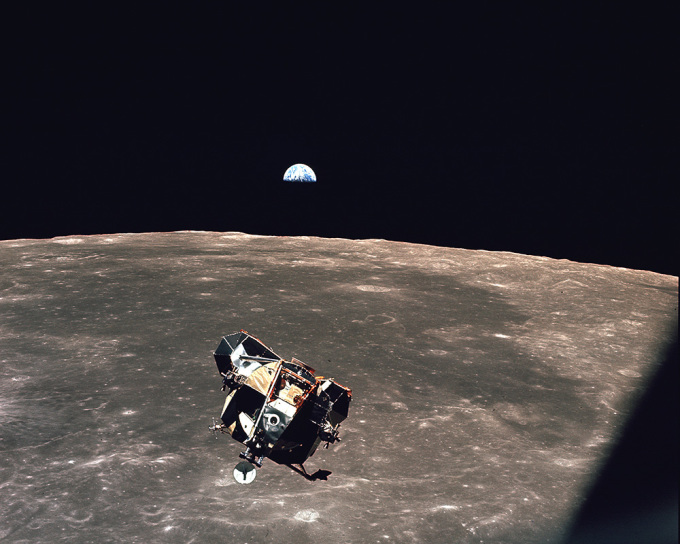
Michael Collins photographed the Eagle module of the Apollo 11 spacecraft, the Moon, and Earth. Photo: NASA
In an interview with The Guardian in July 2009, Collins said he was very worried about Armstrong and Aldrin's safety. He feared they would perish on the Moon, forcing him to return to Earth alone as the mission's sole survivor. Fortunately, all three astronauts eventually returned safely on July 24, 1969. The mission lasted a total of 8 days, 3 hours, 18 minutes, and 35 seconds and became a historic milestone, marking the first time humans set foot on the Moon.
In 1971, after leaving NASA, Collins became Director of the National Air and Space Museum. He held this position until 1978, when he began working at the Smithsonian Institution. During this time, Collins remained in the U.S. Air Force Reserve, rising to the rank of Major General in 1976 and retiring in 1982. In April 2021, his family announced his death at the age of 91 after a long battle with cancer.
With his immense contributions to space exploration, Collins' passing has left a deep sense of loss among the public. U.S. President Joe Biden, Steve Jurczyk—then a director at NASA—and colleagues have sent condolences to Collins' family, while also highlighting his contributions to the world .
Thu Thao (According to IFL Science )
Source link
























































![[Video] Sunset at Lap An Lagoon – Where the sun sets over the fishing nets](https://vphoto.vietnam.vn/thumb/1200x675/vietnam/resource/IMAGE/2026/05/31/1780192137701_beach-landscape-sea-water-nature-grass-745871-pxhere-com.jpeg)

































Comment (0)