


My Son Sanctuary - a mystical masterpiece in the heart of Quang Nam (Photo: My Son Cultural Heritage Management Board)
Love and intimacy
The My Son Sanctuary, a complex of ancient towers belonging to the Champa Kingdom, was begun by King Bhadravarman in the 4th century and completed in the 13th century. Throughout that time, successive generations of Champa kings continuously built and expanded the sanctuary, adding nearly 80 temples and towers reflecting Hindu architecture, culture, and the worship of Shiva.
Those who have been here and truly immersed themselves in the architectural and cultural beauty of the Cham people will agree with me that two adjectives—"love" and "affection"—should be added before the name My Son to make it a more complete name: My Son, the Sanctuary of Love and Affection, which truly deserves the beauty, romance, and hallmarks of Cham culture.
I felt like my soul had been stolen, gazing in a daze at the Apsara dancing her age-old dance. She was the embodiment of passionate love, of intense desire for romance. She had the power to awaken the masculine spirit within each man with the strength of a culture of fertility, innocence, and immortality.
Linga - the erect male genitalia, powerful and majestic amidst nature, trees, and plants... Yoni - the female genitalia lying suspended in a waiting, yearning posture under a sky filled with swirling mist.
On the altars within each ancient brick tower, the symbol of the union of Linga and Yoni always appears prominently and impressively. This represents the harmony of yin and yang, the interaction between male and female, creating vitality and miraculous fertility…
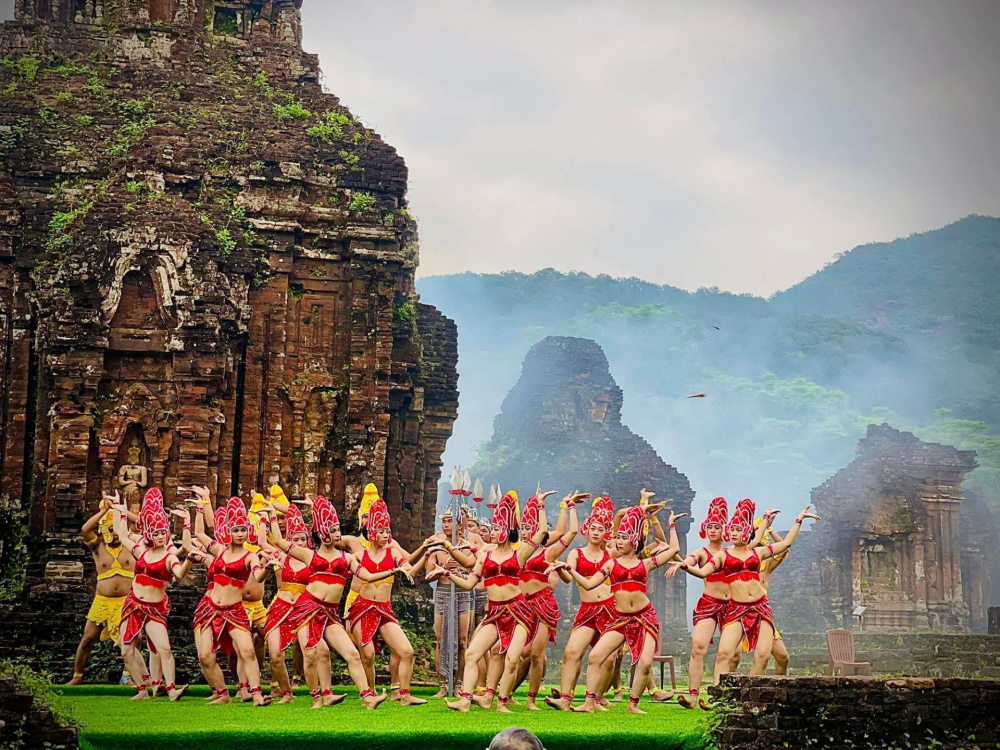
The enchanting Apsara dance (Photo: My Son Cultural Heritage Management Board)
The towers were built using handcrafted fired bricks with meticulous and sophisticated assembly techniques, employing a miraculous binder whose nature, origin, and method of creation by the ancient Cham craftsmen have yet to be precisely deciphered.
The entire complex of majestic, solemn, and proud towers, having stood for 17 centuries, is a source of pride for the Champa people in particular and the Vietnamese people in general. This is a unique architectural masterpiece that reflects the brilliant development of Champa culture within the overall development of Vietnamese culture.
I don't want to be separated from you until the day I die.
This is a true story, yet it seems like an ancient legend, of the first architect who dedicated all his energy, intellect, and love to restoring and renovating the Cham tower complex of My Son in Quang Nam. His name was Kazic, a Pole, who spent the last 16 years of his life here. Every brick, every line, and every plant here became a part of his life.
The most amazing thing we heard about him was that during his time working here, he became particularly close to a mute Cham girl.
Every day, they didn't speak to each other but understood each other very well and were close. Later, when they grew up, she studied Kinh (Vietnamese) with Kazic, and the two began to communicate with each other in a common language...
Around the same time, the cowherd girl actively helped the survey team carry water for daily use and perform many other tasks. No one knew where or when she was born, who her parents were, whether she was happy or sad, or what she wished for, but everyone knew she was a dark-skinned girl, living in poverty and silence, yet incredibly passionate and innocent, day and night, dancing the Apsara dance, just like the legend of Apsara, sent down to earth by the Jade Emperor to teach people the captivating Apsara dance.
As time passed, the mute girl of yesteryear grew into a young woman passionately dancing in the sunlight beside ancient temples and pagodas. Those were the most magical moments Kazic experienced there. Wanting to preserve those precious moments, Kazic secretly painted a picture of a young woman dancing the Apsara dance... As if by magic, the innocent girl of yesteryear became shy and coquettish.
One day, having accidentally seen herself in a painting hidden by Kazic inside an ancient tower—a dark, gaunt figure with tattered clothes and bare, protruding breasts—she silently left... From then on, Kazic could not sleep peacefully for a single night. Every time he closed his eyes, he would see the graceful Apsara dancers emerging from the stone, their breasts prominent, their eyes dreamy, their faces and gazes wild, silently dancing... When Kazic was about to awaken, she would slowly turn back into stone, motionless.
Kazic came to survey and work here, but unfortunately, during a business trip to Hue , he suddenly passed away, leaving unfulfilled his aspiration to restore the complex of towers to its original state (time and especially the bombs of war had severely damaged My Son).
Before taking his last breath, Kazic repeatedly instructed his colleagues: "I cannot leave My Son. Even death cannot take me away from there. Bury me in My Son! I want to see my girl return!"
Locals living around the My Son complex recount that after Kazic's death, the mute cowherd girl returned and transformed into an incredibly beautiful dancer with alluring, honey-colored skin, passionately dancing day and night within the My Son World Heritage site.
It's a pity that they no longer have the chance to meet as before. All she can do is dance, dance, dance, and transform into stone, into Apsara sculptures; they remain forever in the My Son Sanctuary.
Drifting clouds

The remaining ruins in the My Son sanctuary (In the photo: Tower A1 before and after restoration) (Photo: My Son Cultural Heritage Management Board)
As night falls over My Son, a hazy mist descends. The later it gets, the lower the clouds become. The entire valley seems ethereal and mystical in the voice of the Cham singer, Dang Nang Duc: “Sleeping in the Apsara stone form, the artist’s hands transform into ivory. A hundred years for a single moment, a dream nurtured for a thousand generations, a dream that never fades. A thousand years in the Apsara stone form, the dancer’s hands, angelic features, a graceful smile on her lips, her soul unfolding into a form, wandering the earthly path, forever waiting. Apsara, Apsara, Apsara, Apsara, moment… Tomorrow she returns to the stone realm, her curved path, her robes fading away. Apsara, Apsara, Apsara, Apsara, moment… for humanity, for heaven and earth to remember and cherish…”
Amidst growing impatience, the flesh-and-blood Apsara dancers appeared before everyone's eyes, on a stage nestled within the Cham tower complex. Their dance, the "Soul of Stone," captivated the audience, leaving them mesmerized and mesmerized. Everything dissolved, blending together, enthralled by the gaze and graceful steps of the Apsara dancers to the rhythm of the Paranung drums. Everyone seemed hypnotized, transported to a magical world of the flourishing Cham culture, accompanied by the echoing Saranai horns reverberating across the hillsides...
I was truly astonished when the faded green veil that had completely covered the Apsara dancer's body was removed, revealing a beautiful face and an exquisitely alluring, captivating figure!
The astonishment pulled me back to my distant subconscious, and only now do I truly understand the meaning of the lyrics of the song "Rain Falling on Ancient Towers" by composer Tran Tien: “A hundred years of fleeting steps. Ancient towers in ruins... Ancient dances of the past. Curved five fingers representing the five elements. A hundred years of dreamlike steps. Namo Namo Namo Namo Buta. A circle of hypnotic Apsara. The sun and moon shine brightly above. You dance swaying. Ancient towers in ruins. Ancient dances of the past. The sun and moon shine brightly above, far below. Namo Namo Amitabha. Ancient towers in ruins. Curved five fingers representing the five elements. The sun and moon shine brightly above, far below. Namo Namo Amitabha. Namo Namo Namo Buta. A hundred years you dance swaying, swaying, swaying.”
I believe that among the Apsara dancers before me is the silent Cinderella of Kazic's past. The stone spirits of the Apsaras on the moss-covered temples seem to be trembling, stirring to life, and moving the hearts of people today...
The Apsara dance is usually performed by 3 or 4 dancers in the vibrant setting of the My Son Sanctuary complex, with the aim of making viewers feel as if the Apsara goddesses have been resurrected and are stepping out from the stone reliefs.
The dance movements are slow, gentle, graceful, mysterious, and enchanting, with elegant and impressive curves formed by the fingers, hands, feet, and so on.
When the dance ends, the dancers remain motionless, like stone statues covered with faded green cloths as they were when they first appeared, signifying a return to the stone, to the eternity and mystique of Cham culture.
Nguyen Thanh Tuan
Source: https://baolongan.vn/phieu-lang-cung-apsara-a195780.html
![[Photo] Prime Minister Pham Minh Chinh receives the Chinese Ambassador to Vietnam](https://vphoto.vietnam.vn/thumb/1200x675/vietnam/resource/IMAGE/2026/04/05/1775397481797_ndo_br_dsc-5512-jpg.webp)































































Comment (0)