

They brought with them many famous works, some of which had been awarded the State Prize and the Ho Chi Minh Prize for Literature and Art.
However, few people know that behind those timeless works lie deeply moving stories, not only about dedication and sacrifice, but also about the camaraderie and collegiality of the journalists of that era.
Journalist and photographer Chu Chi Thanh, author of the famous work "Two Soldiers" – a work that was awarded the Ho Chi Minh Prize for Literature and Art in 2022 – recalls that when he was 24 years old (journalist Chu Chi Thanh was born in 1944), he and several other reporters were part of the leading photo team of the Vietnam News Agency.
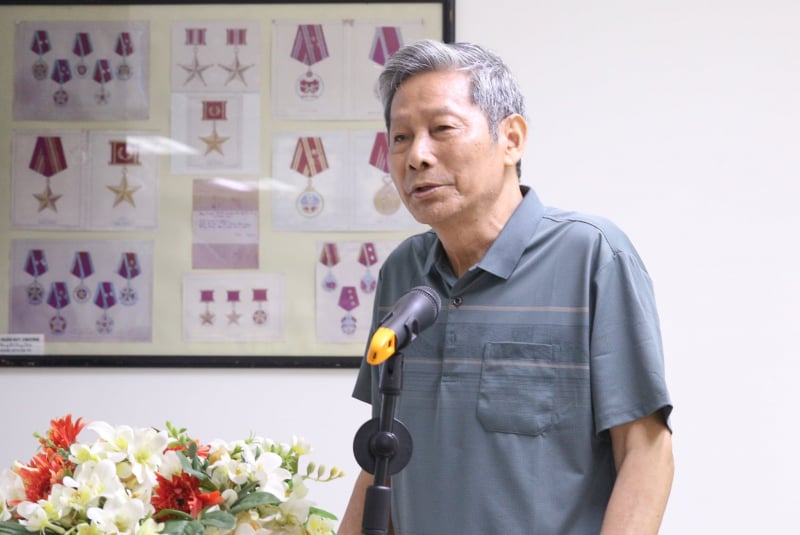
Journalist and photographer Chu Chi Thanh.
Among them, journalist Luong Nghia Dung was both a senior figure in the profession and was assigned to mentor young reporters like himself. Luong Nghia Dung was born in 1934 in Ha Tay (now Hanoi). He studied Physics at Hanoi Pedagogical University and, from 1966, worked as a reporter for the Military News Agency of the Vietnam People's Army; he died in the Quang Tri battlefield in 1972.
He was posthumously awarded the Ho Chi Minh Prize for Literature and Art in 2017 for the collection of works (3 photos) "Moments That Remain" and the State Prize for Literature and Art in 2007 for the work (1 photo) "Artillery Duel at Doc Mieu".
Journalist Chu Chi Thanh stated that at the time he was assigned to the Vietnam News Agency's elite photography team to go to the battlefield, journalist Luong Nghia Dung was already a Party member and a soldier of the Vietnam People's Army, seconded to the Vietnam News Agency.
The three months spent on the battlefield with him were an unforgettable experience in journalist Chu Chi Thanh's life, filled with stories of a time of hardship but also pride, warmth of camaraderie, and brotherhood that journalists today can hardly fully comprehend. "It can be said that back then, journalists 'lived in the heart of B52 bombs'."
We divided ourselves up to observe the battlefield. The enemy dropped B52 bombs in waves, each wave dropping a few bombs. The bombs exploded with a deafening roar. Before that, I had never known what a B52 bomb exploded like. Sitting in the bunker, hearing the bombs explode was incredibly impressive, but I wasn't afraid. When I looked out of the bunker, I saw a dead pig, and a crow came to peck at the carcass. I suddenly wondered, "Will I be sacrificed and become food for the crow like that?", journalist Chu Chi Thanh recounted emotionally.
He said that he only recounted this one detail to help us visualize what journalism was like in the brutal battlefield. After three B52 bombing raids, he regained consciousness in the bunker when the smell of kerosene from the villagers' oil lamps filled the air. He heard a female militia member ask if he was alright. After he replied that he was fine, she left to help people in another bunker. Five to ten minutes later, journalist Luong Nghia Dung returned.
At that time, journalist Luong Nghia Dung was in the anti-aircraft artillery position, 5-6km from the bunker. Each time the enemy dropped B52 bombs, he would lie still for a while, then continue moving. When he met Chu Chi Thanh, journalist Luong Nghia Dung was wearing a short-sleeved shirt, and his arm was scraped and bruised.
“I was sitting in the bunker, still in shock. Dung affectionately called out, ‘Comrade Thanh, are you alright?’ At that time, I was only 24 years old, a youth union member, not yet a party member, but he addressed me in the military way. I said, ‘I’m fine.’ He said, ‘Then come out here and take pictures.’ At that moment, I was bewildered, not knowing what to do. He said, ‘Take pictures of the aftermath.’ He was very calm, always ready for the job. The two of us took pictures of the ruins, bombs, soldiers, and militia digging and repairing bunkers right away, preparing for the next day,” journalist Chu Chi Thanh shared.
Journalist Luong Nghia Dung sacrificed his life in 1972. He left behind many famous works. In addition to works that have been awarded the Ho Chi Minh Prize and the State Prize for Literature and Art, he also has many other impressive works that show the fighting spirit and arduous yet heroic labor of war correspondents.
Later, when interacting with many Western photographers, they all agreed that he was a great photographer, on par with many world-renowned photographers. His work was included in a photo book by two American photographers present in the Indochina battlefield, commemorating those who fell in the Indochina war worldwide, celebrating our nation's great war.
Besides journalist Luong Nghia Dung, many other journalists also went to the battlefield in the past, and they all left behind "timeless" photographic works. Journalist and photographer Nguyen Van Bao (1930-2005) was born in the Kinh Bac region of Bac Ninh province. He was a reporter for the Vietnam News Agency, specializing in photographing General Secretary Le Duan, and was formerly the Deputy Secretary-General of the Vietnam Association of Photographic Artists. He is the author of famous works that have been awarded many national and international photography prizes, including "From the Thunder God to the Buffalo Cart" - a work that won the State Prize for Literature and Art in 2007.
Major Vu Tao (1940-2005), a photojournalist from Ha Nam province, was a photojournalist at the General Political Department of the Vietnam People's Army, seconded to the Vietnam News Agency, and retired in 1988. He was honored with many prestigious awards, including the State Prize for Literature and Art in 2007 for his work "Proud and Unyielding" (Phu Lang Thuong, Bac Giang), the Second and Third Class Military Merit Orders, and numerous domestic and international photography awards.
Photojournalist Hoang Van Sac (1934 – 2015) was born in Hanoi. He worked as a reporter and later as Head of the Industrial Photography Department, Photo Editorial Board of the Vietnam News Agency. His contributions were recognized with many prestigious awards, including the State Prize for Literature and Arts in 2007 for his works "The Squad of 10 Girls at Dong Loc Crossroads" and "The Road to the Front Line" (1968)...
Recalling his colleagues from the war photojournalist team, journalist and photographer Chu Chi Thanh said that they were like brothers not only in their profession but also in their personal lives. They left behind incredibly authentic photographs of invaluable historical value, which will live on through time.
Many call them documentary photographs of history, historical moments, but for him, the photographs themselves are history, because nothing can replace them. This is the legacy left by previous generations of journalists for today's and future generations to learn, study, read, and know more about their country.
Source: https://cand.com.vn/Xa-hoi/phong-vien-anh-chien-truong-trong-ky-uc-nha-bao-chu-chi-thanh-i771702/


![[Photo] Prime Minister Pham Minh Chinh presides over a meeting on private sector economic development.](/_next/image?url=https%3A%2F%2Fvphoto.vietnam.vn%2Fthumb%2F1200x675%2Fvietnam%2Fresource%2FIMAGE%2F2025%2F12%2F20%2F1766237501876_thiet-ke-chua-co-ten-40-png.webp&w=3840&q=75)













































Comment (0)