

Quang Nam: Indian experts will restore three gates and the city walls of the Dong Duong Buddhist monastery complex, which was built in 875.
Mr. Phan Van Cam, Director of the Quang Nam Provincial Management Board of Historical Sites and Scenic Spots, said that at the end of June, five experts from the Archaeological Survey of India (ASI) will arrive at Dong Duong Buddhist Monastery in Binh Dinh Bac commune, Thang Binh district, for a month to survey the foundations, prepare design documents, and restore the relic. The project to preserve and restore Dong Duong Buddhist Monastery is expected to be implemented in 2024. ASI will simultaneously conduct archaeological excavations and restore the architectural structure of the main gate and two side gates.
Earlier in April, a team of ASI experts conducted an initial survey and assessment of the current state and direction of conservation and restoration work at the Dong Duong Buddhist monastery. The experts agreed to repair and restore one main gate, two side gates, and the walls on both sides. This contributes to restoring the appearance and scale of the relic, without affecting archaeological excavations and the restoration of the Sáng Tower inside.
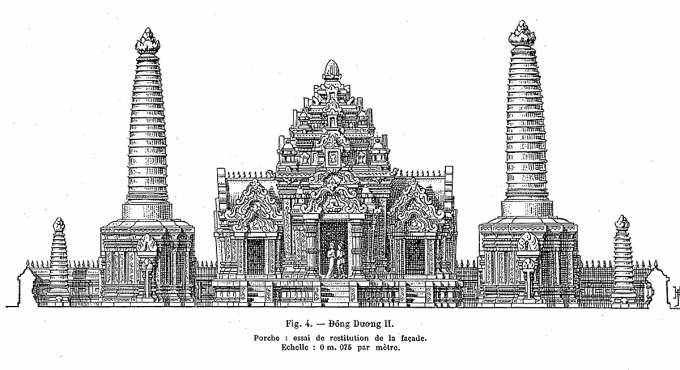
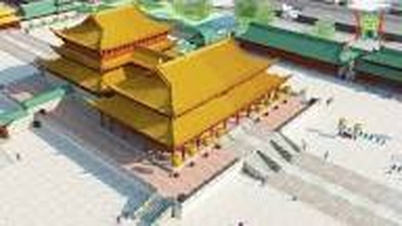
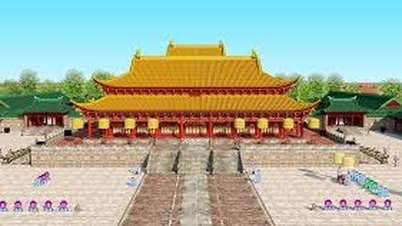
The main gate of the Dong Duong Buddhist monastery will be restored based on the design by the French scientist H. Parmentier from the early 20th century. Photo: Quang Nam Provincial Management Board of Historical Sites and Scenic Spots.
According to the original design, the main gate was located right at the entrance to the Buddhist monastery, with a construction and renovation volume equivalent to four typical Champa towers. This would be the highlight of the entire monastery, a typical symbol of the cultural exchange between Vietnam and India, and a mark of Champa Buddhism and the Southeast Asian region during the medieval period.
Two smaller, similarly styled side gates are located inside the monastery, dividing it into three areas: the monks' quarters (where new students live); the lecture hall; and the main hall (where the main shrine is located).
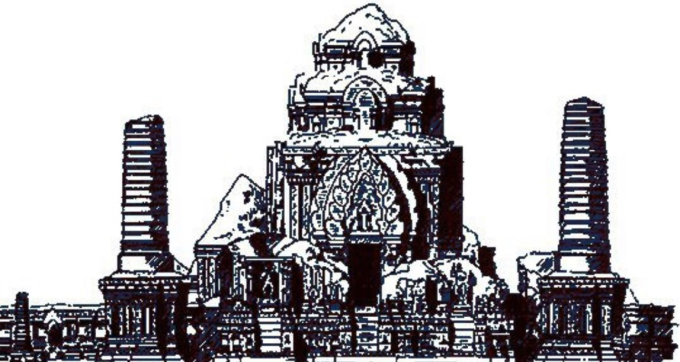
A secondary gate designed by the French scientist H. Parmentier in the early 20th century. Photo: Quang Nam Provincial Management Board of Historical Sites and Scenic Spots.
According to the inscription found in Dong Duong village, the Buddhist monastery was built by King Indravarman II in 875 to worship Laksmindra-Lokesvara, the Bodhisattva who protected the dynasty.
In the early years of the 20th century, French scientists unearthed hundreds of sculptures, most of which are now on display at the Da Nang Cham Museum. The most notable is a bronze Buddha statue over one meter tall, considered a masterpiece of Cham sculpture in Southeast Asia.
In 1902, researcher H. Parmentier excavated the Dong Duong Buddhist monastery. According to H. Parmentier's survey, the entire main temple complex and adjacent towers are distributed along an axis from west to east, approximately 1,300 meters long. The main temple complex is located within a rectangular area 326 meters long and 155 meters wide, surrounded by a brick wall. From the main temple complex, a road approximately 760 meters long runs eastward to a rectangular valley.
Archaeologists have discovered traces of the main hall, the brick foundations of the monks' quarters, and interconnected lecture halls spanning a large area. Roof tiles used for the buildings were also found scattered around, proving this was an ideal model of a self-contained Buddhist monastery for training monks.
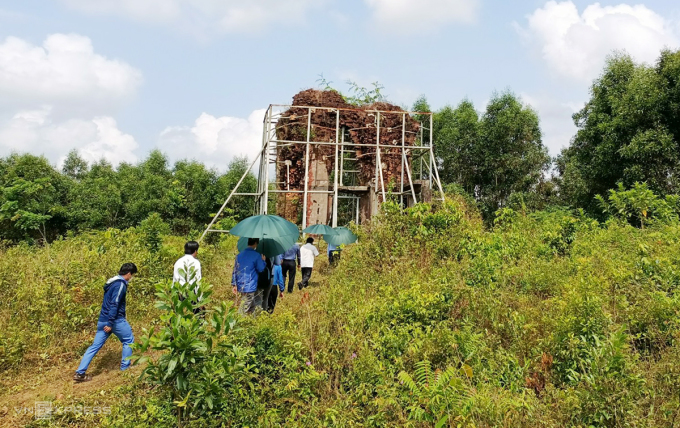
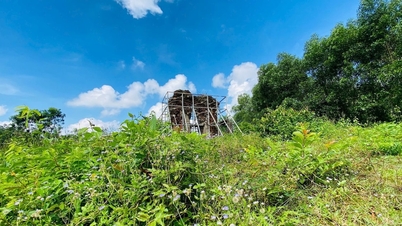
The Đồng Dương Buddhist monastery still retains the Sáng Tower, supported by iron pillars to prevent its collapse. Photo: Đắc Thành
During the war, the Buddhist monastery was destroyed, and now only fragments of the Sáng tower wall, along with the foundations of the architectural structure and some buried decorative objects, remain. Many artifacts found at the Đồng Dương Buddhist monastery have been recognized as national treasures and are currently on display at the Da Nang Cham Sculpture Museum.
In early December 2019, Dong Duong Buddhist Monastery was recognized as a special national historical site. At the end of 2022, Quang Nam province approved a project to preserve and promote the value of the site with an investment of over 5 billion VND.
Source link









































































Comment (0)