

Wagner Prigozhin, once considered a "brilliant businessman" close to President Putin, staged a rebellion challenging the Kremlin.
Yevgeny Prigozhin and several other senior leaders of the Wagner private military corporation have been confirmed dead in a plane crash northwest of Moscow on August 23. The incident occurred two months after Prigozhin led an unsuccessful rebellion that posed an unprecedented challenge to President Vladimir Putin.
In his comments on the August 24 plane crash, President Putin praised Wagner, a prominent figure who has appeared alongside him on numerous occasions, as a "brilliant and skillful" businessman who has also made some mistakes.
Prigozhin was born in Leningrad, now St. Petersburg, in 1961, to a Jewish father. In 1979, at the age of 18, Prigozhin was arrested for petty theft. He subsequently served several prison sentences, totaling nine years, before being pardoned in 1988.
After his release from prison, Prigozhin started his business career with a sausage shop in St. Petersburg, then established a restaurant and catering company called Concord. Prigozhin's restaurant attracted many famous people in the city, including Deputy Mayor Vladimir Putin, a regular customer.
Their relationship gradually became closer, to the point that after Putin became President of Russia, Prigozhin was hired to provide full-service cooking and table service for high-level Kremlin events.
Prigozhin's restaurant was once chosen by Putin to dine with French President Jacques Chirac in 2001, as well as to host many other world leaders. This is why Prigozhin is nicknamed "Putin's Chef" by Western media and has become a close confidant of the Russian President.
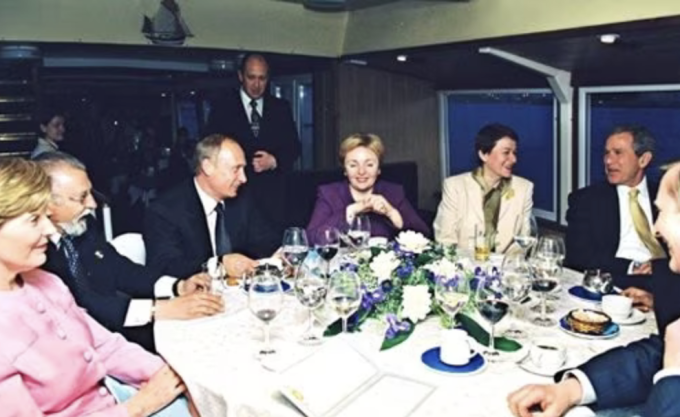
Russian President Vladimir Putin dines at Prigozhin's New Haven restaurant in St. Petersburg in the early 2000s. Photo: Kremlin
Thanks to his close relationship with President Putin, Prigozhin was able to secure large contracts, supplying food to government offices , the military, and even school cafeterias. According to Kompas , Concord's food supply contract for Russian schools alone was worth $2 billion.
In 2014, as the Maidan protests erupted in Ukraine and relations between Moscow and Kyiv became strained, Prigozhin began venturing into the security sector. He partnered with Dmitry Utkin, a former Russian special forces lieutenant colonel, to establish a private military company, recruiting former soldiers on contract as "mercenaries."
The company, named Wagner after Utkin's codename, carried out a variety of tasks for the Kremlin, particularly missions beyond the capabilities of the security agencies.
Wagner operatives are believed to have been involved in providing security for the 2014 referendum on the annexation of Crimea by Russia, as well as providing military support to separatist forces in the Donbass region of eastern Ukraine fighting against Kyiv's government army.
Prigozhin admitted this last year, arguing that he founded Wagner because the quality of Russian volunteers who came to support separatists in eastern Ukraine after 2014 did not meet expectations.
Mercenary organizations are banned under Russian law, but Wagner has survived and expanded its operations. Since 2018, Wagner has signed numerous contracts to provide security and military support to the governments of the Central African Republic and Mali, and has also secured mining rights for minerals such as oil, diamonds, precious stones, and gold in these countries.
With approximately 5,000 fighters deployed to Africa, Wagner is believed to have played a significant role in maintaining and expanding Russia's political, military, and economic influence in Africa. Many African nations that do business with Wagner have refused to condemn Russia's war in Ukraine, nor have they joined Western sanctions against Moscow.
For years, President Putin and Kremlin spokesman Dmitry Peskov only said they knew of a Russian "businessman" operating in African countries, without officially acknowledging the relationship. But on August 24, Putin confirmed that Prigozhin had been doing business in Africa in sectors related to oil and gas, precious metals, and gemstones.
Information about Wagner's involvement in the Ukrainian war effort only emerged in the summer of 2022. Within weeks, Prigozhin had visited numerous Russian prisons in an attempt to recruit inmates to sign combat contracts. A Kremlin spokesman said he had made a "major contribution" to the campaign in Ukraine.
Prigozhin also acknowledged for the first time that he was the founder of Wagner, and declared his support for the Russian army on the Ukrainian battlefield. In November 2022, Prigozhin opened Wagner's headquarters in St. Petersburg.
However, his criticisms of the Russian Ministry of Defense became increasingly harsh. He complained that the Russian military leadership refused to acknowledge Wagner's contributions to the war. He accused Defense Minister Sergey Shoigu and Chief of the General Staff Valery Gerasimov of failing to supply Wagner with ammunition while the group was engaged in fierce fighting in Bakhmut.
Tensions continued to escalate even after Russia gained control of the city of Bakhmut and Wagner fighters withdrew to their rear bases to consolidate their forces. When the Russian Ministry of Defense issued a directive requiring Wagner fighters to sign contracts for military service, Prigozhin strongly objected. At the height of the conflict, he even publicly questioned the objectives of the Ukrainian campaign launched by President Putin in late February 2022.
On June 23, Prigozhin announced a "marching for justice" to Moscow to demand the resignation of Defense Minister Shoigu and Chief of General Staff Gerasimov. This rebellion was seen as a sign of Prigozhin's desperation, and in a moment of impulsiveness, the tycoon had put himself in direct confrontation with President Putin.
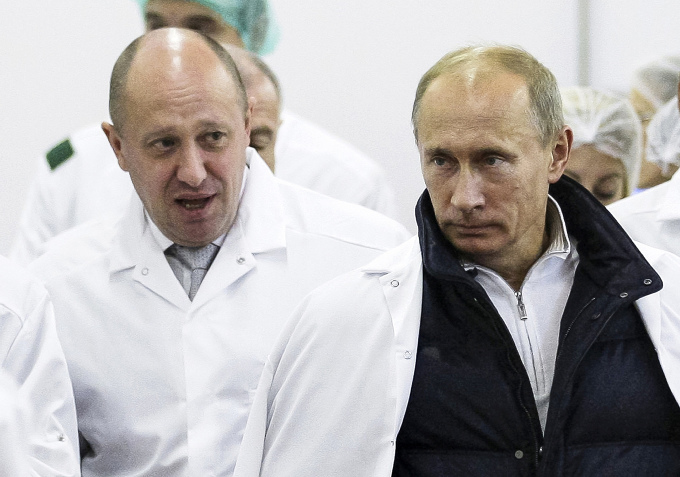
President Putin (right) and Yevgeny Prigozhin near St. Petersburg, Russia in 2010. Photo: Kremlin
During their march, Wagner forces shot down several military aircraft and killed 15 Russian soldiers. The rebellion enraged President Putin, who called them "traitors" and "stabbing the country in the back."
Although the rebellion ended after a day with a troop withdrawal agreement brokered by the Belarusian president, observers believe it created an irreparable rift between Prigozhin and President Putin after three decades of acquaintance.
Prigozhin's actions "directly challenged the Kremlin and Putin, even though the Wagner boss always declared his loyalty to the President," said Russian analyst Dmitry Kolezev.
The Kremlin rejected all speculation that it ordered Prigozhin's assassination in the plane crash, asserting that the Wagner Group had made significant contributions to the campaign in Ukraine. "The Russian president has stated that their heroic act will never be forgotten," spokesman Peskov said.
Thanh Tam (Based on BBC, Kompas, Washington Post )
Source link

![[Photo] General Secretary and President To Lam meets with National Assembly delegates from ethnic minorities.](https://vphoto.vietnam.vn/thumb/1200x675/vietnam/resource/IMAGE/2026/04/20/1776696701056_a1-bnd-8331-3342-jpg.webp)
![[Image] National Assembly discusses the implementation of the socio-economic development plan.](https://vphoto.vietnam.vn/thumb/1200x675/vietnam/resource/IMAGE/2026/04/20/1776696707422_ndo_br_img-20260420-185419-jpg.webp)



























































Comment (0)