

Proactive reception and management
These days, at the Vam Nhut Tao historical site (Nhut Tao commune, Tay Ninh province), upgrading and repair work is being carried out intensively. Since the two levels of local government officially came into operation, the People's Committee of Nhut Tao commune has proactively carried out repairs to several dilapidated areas within the historical site, in preparation for the commemoration of the sacrifice of national hero Nguyen Trung Truc.
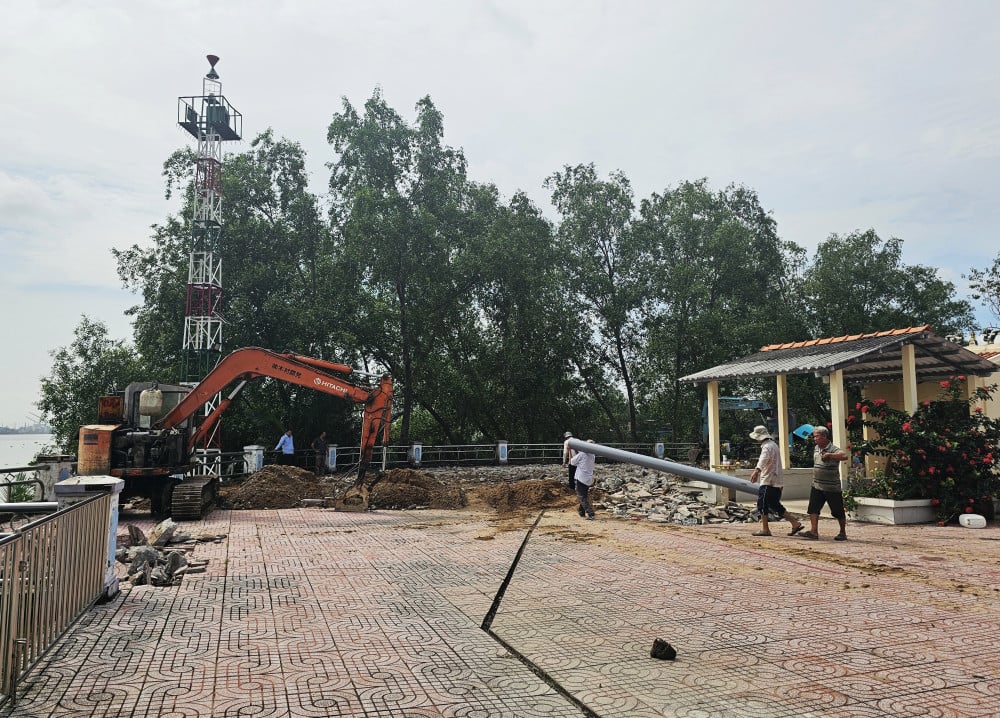
The embankment area within the Vam Nhut Tao historical site is being repaired in preparation for the commemoration of the sacrifice of national hero Nguyen Trung Truc.
The historical and cultural relic site, inaugurated in 2010, covers an area of 6.1 hectares and includes many facilities, becoming a popular destination for visitors from all over. The annual commemoration of the death anniversary of national hero Nguyen Trung Truc attracts hundreds of thousands of people who come to offer incense and pay their respects. Currently, the site is beginning to deteriorate and needs restoration. Immediately after receiving the handover of historical and cultural relics in the commune, the People's Committee of Nhut Tao commune proactively surveyed and upgraded the embankment, electrical system, and built additional restrooms to ensure proper service for the commemoration ceremony to be held at the end of October.
According to Truong Minh Tri, Chairman of the People's Committee of Nhut Tao commune: "When historical and cultural relics are handed over to the commune, management becomes more convenient and easier because the relics are located within the commune's territory, making inspection and supervision easier. Furthermore, when we take over the relics, we also receive the necessary personnel, so the basic upkeep and management are ensured without any interruption or significant impact."
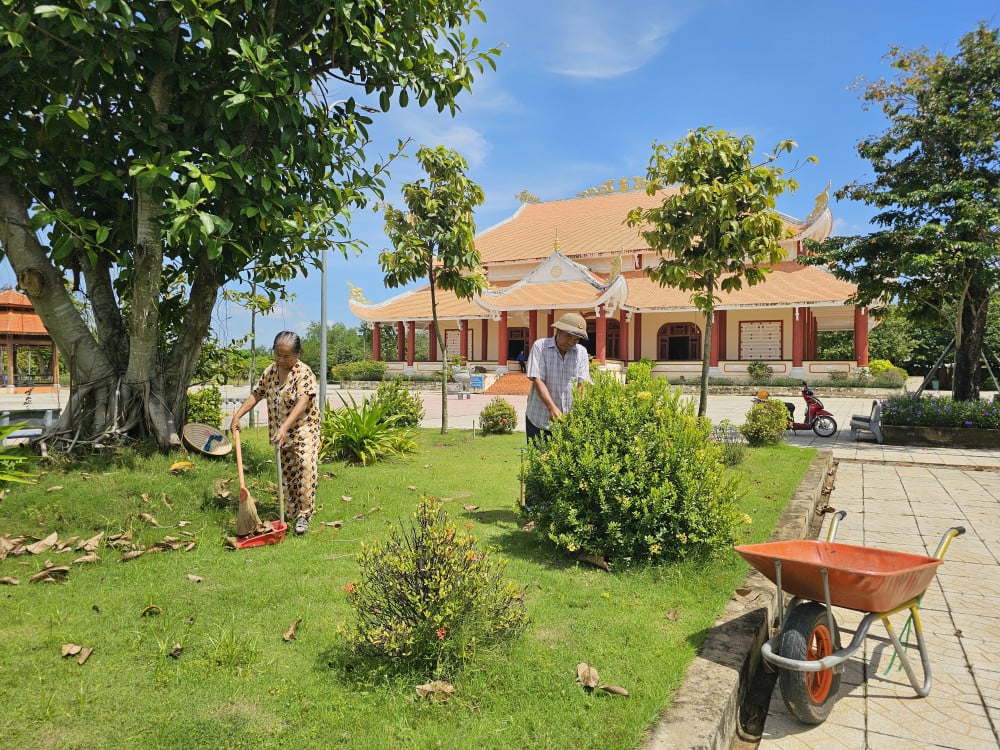
When taking over the management of the Long Khot Fort area historical site, the People's Committee of Tuyen Binh commune also received the necessary personnel, ensuring that the management and care of the site are still maintained. (In the photo: Mr. Nguyen Van Tam and Mrs. Nguyen Thi Phuong are taking care of the Long Khot Fort area historical site. They have been doing this work for many years.)
Similar to Nhut Tao commune, when taking over the management of historical and cultural relics in the area, Tuyen Binh commune received both the relics and the personnel, ensuring that management is well maintained. Currently, Tuyen Binh has 4 historical and cultural relics, of which the Long Khot Fort area relic and the Floating Pagoda relic are two destinations that attract a large number of visitors, especially during the Lantern Festival (at the Floating Pagoda relic) and the commemoration of President Ho Chi Minh's birthday and the tribute to the heroic martyrs (at the Long Khot Fort area relic).
According to Vo Hong Linh, Vice Chairman of the People's Committee of Tuyen Binh commune, in the coming time, the commune will conduct a survey of the current state of historical sites in the area, and from there, plan the restoration and upgrading of these sites to ensure they serve tourists well in the future. Regarding the funding, it will depend on guidance from higher authorities to develop a specific plan.
Waiting for the mechanism to be finalized.
Currently, due to the lack of regulations on the hierarchical management, protection, and promotion of cultural heritage values within the province, local authorities are still waiting to understand the extent of their delegated authority in managing historical sites in their areas.
In Tra Vong commune, there are currently two historical sites: the Temple of Lord Tra Vong Huynh Cong Gian and the Mausoleum of Lord Tra Vong. According to Mr. Nguyen Thai Sung, Head of the Culture and Social Affairs Department of the commune, previously, the Temple of Lord Tra Vong, also known as Dinh Ong, was managed by the commune, while the mausoleum was managed by the district. After the implementation of the two-tiered local government system, the historical sites in the area were transferred to the commune for management.
“Regarding state management, there is a difference: previously, the district held the land use right certificate for the mausoleum, but now it has been handed over to the commune. As for cultural management, when there is restoration, construction, or repair, the locality still has to seek the opinion of the Department of Culture, Sports and Tourism as before. Currently, there are no new guidelines, so basically nothing has changed. In the near future, the locality will reorganize the Management Board of the relic, and at the same time, will promote it on local information websites so that everyone knows about it,” said Mr. Nguyen Thai Sung.
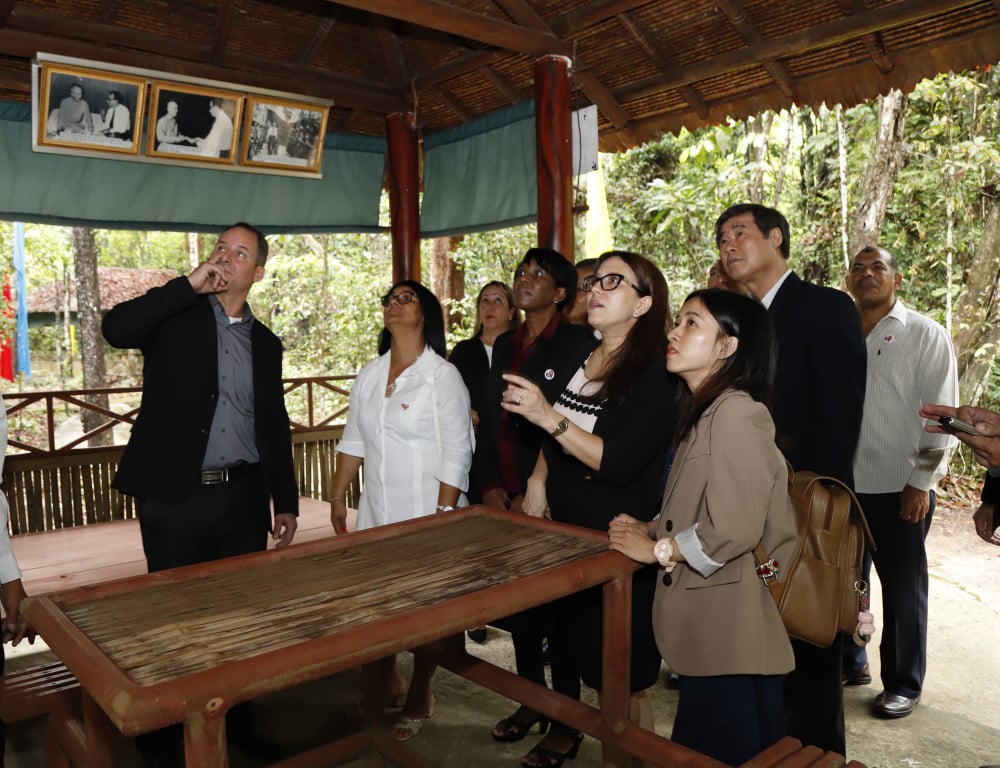
Cuban delegates visited the workplace of Cuban Ambassador Raul Vades Vivo located at the historical site of the Provisional Revolutionary Government of the Republic of South Vietnam.
Regarding the management of historical sites, each site has a Management Board responsible for worship, care, and preservation, so there are currently no difficulties in decentralizing management to the communes. As for the restoration and upgrading of historical sites, since the province has already given permission, it is still proceeding as planned.
Over the past period, the locality has carried out many activities to restore and renovate both historical sites, showing the respect of today's generation for those who contributed to expanding the territory and protecting the villages. "About three years ago, someone donated 1,000 square meters of land to expand the mausoleum, and the land handover procedures have recently been completed. In the near future, we will focus on building a fence according to the provincial plan previously approved, with funding from local contributions," said the Head of the Culture and Social Affairs Department of Tra Vong commune.
At the Management Board of Revolutionary Historical Sites in Southern Vietnam (hereinafter referred to as the Management Board), the unit currently manages 5 historical sites that were previously under provincial-level management. All management and protection activities continue as normal as before the merger. According to Mr. Phan Thanh Nhan, Director of the Management Board, since the implementation of the two-tiered local government system, the province has adopted a policy of maintaining the status quo of public service units under the Provincial People's Committee. Therefore, the unit's management of historical sites remains unchanged.
“Currently, the unit’s operations rely on funding from the state budget. Annually, the unit receives funding for anti-deterioration measures from the regular budget. If major construction or repairs are needed, a separate plan will be developed. The Management Board continues to regularly monitor and manage the relics to promptly address and repair any issues that may affect them,” said Mr. Phan Thanh Nhàn.
Since the beginning of the year, the Management Board has carried out restoration, preservation, and anti-degradation work at 5 historical sites. In particular, to commemorate the 50th anniversary of the liberation of Southern Vietnam and national reunification (April 30, 1975 - April 30, 2025), the Management Board coordinated with relevant departments and agencies to implement a project to repair and restore several items and structures within the Special National Historical Site of the Central Committee Base of Southern Vietnam, with a total investment of over 65.8 billion VND.

Students from Tan Bien district are having a history lesson at the Central Committee Headquarters of the Southern Region historical site (Photo: Duong Duc Kien)
After restoration, the site has incorporated digital technology for exhibiting artifacts and screening documentary films using 3D mapping technology, including two films: one on the history and operations of the Central Committee of the Southern Region, and another on the victory of the army and people of Tay Ninh at Junction City.
According to information from the Department of Culture, Sports and Tourism, the Department is currently drafting regulations on the decentralization of management, protection, and promotion of cultural heritage values to facilitate local authorities in managing historical and cultural relics in their areas.
Furthermore, the Department will also promote the socialization, preservation, and promotion of the value of cultural works, historical relics, cultural and religious activities, etc., as well as focusing on the management and exploitation of historical and cultural relics, festivals, etc. In particular, seriously degraded relics will be given special attention in proposing construction, restoration, and renovation.
It can be seen that, after the merger, the decentralization of heritage site management to the communes has initially proven effective, creating flexibility and proactiveness in preserving and restoring cultural heritage at the grassroots level. However, to ensure that conservation work goes deeper, while guaranteeing legal compliance and promoting long-term value, it is essential to soon issue specific regulations on decentralization. This will provide localities with a stronger basis for implementation and mobilize community participation in preserving and promoting the value of these heritage sites.
The biggest challenge for the locality at the moment is organizing the upcoming commemoration ceremony for the sacrifice of national hero Nguyen Trung Truc. Previously, the organization of these events was usually handled by the district, mobilizing resources from across the district to support the celebrations, which typically attract hundreds of thousands of visitors. With the current human resources of the commune, organizing the commemoration will be a huge challenge, especially since this is the first year the commune is undertaking this responsibility. Support from the Department of Culture, Sports and Tourism and neighboring communes is urgently needed.” Chairman of the People's Committee of Nhựt Tảo Commune, Trương Minh Trí |
Ngoc Dieu - Que Lam
Source: https://baolongan.vn/quan-ly-hieu-qua-di-tich-lich-su-a202760.html




![[Photo] National Assembly Chairman Tran Thanh Man attends the policy seminar to promote Vietnam-Türkiye cooperation.](https://vphoto.vietnam.vn/thumb/1200x675/vietnam/resource/IMAGE/2026/04/16/1776351415367_vna-potal-chu-tich-quoc-hoi-tran-thanh-man-du-toa-dam-chinh-sach-thuc-day-hop-tac-viet-nam-tho-nhi-ky-8705791-jpg.webp)




















![[Image] Bridges and roads connecting the eastern part of Ho Chi Minh City](https://vphoto.vietnam.vn/thumb/1200x675/vietnam/resource/IMAGE/2026/04/16/1776328595108_ndo_br_bh-vt5-jpg.webp)


























![[Infographic] Details of the Hanoi-Quang Ninh High-Speed Railway Project](https://vphoto.vietnam.vn/thumb/402x226/vietnam/resource/IMAGE/2026/04/16/1776338188424_anh-man-hinh-2026-04-16-luc-18-16-10.png)

![[Photo] National Assembly Chairman Tran Thanh Man meets with the Speaker of the Georgian Parliament](https://vphoto.vietnam.vn/thumb/402x226/vietnam/resource/IMAGE/2026/04/16/1776338494029_anh-man-hinh-2026-04-16-luc-18-21-21.png)











Comment (0)