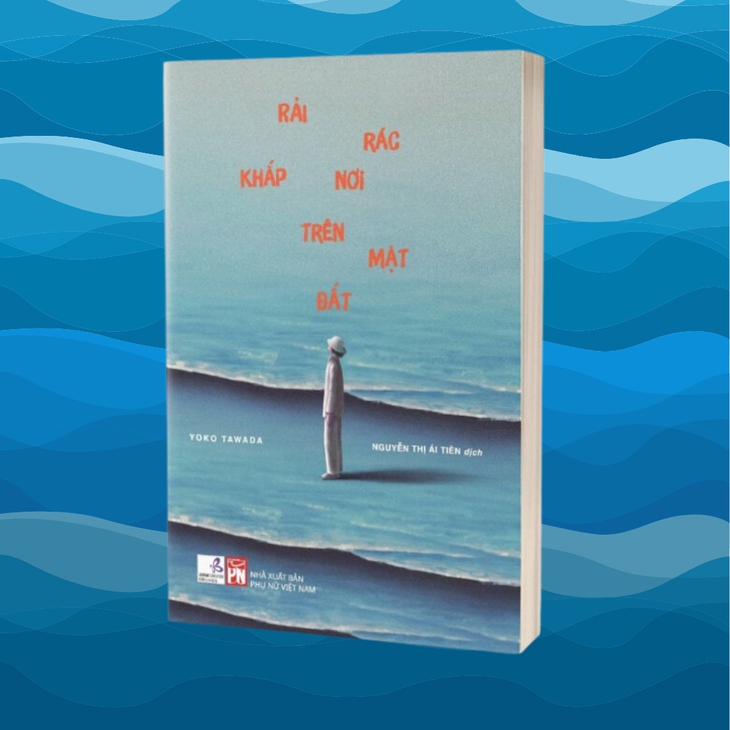
Scattered everywhere on the ground (Translated by Nguyen Thi Ai Tien, Women's Publishing House, 2026) - Photo: Publishing House of Vietnam
All boundaries (even those seemingly solid and immutable like "nation") are blurred and indistinct.
There, nationality and identity cards virtually cease to exist or are untraceable. It's as if a terrible catastrophe has swept across the globe, tossing everything around, mixing it all together, and scattering it in all directions.
No common ground
In a post-apocalyptic world , humans have lost their homes, left with only memories of a vague, unreal homeland. In that world, language becomes the only thing that reminds them where they belong.
Tawada previously addressed a similar theme in his play *The Tower of Babel: Animals*, set after a great flood, where dogs, cats, squirrels, and bears converse. One squirrel declares: "From the 21st century onwards, all humans will become slaves" (translated by Ai Tien).
In *Scattered Across the Earth*, the people seem to be a form of slavery, caught up in the machinery of life, a machine that continues to operate regardless of what they endure.
Language not only connects people but also shapes individual identity, reconstructs culture and memory. Language is also a powerful force that weighs heavily on the human soul, binding people to a community. But that community is a strange, fragmented collection.
In Scattered Across the Earth, one character, seeking personal freedom, creates their own unique language. Another character, rejecting the idea that language must be tied to speech, chooses the language of silence, yet still manages to convey their message.
Lost myself
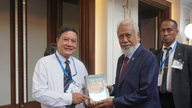
Composing in two languages allows Tawada to speak as part of a diverse culture and increasingly embrace the globalized narrative.
Language is the object Tawada wants to explore and play with. In *The Lamp Messenger*, it's wordplay based on the homophones or near-homophones of words. In *Scattered Across the Earth*, language becomes almost the only legacy a person can hold onto after the vicissitudes of time.
Tawada throws the reader into a predetermined world. People live there without a second thought about what has happened. We also don't know what the "catastrophe" was that has thrown humanity out of that normal life.
Globalization, a slogan that has been on the lips of the world's citizens for many years, is depicted in this novel as nothing more than a post-apocalyptic world.
A catastrophe that even humanity doesn't recognize. An irreversible loss of normalcy. A catastrophe unfolding slowly, gradually eroding boundaries and characteristics. At some point, humanity will exist only as a symbol in the globalized tapestry of change.
Tawada's brilliance lies in presenting a crucial and complex issue with a nonchalant style. That obviously chaotic world is like a curved mirror in a house of laughter, reflecting the very world we live in.
Tawada exploited paradoxical situations, finding in them tragicomic events that brought tears to her eyes.
In The Lamp of Hope, the world, though seemingly dying at first glance, continues to move forward and, above all, continues to hope. Because there are still those "anonymous" children, ill-fated but confident, carrying within them the whole world, carrying within them the fragile seed of life.
In Scattered Across the Earth, humanity is in crisis of identity and purpose, yet these individuals continue to explore the possibilities of language, which means exploring the possibilities of existence itself. They continue their journey to rediscover the fragments of humanity.
The novel Scattered Across the Earth was born under the shadow of the mythical tree in the allegory of the Tower of Babel. It is a story of creation, or rather: the recreation of the world. The apocalypse has occurred, humanity has not perished, they don't even know they are living in an apocalypse.
It is a story of humanity searching for humanity. Amidst a globalized world. Amidst a world where people are lost and scattered across the earth.

![Twelve Centuries of Japanese Literature [Part 3]](https://vphoto.vietnam.vn/thumb/192x108/vietnam/resource/IMAGE/2025/1/18/c6ce693d9be64beab4d6426c6abcc828)


Tawada Yoko
Yoko Tawada was born in Japan and currently lives in Germany. She writes in both German and Japanese, oscillating between Eastern and Western cultures. In her work, readers can easily recognize a sense of wanderlust. Her novel, *Scattered All Over the Earth*, further highlights this feeling.
Yoko Tawada was first known to Vietnamese readers through her novel *Naked Eyes*. In recent years, many of her works have been translated and introduced in Vietnam, such as *The Lantern Messenger*, *The Dog Boy*, and *White Crane Spreading Its Wings*. Through each of her works, Vietnamese readers are gradually gaining insight into the literary career of one of the most outstanding contemporary authors in Japan and the world.
Source: https://tuoitre.vn/rai-rac-khap-noi-tren-mat-dat-2026050410364793.htm
![[Image] Ho Chi Minh City: Ma Lang area, Chicken-Rice Market about to change its appearance](https://vphoto.vietnam.vn/thumb/1200x675/vietnam/resource/IMAGE/2026/06/25/1782377698627_ndo_br_m1-jpg.webp)
![[Photo] General Secretary and President To Lam receives Palestinian Ambassador Saadi Salama](https://vphoto.vietnam.vn/thumb/1200x675/vietnam/resource/IMAGE/2026/06/25/1782365384740_a1-bnd-9423-8322-jpg.webp)

![[Image] Schools organize meetings and introduce teaching models to students admitted to grade 10.](https://vphoto.vietnam.vn/thumb/1200x675/vietnam/resource/IMAGE/2026/06/25/1782368077271_ndo_br_z7970052192242-1ec8daeb77a6eed1a4e9f58c564ddd3e-jpg.webp)